
Alrosa CEO Declares Peak Diamond Mining: A New Era for the Global Diamond Market
A Pivotal Shift: Global Diamond Mining Reaches Its Apex
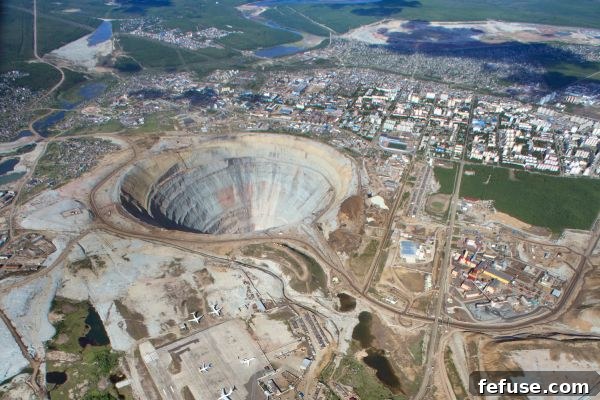
In a declaration that could redefine the future trajectory of the global diamond industry, Sergey Ivanov, CEO of Russian diamond giant Alrosa, announced this week that worldwide diamond mining likely reached its zenith in 2017. This assertion carries profound implications, signaling what Ivanov termed “good news for future rough diamond prices” and, by extension, for leading diamond producers such as Alrosa. The company, a dominant force in the industry, continues its operations across vast and productive sites, including its impressive Udachny underground mine, a testament to its long-standing commitment to diamond extraction.
The concept of “peak diamond” suggests that the maximum annual volume of natural diamonds extractable from the Earth has now been attained, or will soon be. Should this projection hold true, it implies a natural constriction of supply in the coming years, which historically translates into upward pressure on prices for rough diamonds. For a company like Alrosa, which controls a significant portion of the world’s diamond output, such a market dynamic could bolster profitability and ensure a robust future, making strategic planning even more critical in an evolving landscape.
Alrosa’s 2017 Performance: Navigating Headwinds in a Challenging Year
Financial Overview: Declines Amidst Complex Market Factors
Alrosa’s financial results for 2017, reported earlier this week, painted a picture of a company navigating significant headwinds. Despite the long-term optimism regarding peak mining, the immediate-term performance reflected several market and macroeconomic pressures. The Moscow-based diamond miner announced a 17 percent decline in its 2017 sales, a downturn attributed primarily to an unfavorable product mix and the strengthening of the Russian ruble against major currencies.
Revenue figures underscored this challenging period, falling 13 percent year-over-year. The company’s top line decreased from an impressive 317.1 billion rubles in 2016 (approximately $5.51 billion at the time) to 275.4 billion rubles in 2017 (roughly $4.79 billion). This significant drop in revenue directly impacted the company’s profitability. Net profit experienced an even sharper contraction, plummeting by 41 percent to 78.6 billion rubles (approximately $1.37 billion). These figures highlight the intricate interplay of global demand, currency fluctuations, and operational challenges that can influence even the most established players in the diamond market.
Key Factors Impacting Profitability and Sales
During the detailed earnings call, CEO Sergey Ivanov elaborated on the specific factors that contributed to the less-than-stellar financial performance in 2017:
- Shifting Demand for Small-Sized Rough Diamonds: Early in 2017, the market saw a pronounced surge in demand for smaller rough diamonds. This shift in preference led to a 9 percent decrease in the average price of gem-quality diamonds sold by Alrosa throughout the year. While overall carat sales remained strong, the lower price point for a significant segment of its offerings impacted total value.
- Impact of India’s Demonetization: The Indian government’s demonetization policy in late 2016 had lingering effects well into 2017, particularly on the trade of smaller diamonds. India is a global hub for diamond cutting and polishing, especially for smaller stones. The sudden withdrawal of high-denomination currency left many local dealers and artisans without the necessary cash flow to purchase rough diamonds, leading to an overstock of small goods for Alrosa. Fortunately, the company successfully cleared this accumulated stock during 2017, mitigating further long-term impact.
- Ruble Appreciation: As an international exporter, Alrosa’s revenues are significantly affected by currency exchange rates. A 13 percent appreciation of the Russian ruble during 2017 made its products effectively more expensive for international buyers in dollar terms, thereby impacting sales volume and revenue when converted back to rubles for reporting. Ivanov noted that this stronger ruble, combined with the other market challenges, “[dragged] down our annual performance.”
Despite these considerable financial headwinds, it is crucial to note a remarkable operational achievement: Alrosa’s diamond output for 2017 reached levels not witnessed since 1990. This demonstrates the company’s robust production capabilities and its commitment to maximizing extraction, even as market dynamics presented pricing and sales challenges.
Production Growth vs. Sales Dynamics
Delving deeper into the operational statistics, Alrosa reported impressive production growth. Diamond production increased by 6 percent year-over-year, reaching a substantial 39.6 million carats. Diamond sales also saw a positive uptick, rising by 3 percent from 40 million to 41.2 million carats. This increase was driven primarily by a 5 percent increase in the sale of high-value gem-quality diamonds, which managed to offset a 2 percent decrease in the sale of industrial diamonds. The ability to increase sales of gem-quality stones, despite a drop in their average price, underscores strong underlying demand for higher-end products in key consumer markets.
Rising Expenses and Industry Contributions
Naturally, increased production and sales growth led to a rise in operational expenses. However, other significant factors also contributed to the overall cost base:
- Diamond Producers Association (DPA) Contribution: Alrosa significantly ramped up its financial commitment to the Diamond Producers Association (DPA), an industry body dedicated to promoting the integrity and desirability of natural diamonds. The company’s contribution quadrupled in 2017, reaching 1.5 billion rubles (approximately $26 million). This substantial investment reflects Alrosa’s strategic commitment to generic marketing efforts aimed at bolstering consumer confidence and demand for natural diamonds globally.
- Mir Mine Accident Losses: The company also incurred substantial losses and expenses related to the tragic accident at its Mir underground mine in August 2017, which resulted in the devastating loss of eight workers’ lives. This unforeseen and unfortunate event had both direct financial implications and a profound impact on the company’s operations and workforce.
Tragedy and Resilience: The Mir Mine Incident
The flooding at the Mir underground mine was unequivocally the most somber event for Alrosa in 2017. CEO Sergey Ivanov candidly referred to it as “obviously … the worst event of the year.” The tragedy not only caused an immeasurable human cost but also led to the indefinite closure of one of Alrosa’s most iconic and productive assets. In the wake of the disaster, Alrosa demonstrated commendable corporate responsibility by prioritizing its workforce. Ivanov confirmed that the company had recently completed comprehensive measures to re-employ workers displaced by the Mir mine closure, providing them with alternative positions across other operational sites, thus ensuring job security and continuity for its valuable personnel. While the Mir mine remains closed and its future uncertain, the company’s focus has shifted to optimizing output from other major sites, such as the Udachny mine, to compensate for the lost production capacity.
A Glimmering Outlook for 2018: Robust Demand and Market Recovery
Strong Start and Optimistic Projections
Despite the challenges of 2017, Alrosa executives presented an optimistic outlook for the new year, noting that 2018 had commenced with a strong surge in rough diamond sales. This positive momentum was largely attributed to solid retail sales of polished diamonds throughout 2017, particularly during key holiday seasons. Reflecting this buoyancy, CEO Ivanov estimated that the global diamond jewelry market experienced a healthy 5 percent growth last year, indicating sustained consumer appetite for diamond products worldwide.
Alrosa’s upbeat assessment resonates with observations from other industry leaders. The company’s statements mirror those previously released by De Beers, its major competitor, when it reported its latest sales figures earlier in the month. This alignment across major producers suggests a broad-based recovery and positive market sentiment across the diamond supply chain.
Early 2018 Sales Momentum
Specific sales figures for the early months of 2018 underscore this positive trend:
- January Sales: Alrosa’s total rough and polished diamond sales for January reached $504.5 million. The vast majority of this came from rough diamond sales, which accounted for $499 million, while polished diamond sales contributed $5.5 million.
- February Sales: The momentum continued into February, with total sales rising to $541.9 million. Rough diamond sales remained dominant at $532.8 million, and polished sales saw a notable increase to $9.1 million. The steady growth in polished sales, though a smaller component of Alrosa’s total, signals healthy downstream demand from retailers and consumers.
Factors Driving 2018 Demand
Deputy CEO Yury Okoemov provided further insights into the strong demand observed in 2018. He highlighted robust demand across all core diamond markets, driven by several key factors:
- Strong 2017 Retail Sales: The sustained strong retail sales in 2017, especially during crucial holiday periods, led to depleted inventories among manufacturers and jewelers. This necessitated significant restocking efforts at the beginning of 2018, driving up demand for rough diamonds.
- Chinese New Year Boost: Retail demand in China, a critical market for luxury goods, was exceptionally strong in the lead-up to the Chinese New Year (which fell on February 5th in 2018). This cultural celebration traditionally spurs high diamond jewelry sales, creating a pre-emptive surge in demand for rough stones.
- Price Increases Across Sizes: Reflecting the renewed demand, Okoemov noted that prices for diamonds across most sizes experienced increases in both January and February. This widespread price appreciation is a strong indicator of a healthier and more balanced supply-demand environment, a welcome change after the pricing pressures experienced in 2017.
Conclusion: Alrosa’s Strategic Position in a Maturing Market
Alrosa stands at a fascinating juncture in the global diamond industry. While 2017 presented a complex financial landscape, marked by challenging market conditions, currency pressures, and a tragic operational incident, the company demonstrated remarkable resilience through robust production volumes and a strategic approach to inventory management. More significantly, CEO Sergey Ivanov’s declaration of “peak diamond mining” signals a potentially transformative era for the industry. This long-term supply constraint, coupled with Alrosa’s strong start to 2018, driven by healthy retail demand and restocking cycles, positions the company favorably for sustained growth and profitability in the years to come. As the diamond market continues to evolve, Alrosa’s strategic vision, operational strength, and commitment to industry development will undoubtedly play a pivotal role in shaping its future.