
The Gemological Institute of America (GIA), a global leader in gemological research and standards, has introduced significantly enhanced grading reports for jade, one of the world’s most historically revered and valuable gemstones. This pivotal development aims to bring unprecedented depth, clarity, and assurance to both trade professionals and consumers navigating the intricate world of jade. The new GIA Jade Report is meticulously designed to provide comprehensive insights, ensuring greater transparency and confidence in a market that often presents unique challenges.
Central to these enhanced reports is the precise identification of the jade specimen. Each report now definitively includes the specific type of jade, categorized as A, B, or C, along with its precise species – whether it is nephrite or jadeite. This fundamental classification is critical, as the value and properties of jade vary dramatically based on these distinctions. Type A jade, revered for its natural beauty, signifies jade that is completely untreated, having undergone no artificial enhancement beyond traditional cutting and polishing. Type B jade indicates material that has been bleached and polymer-impregnated, a treatment designed to improve its appearance by removing impurities and filling fractures. Type C jade, on the other hand, refers to jade that has been dyed to achieve or enhance its color, often masking lower-quality material. Understanding these classifications is paramount for accurate valuation and for consumer protection, as treated jade commands a significantly different price point than its natural, untreated counterpart.
Beyond the fundamental classification, the new GIA Jade Report addresses an important aspect of trade terminology. The commonly-used trade term “Fei Cui” will now be listed prominently in the comments section when appropriate. This inclusion is accompanied by a clear and concise explanatory note stating that “Fei Cui” is a term specifically used to refer to jadeite, omphacite, and kosmochlor. This clarification is vital for bridging the gap between traditional market language and precise gemological identification. “Fei Cui” holds deep cultural significance, particularly in Asian markets, often being synonymous with the most desirable forms of jadeite. By providing this definition within the official report, GIA enhances understanding and prevents potential misinterpretation, ensuring that buyers and sellers are operating with a shared, accurate vocabulary.
Jadeite, in particular, stands as one of the rarest and most valuable of all gemstones, a fact underscored by its breathtaking performance in auction houses worldwide. Its scarcity, combined with its extraordinary beauty and cultural significance, propels its value to staggering heights. The vibrant, translucent “imperial green” jadeite, in particular, is coveted by collectors and connoisseurs globally. This distinct jade variety, prized for its intense color and exceptional translucency, is often considered the pinnacle of jade quality and fetches prices that rival, and often surpass, those of diamonds and other traditional precious gems. The demand for fine jadeite remains consistently strong, driven by both its inherent beauty and its profound symbolic meaning across various cultures.
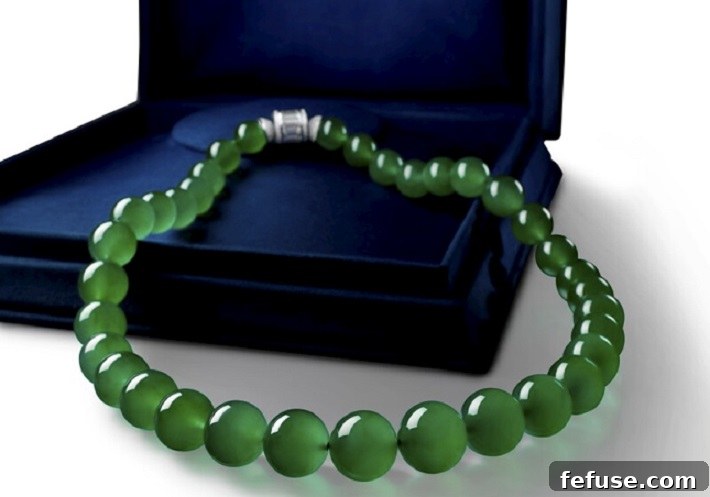
Recent history is replete with examples illustrating jadeite’s immense value. In August of a recent year, a magnificent necklace featuring 35 perfectly matched green jadeite beads, complemented by 7.70-carats of dazzling white diamonds, commanded an astounding $2.3 million at Sotheby’s Hong Kong. This sale highlighted not only the intrinsic value of exquisite jadeite but also the enduring appeal of historically significant pieces crafted with unparalleled artistry. Such items are not merely jewelry; they are wearable art, embodying centuries of cultural heritage and masterful craftsmanship.
Even more remarkable was the auction in 2014, when a legendary jadeite bead necklace, once belonging to the Woolworth heiress Barbara Hutton, shattered world records. This iconic piece sold for an incredible $27.4 million at a Sotheby’s auction, setting a new global benchmark for any jadeite item ever sold. The “Hutton-Mdivani” necklace, as it is famously known, is a testament to the timeless allure and significant investment potential of exceptional jadeite. Its provenance, combined with the rarity and perfection of its beads, elevated it to legendary status, making it a highly sought-after masterpiece. These landmark sales underscore the critical role of expert authentication and detailed reports, as they provide the verifiable assurance that justifies such extraordinary valuations.
Tom Moses, GIA’s Executive Vice President and Chief Laboratory and Research Officer, articulated the driving force behind these significant enhancements. He stated, “We made these improvements to our ‘Jade Report’ recognizing its history, symbolism and overall importance to consumers.” This sentiment encapsulates GIA’s commitment to honoring jade’s profound cultural legacy while simultaneously ensuring the highest standards of gemological accuracy and consumer protection. Jade is more than just a gemstone; it is deeply interwoven with human history, particularly in Asian civilizations where it symbolizes purity, nobility, immortality, and good fortune. For centuries, it has been carved into intricate objects of art, worn as protective amulets, and passed down through generations as cherished heirlooms. Understanding this multifaceted importance is crucial for any institution aiming to serve the jade market effectively.
The complexity of jade – encompassing two distinct mineral species (nephrite and jadeite), a spectrum of natural colors, and various treatment methods – necessitates robust and transparent grading practices. Without precise identification and disclosure, the market is susceptible to confusion and potential misrepresentation. GIA’s enhanced reports directly address this need by providing unequivocal declarations regarding species, type, and any detected treatments. This level of detail empowers buyers to make informed decisions, knowing precisely what they are acquiring. For sellers, it instills confidence and provides a credible basis for their valuations, ultimately fostering a more trustworthy and vibrant global jade market.
Furthermore, these improvements reinforce GIA’s role as an impartial arbiter in the gem and jewelry industry. By continuously refining its methodologies and expanding its reporting capabilities, GIA ensures that its certifications remain the gold standard for accuracy and reliability. This dedication to ongoing research and innovation is particularly vital for gemstones like jade, which present unique challenges in their identification and classification compared to more conventional gems like diamonds or sapphires. The ability to distinguish between jadeite and nephrite, for instance, requires specialized expertise and sophisticated analytical equipment, as their appearances can sometimes be deceptively similar despite vast differences in their mineral composition and market value.
The implementation of these new GIA Jade Reports marks a significant milestone for the entire jade industry. It signifies a greater commitment to transparency, consumer education, and the preservation of jade’s enduring legacy. As the global market for rare and precious gemstones continues to evolve, GIA’s proactive measures ensure that jade, with its rich history and profound cultural resonance, receives the rigorous scientific scrutiny and clear reporting it deserves. This move will undoubtedly strengthen consumer confidence, facilitate fair trade practices, and ultimately elevate the appreciation and understanding of this extraordinary gemstone for generations to come, securing its rightful place among the world’s most cherished treasures.