
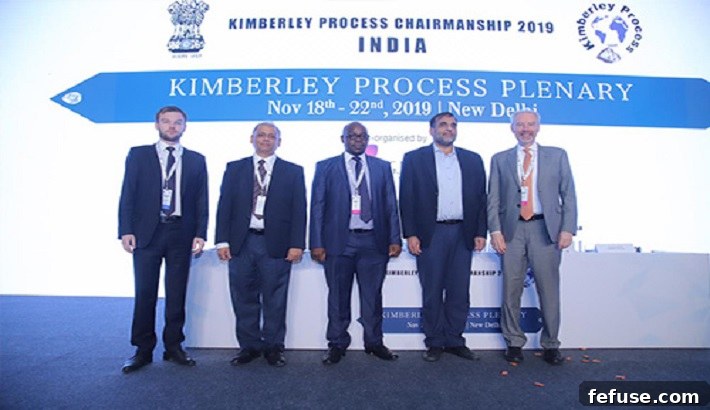
Kimberley Process Plenary 2019: Paving the Way for a More Resilient and Ethical Diamond Industry
The global diamond industry converged in New Delhi, India, for the much-anticipated 2019 Plenary Meeting of the Kimberley Process (KP). This critical gathering, held amidst growing calls for reform and greater transparency, brought together a diverse group of international dignitaries, government officials, industry leaders, and civil society representatives. The Plenary served as a crucial platform to address the evolving landscape of diamond trade, reinforce commitments to eradicating conflict diamonds, and deliberate on key challenges and opportunities facing the sector.
The inaugural ceremony, marked by an impressive display of international cooperation, underscored India’s pivotal role as a founding member and active participant in the Kimberley Process Certification Scheme (KPCS). Dignitaries from India and across the globe participated, setting a tone of collaborative dialogue aimed at strengthening the framework that has, for nearly two decades, safeguarded the integrity of the legitimate diamond supply chain.
A Confluence of Global Leadership and Expertise
The dais at the inaugural session reflected the multi-stakeholder nature of the Kimberley Process. Key figures included Mr. B.B. Swain, the KP Chair for 2019, who presided over the proceedings; Mr. Alexander Alexeevich Pshenichnikov, the KP Vice-Chair, representing the future leadership; Dr. Anup Wadhawan, Commerce Secretary, Government of India, whose presence highlighted the host nation’s commitment; Mr. Stephane Fischler, President of the World Diamond Council (WDC), articulating industry perspectives; and Mr. Shamiso Mtisi, Coordinator of the Civil Society Coalition, voicing critical independent insights. This diverse representation underscored the collective responsibility shared by governments, industry, and civil society in maintaining a robust and relevant Kimberley Process.
KP Chair B.B. Swain extended a warm welcome to all participants and observers, emphasizing India’s unwavering dedication to facilitating meaningful deliberations on all pressing issues. He reiterated India’s historic commitment, stating, “India has always been at the forefront of identifying challenges faced by the industry and will continue to support KP’s efforts in terms of capacity building, providing technical assistance and education and in moving forward.” His words underscored India’s proactive stance in fostering an environment conducive to progress and continuous improvement within the KP framework.
India’s Enduring Commitment to the Kimberley Process
As a founding member, India has consistently demonstrated leadership within the Kimberley Process, playing a vital role in its development and implementation since its inception in 2003. The nation’s significant contribution to the global diamond pipeline, encompassing cutting, polishing, and trading, lends considerable weight to its perspective on responsible sourcing and trade practices. Dr. Anup Wadhawan, Commerce Secretary, Government of India, proudly highlighted India’s instrumental involvement in developing the KPCS into an essential protocol that has ensured over 99.8% of the world’s diamonds are conflict-free. This remarkable achievement, he noted, is a testament to the collective efforts of all KP participants.
Driving Dialogue and Development
Dr. Wadhawan further elaborated on the imperative to keep the Kimberley Process efficient and effective, thereby maintaining its crucial role in preserving the conflict-free status of diamonds globally. He conveyed India’s commitment to strengthening the process through enhanced administration and implementation, ensuring its promises are delivered effectively, and fostering greater transparency. A particularly significant aspect of India’s vision, as articulated by the Commerce Secretary, was an empathetic approach towards the livelihoods of individuals dependent on diamond production, trade, and manufacturing. This focus on human welfare underscores a holistic understanding of responsibility, extending beyond merely preventing the trade of conflict diamonds to promoting sustainable and equitable development within diamond-producing communities.
Addressing Critical Industry Challenges
The KP Chair, B.B. Swain, also emphasized India’s sensitivity to critical issues and challenges confronting the KP, particularly as the current review cycle drew to a close. These challenges included complex discussions on expanding the scope of conflict diamonds—a contentious yet vital debate—as well as the multifaceted issues faced by artisanal and small-scale mining (ASM) communities. Further critical decisions loomed regarding the establishment of a Permanent Secretariat, the funding and operationalization of a Multi-Donor Trust Fund (MDTF), and the refinement of the peer review mechanism, all of which are essential for the long-term institutional strength and effectiveness of the KP.
Navigating the Core Agenda: Pillars of Reform and Progress
The Plenary agenda was packed with discussions on pivotal issues designed to fortify the Kimberley Process against emerging threats and ensure its continued relevance in a dynamic global market. These dialogues aimed to address both the definitional aspects of conflict diamonds and the practical challenges of implementation on the ground.
Broadening the Definition of Conflict Diamonds
One of the most intensely debated topics was the expansion of the KP’s definition of “conflict diamonds.” Currently, the definition is narrowly confined to “rough diamonds used by rebel movements to finance wars against legitimate governments.” However, many stakeholders, particularly civil society organizations, argue that this definition is outdated and fails to address other forms of conflict, violence, and human rights abuses that may occur within the diamond supply chain, even without the involvement of rebel groups. The urgency of this discussion was highlighted by WDC President Stephane Fischler, who warned that “the outside world would characterize this Plenary as a failure, if there is no progress on the KP definition.” This sentiment underscored the critical need for the KP to evolve and align with broader ethical sourcing standards to maintain its credibility and consumer confidence.
Supporting Artisanal and Small-Scale Mining (ASM)
The challenges faced by artisanal and small-scale mining (ASM) communities constituted another central theme. These miners, often working in precarious conditions and vulnerable to exploitation, produce a significant portion of the world’s diamonds. The Commerce Secretary stated that India is highly sensitive to the issues confronting ASM and acknowledged the invaluable contributions made by KP members, observers, and agencies towards their upliftment. The call was for continued support for ASM countries through comprehensive capacity building, technical assistance, and education. This support encompasses crucial areas such as fair valuation practices, the differentiation between natural and lab-grown diamonds (to prevent misrepresentation), and the promotion of legal and formal mining practices that ensure safety, environmental responsibility, and fair wages. Empowering ASM communities is not only an ethical imperative but also a strategic move to secure a transparent and responsible diamond supply chain from its very source.
Strengthening KP’s Operational Framework: Permanent Secretariat and Multi-Donor Trust Fund
The institutional backbone of the Kimberley Process relies heavily on a robust operational framework. Discussions at the Plenary focused on critical decisions related to the Permanent Secretariat (PS) and the Multi-Donor Trust Fund (MDTF). The establishment of a Permanent Secretariat is seen as vital for providing continuity, institutional memory, and consistent administration to the KPCS, moving beyond the current rotating chairmanship model. Similarly, the MDTF is deemed essential for securing stable funding for various KP initiatives, including capacity building in member countries and the implementation of reform programs. Stephane Fischler emphasized their importance, stating, “The issue of funding of Permanent Secretariat (PS) and Multi Donor Trust Fund (MDTF), is essential for strengthening the scope of KPCS. This underpins all the decisions at the Plenary.” Without adequate funding and a strong administrative body, the KP’s ability to enforce its mandates and adapt to future challenges would be severely hampered.
Differentiating Natural from Lab-Grown Diamonds
With the rise of lab-grown diamonds in the market, ensuring clear differentiation from natural diamonds has become a crucial concern for consumer confidence and fair trade. The Commerce Secretary informed the gathering that India has taken a leadership role in addressing the issue of differentiation between natural and lab-grown diamonds. India pledged to undertake further initiatives to ensure better differentiation and promote responsible business practices on this front. This includes advocating for transparent disclosure, clear labeling, and educational campaigns to prevent consumer confusion and protect the value proposition of both types of diamonds within their respective markets. India also reinforced its commitment to a consensus-based decision-making process within the KP, ensuring that all voices, including those of smaller stakeholders, are heard and considered in policy formulations.
Perspectives from Key Stakeholders: Driving Towards Collective Action
The Plenary also served as a forum for key stakeholders to present their perspectives, highlighting areas of concern and proposing pathways for collaborative action.
The World Diamond Council’s Call to Action
WDC President Stephane Fischler delivered a poignant address, acknowledging the culmination of “three years of countless meetings” and underscoring the gravity of the decisions to be made in New Delhi. He powerfully stated, “I believe the future of KP will be decided by you KP members this week. Lives will be impacted by your decisions, especially in artisanal mining areas.” Fischler stressed that conflicts undeniably damage the reputation of diamonds and that the industry needs to establish clear benchmarks against which its ethical practices will be judged. He also reiterated that “KP is not a sanctions imposing body,” but rather a mechanism designed to ensure that all diamonds meet international market standards. His message was a call for long-term commitment to protecting the weakest stakeholders within the diamond supply chain, particularly those in vulnerable mining communities.
Civil Society’s Voice for Broader Reform
Representing the Civil Society Coalition, Shamiso Mtisi reiterated the critical importance of broadening the scope of the KP. He emphasized the urgent need to reach conclusions on all reform areas, cautioning that “Failure to stop diamonds from funding conflict is a failure of the KP.” The Civil Society Coalition consistently advocates for an expanded definition of conflict diamonds that includes violence, human rights abuses, and environmental damage linked to diamond extraction, even if not directly tied to rebel groups. Their persistent advocacy plays a vital role in pushing the KP towards greater accountability and alignment with evolving global human rights standards.
Beyond the Plenary: Special Forums and Future Directions
Beyond the formal Plenary sessions, the meeting also hosted three insightful special forums, designed to explore contemporary issues and future trajectories for the diamond industry. These forums addressed:
- Financial Inclusion and Women Empowerment through Sustainable Livelihood Creation: This forum delved into strategies for empowering women and fostering economic stability in diamond-producing regions, recognizing their crucial yet often overlooked role in the sector.
- Diamond Industry – Adapting to Change: This session focused on how the diamond industry can effectively navigate and adapt to rapid technological advancements, evolving consumer preferences, and new market dynamics, including the rise of lab-grown diamonds.
- Diamond Origin and Identification: This forum explored innovative technologies and methodologies for robustly tracking the origin of diamonds, enhancing traceability, and ensuring consumer confidence in the provenance of their purchases.
These specialized discussions reflected a proactive approach to addressing the complex interplay of socio-economic factors, technological innovations, and ethical considerations that shape the modern diamond trade. Over the next few days following the inaugural ceremony, meetings of different working groups and committees of the KP were held, diving into the technical details and drafting recommendations on these various fronts.
The Kimberley Process: A Legacy of Responsibility and Peace
Since its launch in 2003, the Kimberley Process has been instrumental in safeguarding the legitimate global diamond trade from the scourge of conflict diamonds. Its establishment marked a paradigm shift, transforming an industry once shadowed by illicit trade into one largely defined by ethical sourcing and supply chain integrity. The KP has contributed significantly towards fostering peace, enhancing security, and promoting prosperity in numerous diamond-producing regions. India, as one of its founding members, remains steadfastly committed to maintaining the unity of this vital international mechanism and to advancing its mandate through an inclusive, deliberative, and consensus-based decision-making approach. The participation of more than 55 delegates from the 82 countries constituting the KP at the New Delhi Plenary underscored the broad global consensus and commitment to these shared objectives.
Conclusion: Charting a Course for a Conflict-Free Future
The 2019 Kimberley Process Plenary Meeting in New Delhi represented a pivotal moment for the global diamond industry. It was a testament to the ongoing dedication of governments, industry stakeholders, and civil society to uphold the principles of ethical sourcing and responsible trade. While significant progress has been made in virtually eliminating conflict diamonds from the mainstream market, the Plenary discussions highlighted the continuous need for vigilance, adaptation, and reform. Addressing the evolving definition of conflict, supporting vulnerable artisanal miners, strengthening institutional mechanisms, and navigating the complexities of new market entrants like lab-grown diamonds are crucial challenges that the KP must collectively overcome. The outcomes of this Plenary were instrumental in charting a strategic course for the Kimberley Process, aiming to reinforce its effectiveness and ensure the diamond industry continues to shine as a beacon of integrity and sustainable development for years to come.
News Source: gjepc