
India’s Golden Ambition: Leveraging Technology and Standards for Global Jewellery Export Leadership
India is poised to become the world’s largest exporter of gold jewellery by 2025, an ambitious target underpinned by two critical pillars: the widespread adoption of cutting-edge manufacturing technology and an unwavering commitment to self-regulation and compliance with international standards. These foundational insights were among the most significant takeaways from the inaugural India Gold & Jewellery Summit, an influential gathering held in New Delhi on November 23-24, 2018, bringing together industry leaders, innovators, and policymakers.
The summit served as a crucial platform for dissecting the strategic pathways India must navigate to achieve its golden vision. Discussions spanned technological advancements transforming the design and manufacturing landscape, the imperative for robust industry standards to bolster global trust, and macroeconomic factors influencing the precious metal market. This comprehensive approach underscores the industry’s proactive stance in addressing both internal efficiencies and external market demands.
Revolutionizing Jewellery Manufacturing: The Power of Technology and Innovation
The session titled ‘Technology and Innovation in Jewellery Manufacturing – Doubling of Exports’ highlighted the pivotal role new technologies will play in catapulting the Indian jewellery industry to the forefront of the global stage. Experts from diverse backgrounds, including technology and jewellery manufacturing, engaged in a vibrant discussion on how innovation can unlock unprecedented growth.
Artificial Intelligence and Cloud Computing: Reshaping Retail
Setting the tone for the technological discourse was Mr. Amith Singhee, STSM & Manager, Retail & Operations, IBM Research India. He illuminated the transformative potential of integrating Artificial Intelligence (AI) and cloud computing into software programs designed for the jewellery sector. Mr. Singhee captivated the audience with a demonstration of a ‘cognitive mirror’ technology, a prime example of how AI can fundamentally redraw the contours of jewellery retail. Imagine a customer trying on virtual jewellery, receiving personalized recommendations based on their preferences, and experiencing an interactive shopping journey—all powered by AI. This level of immersive, data-driven engagement is set to revolutionize consumer experiences, making jewellery shopping more dynamic, efficient, and tailored than ever before.
Empowering Artisans Through ‘Karigar Centres’
Shifting focus to the manufacturing backbone, Mr. Sanjay Ranawade, Chief Manufacturing Officer, Titan Company Ltd., introduced the innovative concept of ‘Karigar Centres’. These fully-equipped manufacturing hubs are designed to empower local artisans—the ‘karigars’—who undertake job work for the company. By providing access to state-of-the-art technological systems, these centres allow artisans to transition from manual, often repetitive tasks to focusing on their core competencies: intricate design and unparalleled craftsmanship. This strategic integration of technology not only enhances productivity and precision but also preserves the rich heritage of Indian artistry, ensuring that traditional skills evolve alongside modern capabilities. The initiative aims to create a symbiotic relationship where technology amplifies human creativity, leading to superior quality products that meet global benchmarks.
The Call for ‘Smart Manufacturing’
Mr. K. Srinivasan, Convener, Jewellery Panel Committee of GJEPC, underscored the urgent need for continuous innovation, advocating for the industry to keep pace with global advancements. He observed a striking paradox: while ‘smart’ technologies were being widely adopted across numerous sectors, the jewellery manufacturing domain, particularly in India, had not yet embraced ‘smart manufacturing’ sufficiently. Smart manufacturing, in the context of jewellery, encompasses automation, Internet of Things (IoT), data analytics, and advanced robotics to create intelligent, interconnected, and highly efficient production processes. Integrating these technologies can lead to significant improvements in precision, waste reduction, speed, and cost-effectiveness, all crucial for scaling up exports.
Personalization and Mass Customization with 3D Printing
Mr. Tanmay Shah of Imaginarium shed light on how technology can solve specific market demands, particularly the burgeoning desire for personalization among young buyers. He explained that by leveraging systems like cloud computing and advanced 3D printing—technologies offered by Imaginarium—companies can achieve mass customization. This allows businesses to offer bespoke designs with time-bound delivery, all while maintaining almost zero inventory. This paradigm shift means jewellers can cater to individual preferences without the prohibitive costs and risks associated with holding large stocks of varied designs. It democratizes unique design access and accelerates product development cycles, giving Indian manufacturers a significant competitive edge in the global market.
Dubai’s Technology-Driven Ecosystem: A Blueprint for Efficiency
Mr. Tarun Jain, Head of Dubai Design Academy, DMCC, presented a compelling case for end-to-end technological integration. He highlighted how Dubai’s systems are entirely technology-driven, from the initial design phase to post-sale customer feedback. This includes access to virtual design libraries, enabling customers to adapt designs “anytime, anywhere” through digital platforms, and sophisticated tech-driven feedback mechanisms. Such systems provide invaluable data that can drive continuous improvement, course corrections, and future product planning. The seamless flow of information and automation minimizes errors, enhances customer satisfaction, and fosters rapid adaptation to market trends.
Expanding Tech Solutions for the Industry
Further enriching the session, three other distinguished speakers from the technology sector—Mr. Gaurav Mathur, CEO, Safe Gold; Ms. Priya Meenakshi Narsimha, PhonePe; and Prof. Kiran Momaya, Professor, IIT – Bombay—shared insights into the products and services their organizations offer. These innovations are designed to help individual jewellery companies leverage the ongoing technological revolution, from digital gold investment platforms to secure payment solutions and advanced research applications. Their presentations underscored the growing ecosystem of support available to the jewellery industry for navigating its digital transformation. The session, skillfully moderated by Mr. Colin Shah, Vice Chairman, GJEPC, provided a holistic view of technology’s immense potential.
The Imperative of Robust Standards and Compliance in the Gold Industry
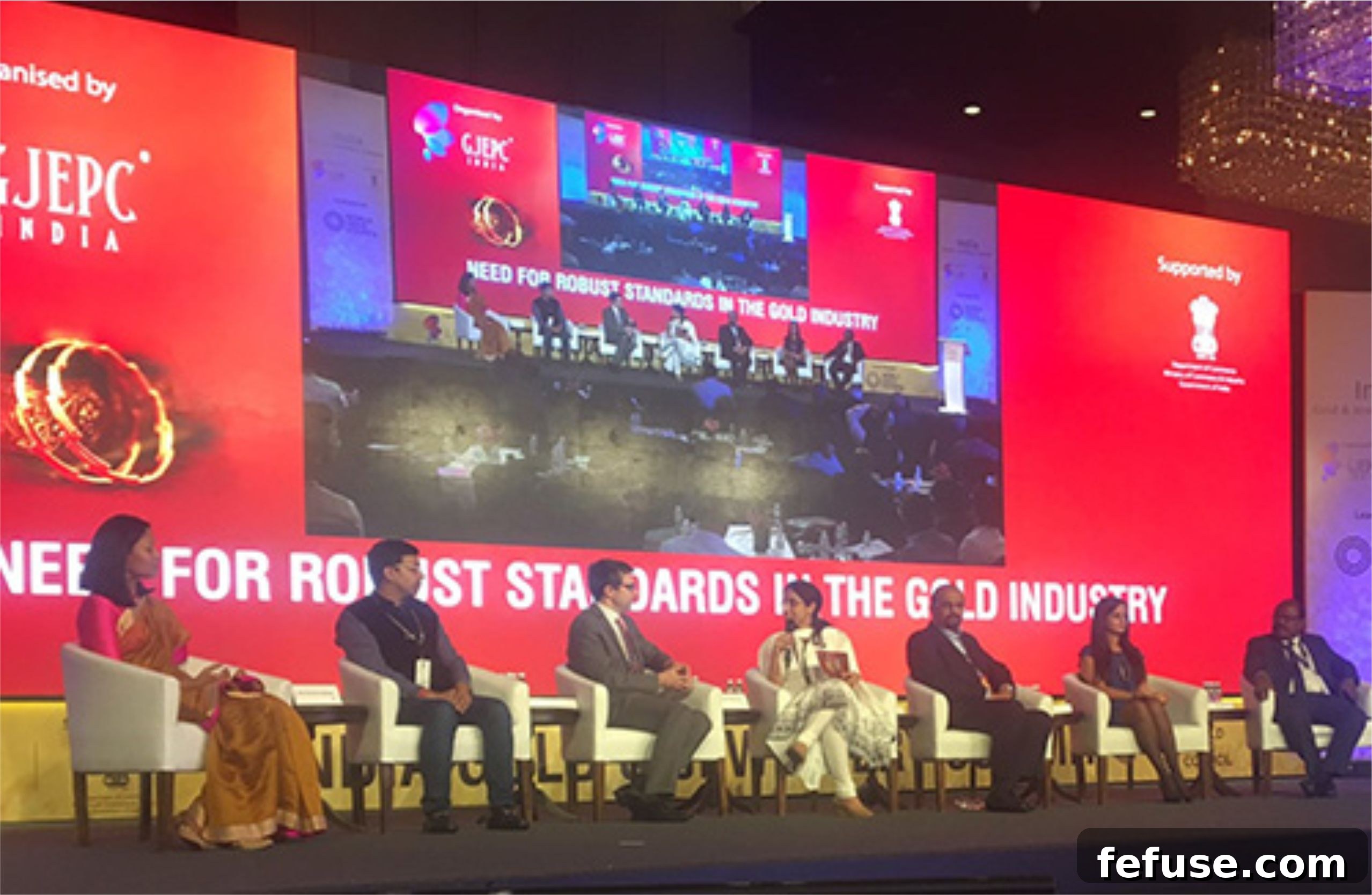
The focus of the summit’s concluding session shifted to the critical area of compliance and standards, featuring a panel discussion on “Need for Robust Standards in the Gold Industry.” This discussion was preceded by key presentations highlighting the evolving landscape of investor expectations and consumer trust.
Investor Influence and Consumer Perception
Mr. Terry Heymann, Chief Financial Officer, World Gold Council, commenced by addressing the growing trend of investors being increasingly influenced by a company’s or industry’s impact on climate change and broader ESG (Environmental, Social, and Governance) factors. This signals a shift towards responsible investing, where the ethical sourcing and sustainable practices of gold producers and retailers become paramount. Following this, Ms. Rashmi Dastidar, Chief Risk and Compliance Officer, MMTC-Pamp, emphasized that establishing robust standards is not merely about meeting regulatory requirements. More profoundly, it shapes consumer perception, building trust and enhancing a company’s reputation in a globally interconnected market. For Indian exporters, adhering to international standards is a non-negotiable step towards gaining access to discerning international markets and building a credible brand image.
The Panel Discussion: Industry-Led vs. Government-Driven Standards
Both Mr. Heymann and Ms. Dastidar then joined a dynamic panel discussion moderated by Ms. Aarti Nilhalani, Partner, Oliver Wyman. The panel also included eminent figures such as Mr. Rahul Gupta, Bullion Federation of India (BFI); Ms. Sakhila Mirza, Executive Director, LBMA; Mr. James Jose, Founder Secretary, The Indian Association of Hallmarking Centres; and Mr. T. Kalaivanan, Deputy Director General (Hallmarking), BIS. A broad consensus emerged regarding the fundamental necessity of creating and adhering to standards—both to win consumer confidence and to comply with regulatory frameworks. However, the discussion revealed some divergence on the optimal approach for achieving this goal.
An intense debate unfolded around a crucial question: should the industry proactively step forward, define its own standards, and encourage compliance through peer pressure and competitive advantage to attract consumers? Or should it patiently await government intervention to establish a comprehensive regulatory framework and enforcement mechanism? Proponents of industry-led initiatives argued that such an approach allows for greater agility, ensures that standards are practical and tailored to industry realities, and can foster innovation. They cited examples like the London Bullion Market Association (LBMA), which established “good delivery” standards for gold many years ago, demonstrating the effectiveness of self-regulation in building global trust and avoiding direct government monitoring. This approach empowers the industry to shape its destiny and respond swiftly to market changes.
Conversely, others argued that in a vast and diverse country like India, achieving uniform compliance across a fragmented industry is an inherently complex process. They suggested that governmental bodies play a vital role in formulating comprehensive regulatory frameworks and robust enforcement mechanisms to ensure consistency and widespread adoption. While cautioning that governments should act with care and consultation, the argument for state oversight focused on the need for universal application, legal backing, and the ability to penalize non-compliance, thereby ensuring a level playing field and protecting consumers more broadly. The complexity lies in balancing the need for speed and industry relevance with the imperative for widespread, equitable enforcement.
Significantly, compared to a decade ago when discussions around standards and compliance often met with resistance, the parameters of the debate have irrevocably shifted. Today, the fundamental need for robust standards is widely accepted across the Indian gold industry. While the precise path forward, whether predominantly industry-led or government-mandated, continues to be refined, the recognition of standards as a critical enabler for growth and global leadership is firmly established.
Global Market Insights and Digital Transformation
Beyond the core discussions on technology and standards, the summit featured insightful presentations on broader themes impacting the global gold industry.
A Global Gold Industry Overview
During the morning session, Mr. John Reede, Chief Market Strategist and Head of Research, World Gold Council, presented a “Global Gold Industry Overview.” He meticulously outlined the various short-term and longer-term influences on gold prices. Historically, the strength of the US dollar has been a predominant factor affecting short-term price movements. However, Mr. Reede highlighted an emerging trend: over time, a growing number of central banks globally are expected to reduce the share of US dollars held in their reserves. This diversification strategy, driven by evolving geopolitical landscapes and the rise of other economic powers, could significantly alter the traditional equation linking the US dollar to gold prices, potentially leading to increased volatility or new price dynamics for gold as a global safe-haven asset.
Mr. Reede also raised concerns about scrap, or recycled gold, which, while currently an important source of supply—with volumes typically rising when prices increase—is likely to face increasing pressure. The challenge lies in assuring consumers of the integrity and provenance of the raw material, tracing it back to its original source. In an era where ethical sourcing and supply chain transparency are paramount, the inability to verify the origin of recycled gold poses a significant hurdle, potentially diminishing its appeal over time. This underscores the need for robust tracking and verification systems even for recycled materials to meet evolving consumer and regulatory expectations.
Branding in the Digital Age: Responding to ‘Digitalism’
Another compelling presentation was delivered by Mr. Harish Bijoor, a renowned branding and management consultant. He delved into the evolving concept of a brand, its application within the jewellery industry, and how this concept is being profoundly reshaped by disruptions, particularly digital disruption, across almost every facet of manufacturing, marketing, and retailing. Mr. Bijoor asserted that “Digitalism is the new ism that will impact every aspect of the market in the coming years,” urging jewellers to fundamentally rethink their traditional approaches and adopt innovative strategies to thrive in this new reality. This includes embracing e-commerce, leveraging social media for brand building and customer engagement, utilizing data analytics to understand consumer behavior, and exploring virtual try-on technologies to bridge the gap between online and offline shopping experiences. The future of jewellery branding lies in seamlessly integrating digital touchpoints into every customer interaction.
Conclusion: Paving the Way for India’s Gold Jewellery Supremacy
The India Gold & Jewellery Summit 2018 laid out a clear roadmap for India’s aspirations to become the undisputed leader in global gold jewellery exports by 2025. The discussions unequivocally highlighted that embracing cutting-edge technology—from AI in retail to 3D printing in manufacturing—is not merely an option but an absolute necessity for enhancing efficiency, fostering innovation, and catering to evolving consumer demands. Concurrently, the commitment to establishing and adhering to robust industry standards, whether driven by industry initiatives or governmental frameworks, is paramount for building international trust, ensuring ethical practices, and securing India’s reputation as a reliable and responsible global supplier. By strategically integrating these twin pillars, the Indian gold and jewellery industry is poised to unlock its immense potential, drive sustained growth, and solidify its position at the apex of the global market.
News Source: gjepc.org