
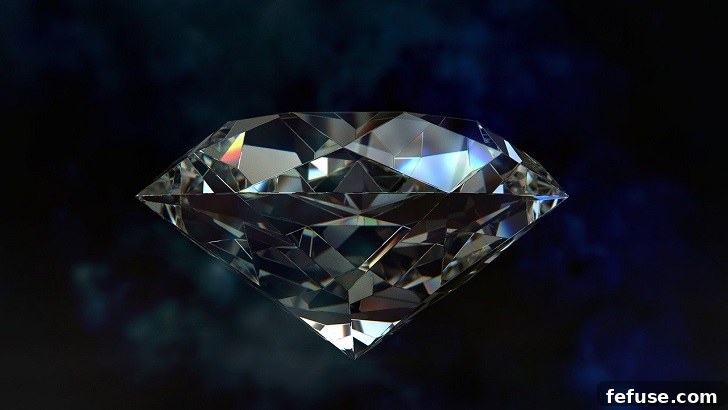
Diamonds have captivated humanity for millennia, revered not only for their breathtaking beauty but also for their profound rarity and enduring value. These magnificent precious stones are primarily sourced from deep within the Earth’s crust, forged under immense pressure and heat over billions of years. Formed approximately 500 kilometers below the surface, they are geological marvels, remnants of ancient carbon transformed into the hardest known natural substance. Yet, not all diamonds are created equal, nor do they command the same prestige or price. The true treasures among them possess an extraordinary combination of characteristics: exceptional color, impeccable clarity, a masterful cut, and significant carat weight. These are the qualities that elevate certain gems from mere stones to legendary artifacts, making them extraordinarily rare and, consequently, incredibly expensive.
Throughout history, diamonds have symbolized power, wealth, and eternal love, adorning royalty, inspiring legends, and breaking auction records year after year. Gemologists are perpetually astonished by their mesmerizing allure, and the world’s wealthiest collectors engage in a constant pursuit to acquire these ultimate symbols of luxury and status. These aren’t just minerals; they are pieces of history, natural wonders, and timeless investments. In this exploration, we delve into the realm of the truly extraordinary, unveiling the top ten most expensive and historically significant diamonds that have ever graced our planet, each with a unique story and an unparalleled price tag.
1. The Koh-I-Noor
Widely considered the most legendary and, in many respects, the most invaluable diamond on Earth, the Koh-I-Noor stands unparalleled. Its true monetary worth remains unknown, as it has never been offered for auction, rendering it a priceless artifact. The diamond’s history is steeped in myth, controversy, and a rich tapestry of geopolitical events. Believed to have been discovered in India’s Golconda mines around the 13th or 14th century, its journey through various empires and dynasties is a saga of power and conquest. The stone’s ownership has been fiercely contested, leading to numerous claims and counter-claims, particularly regarding its acquisition by the British. While the specifics of its transfer to British possession in 1850 are debated, it unequivocally became part of the British Crown Jewels.
Originally weighing an astounding 186 carats, the Koh-I-Noor was recut under the supervision of Prince Albert in 1852 to enhance its brilliance, reducing its weight to its current 105.6 carats. This transformation aimed to maximize its sparkle, aligning with contemporary European cutting techniques. Despite the reduction in size, its mesmerizing beauty continues to captivate onlookers. Often referred to as the “Mountain of Light,” the Koh-I-Noor is not merely a gemstone; it is a profound historical emblem, shrouded in mystery and continuously sparking debate about its origins and rightful custodianship. Its place in history, coupled with its sheer beauty, solidifies its position as the most famous diamond in existence.
2. The Cullinan Diamond
Discovered in 1905 at the Premier No. 2 mine in Cullinan, South Africa, the Cullinan Diamond holds the undisputed title of the largest gem-quality rough diamond ever found. This colossal stone weighed an incredible 3,106.75 carats (approximately 1.37 pounds), a size that stunned the gemological world. Its discovery was a monumental event, and the diamond was subsequently presented as a gift to King Edward VII of the United Kingdom in 1907. Due to its unprecedented size and value, the task of cutting this magnificent rough diamond was entrusted to the renowned Asscher Company of Amsterdam, a process that required months of meticulous planning and exceptional skill.
From the original Cullinan, nine significant diamonds were ultimately fashioned, alongside 96 smaller brilliant cuts. The two largest and most famous fragments are Cullinan I and Cullinan II. Cullinan I, also known as the Great Star of Africa, is a pear-shaped diamond weighing 530.2 carats, making it the largest clear-cut diamond in the world until 1985. It is set in the Sovereign’s Sceptre with Cross, one of the British Crown Jewels. Cullinan II, or the Second Star of Africa, is a cushion-cut diamond weighing 317.4 carats, prominently featured in the Imperial State Crown. The combined estimated value of the Cullinan diamonds, particularly Cullinan I and II, is staggering, often cited at around $2 billion. Its immense size, flawless quality, and integral role in the British monarchy’s regalia underscore its status as one of the world’s most breathtaking and valuable gemstones.
3. The Hope Diamond
The Hope Diamond is a gem shrouded in mystique, distinguished by its incredibly rare and captivating dark gray-blue hue. This antique cushion-cut masterpiece, weighing precisely 45.52 carats, originated from India’s Golconda mines in the 17th century. Its journey began as a much larger stone known as the Tavernier Blue, which was acquired by King Louis XIV of France in 1668 and recut into the “French Blue.” The diamond remained a prized possession of the French monarchy until the tumultuous French Revolution, during which it was famously stolen in 1792 amidst a royal inventory looting.
Following its disappearance, the diamond resurfaced in London in 1839, having been recut to its current size and acquiring the name “Hope” from its then-owner, the banking family Hope & Co. Its subsequent owners faced a series of misfortunes, leading to the pervasive legend of the “Hope Diamond Curse,” a captivating tale that adds to its enigmatic allure. In 1949, the renowned jeweler Harry Winston acquired the diamond and, in a magnanimous gesture, donated it to the Smithsonian Institution in 1958. It now resides as the centerpiece of the National Gem and Mineral Collection at the Smithsonian National Museum of Natural History in Washington D.C., attracting millions of visitors annually. With an estimated value ranging between $200 million and $250 million, the Hope Diamond remains not only a symbol of profound beauty but also a testament to centuries of human history and fascination.
4. The Centenary Diamond
Discovered in 1986 at the Premier Mine in South Africa, the same mine that yielded the Cullinan, the Centenary Diamond is a testament to perfection and meticulous craftsmanship. In its rough state, this monumental diamond weighed over 500 carats, making it one of the largest gem-quality diamonds ever found. Its transformation into a finished gem was an extraordinary feat, taking a team of highly skilled cutters and polishers over 154 days to complete. The result is a modified heart-shaped brilliant diamond weighing 273.85 carats, a significant reduction from its original rough form but one that dramatically enhanced its optical properties.
The Centenary Diamond is celebrated for its unparalleled clarity and color, earning it the highest possible grades in both categories: D-color (absolutely colorless) and internally flawless. Its flawless appeal and radiant sparkle are a direct consequence of the painstaking recutting process, which prioritized perfection above all else. This diamond was unveiled in 1991, fittingly coinciding with the 100th anniversary of De Beers, hence its name. While it has never been publicly valued for sale, its estimated worth in modern times is around $100 million, reflecting its exceptional size, perfect characteristics, and the master artistry involved in its creation. The Centenary Diamond truly embodies the pinnacle of diamond quality and human skill.
5. The Pink Star
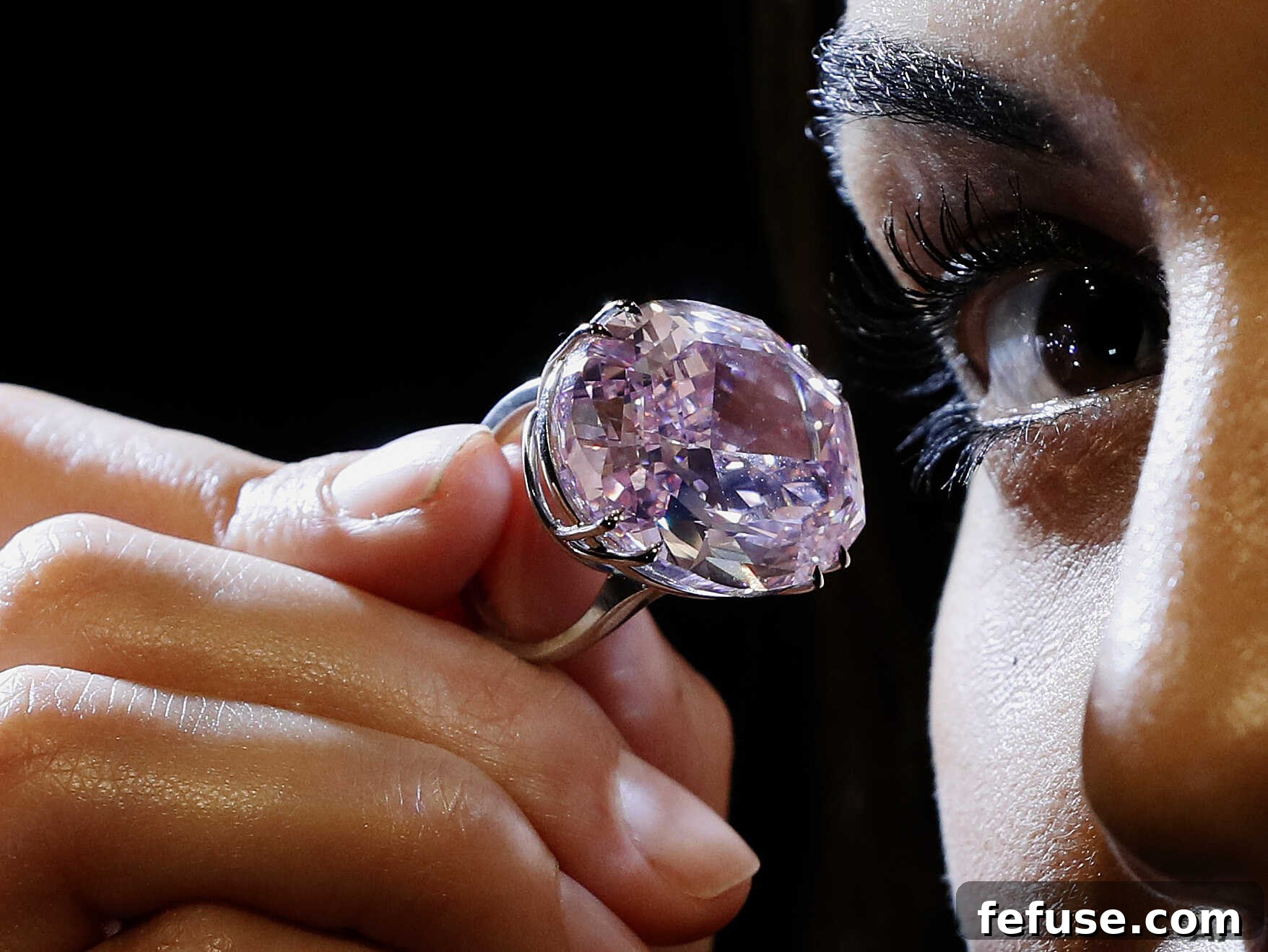
The Pink Star is an icon of rarity and exquisite beauty, holding the distinction of being the largest flawless fancy vivid pink diamond ever graded by the Gemological Institute of America (GIA). Discovered in 1999 in Southern Africa by De Beers, the rough stone weighed a remarkable 132.5 carats. It took a team of eight polishers over two years to cut and polish this extraordinary gem into its current magnificent oval mixed cut of 59.60 carats. Originally known as the “Steinmetz Pink,” the diamond was renamed after its record-breaking sale.
In April 2017, the Pink Star made headlines worldwide when it was sold at a Sotheby’s auction in Hong Kong for an astonishing $71.2 million. The buyer was Chow Tai Fook Enterprises, a prominent Hong Kong-based jewelry company, which acquired the diamond via a telephone bid. Following its acquisition, the company renamed it the “CTF Pink Star” in memory of the late Dr. Cheng Yu-tung, the father of Chow Tai Fook’s chairman. Its vibrant, unadulterated pink hue, combined with its internal flawlessness and considerable size, makes it an exceptionally coveted gemstone. The Pink Star is not just a diamond; it’s a natural masterpiece and a testament to the unparalleled value of colored diamonds, especially those in the vivid pink category.
6. The Winston Blue
The Winston Blue is a gemstone that truly takes one’s breath away, renowned for its dazzling “fancy vivid blue” color and flawless clarity. This pear-shaped diamond weighs 13.22 carats and holds the prestigious title of being the largest internally flawless fancy vivid blue diamond in the world, as confirmed by the GIA. Its exceptional hue, devoid of any secondary color modifiers, gives it a pure, intense blue that is incredibly rare and highly sought after by collectors and connoisseurs alike.
The diamond’s original name was changed to “The Winston Blue” after it was acquired by the legendary jeweler Harry Winston in 2014. It was sold at a Christie’s auction in Geneva for $23.8 million, exceeding initial estimates. At the time of its sale, its price per carat was approximately $1.8 million, a testament to its extraordinary rarity and quality. The value of blue diamonds, particularly those of such vivid color and impeccable clarity, has consistently soared, making the Winston Blue not only a stunning piece of jewelry but also a significant investment. Its unique combination of size, shape, and an almost otherworldly blue sparkle ensures its place among the most valuable diamonds ever sold.
7. The Wittelsbach Diamond
The Wittelsbach Diamond, now officially known as the Wittelsbach-Graff Diamond, boasts a rich and regal history spanning centuries. This deep blue diamond’s original weight was 35.56 carats, and it was renowned for its antique cushion cut and exceptional clarity. Its provenance can be traced back to India, eventually becoming a prized possession of the Bavarian House of Wittelsbach in the 18th century, and subsequently gracing the Austrian and Bavarian Crown Jewels. This historical gem remained within European royal families, passed down through generations, making it a tangible link to centuries of aristocratic heritage.
In 2008, the diamond was controversially recut by Laurence Graff, a prominent diamond dealer, reducing its weight to 31.06 carats and improving its color and clarity grades to a “fancy deep blue, internally flawless.” While the recut sparked debate among historians and gemologists regarding the preservation of its historical integrity, it ultimately enhanced its brilliance and market value. Graff sold the diamond in 2011 for a reported $80 million, though its current estimated value stands at around $23.4 million, reflecting its unique color, historical significance, and now, its enhanced gemological characteristics. The Wittelsbach Diamond remains a magnificent example of a rare blue diamond with an unparalleled royal lineage.
8. The Perfect Pink
The Perfect Pink diamond is a marvel of nature, celebrated for its incredibly intense pink hue, which is exceptionally rare in the world of colored diamonds. Weighing 14.23 carats, this emerald-cut diamond truly lives up to its name, exhibiting a purity and saturation of color that places it in a league of its own. Unlike many other pink diamonds that may have secondary color modifiers, the Perfect Pink’s color is a vibrant, unadulterated shade of pink, making it extraordinarily coveted. Its emerald cut further highlights its clean lines and internal structure, allowing the intense color to take center stage.
In 2010, this extraordinary diamond was sold at a Christie’s auction in Hong Kong to an unknown bidder for a remarkable $23.2 million. At the time, this sale set a world record for any pink diamond. The scarcity of such large, intensely colored, and perfectly cut pink diamonds ensures its continuous appreciation in value. Its unique combination of significant size, perfect cut, and an almost mythical color intensity makes the Perfect Pink a true one-of-a-kind treasure and a highlight in the world of fine gemstones, appealing to collectors who seek the absolute pinnacle of rarity and beauty.
9. The Heart of Eternity
The Heart of Eternity is an enchanting blue diamond, renowned for its exceptional “fancy vivid blue” color. Discovered in the Premier Mine in South Africa, which has yielded many legendary diamonds, this particular gem is distinguished by its pure, rich blue hue, notably lacking the black or grey undertones that can sometimes dull the brilliance of other blue diamonds. This purity of color contributes significantly to its rarity and immense value. The original rough diamond from which it was cut weighed a colossal 777 carats.
Fashioned into a magnificent heart shape, the Heart of Eternity weighs 27.64 carats. Its initial owner was the esteemed Steinmetz Group, before it was sold to a private collector. While the exact transaction details are often kept private for such high-value diamonds, its estimated value in present times is up to $16 million. The Heart of Eternity has also been featured in exclusive exhibitions, including the Smithsonian’s “The Nature of Diamonds” exhibit, where it captivated audiences with its stunning color and romantic cut. As blue diamonds are among the rarest and most sought-after colored diamonds, the Heart of Eternity stands as a testament to nature’s profound artistry and the enduring allure of these precious blue gems.
10. The Moussaieff Red Diamond
Concluding our list is one of the most unique and exceptionally rare diamonds in the world: the Moussaieff Red Diamond. Discovered by a farmer in the Abzanda river area of Brazil in the 1990s, this extraordinary stone initially weighed 13.9 carats in its rough form. It was subsequently cut into a magnificent triangular brilliant cut, resulting in its current weight of 5.11 carats. Its original name was “Red Shield,” a fitting moniker for its captivating color.
What sets the Moussaieff Red apart is its astonishing color: it is a “fancy red” diamond, a classification that represents the pinnacle of rarity in the colored diamond spectrum. The Gemological Institute of America (GIA) has confirmed its natural red color, a distinction held by only a handful of diamonds globally. Red diamonds are so rare that fewer than 30 true fancy red diamonds are known to exist worldwide, and most are less than one carat. Despite its relatively modest size compared to some other diamonds on this list, its unparalleled rarity commands an incredibly high price. The Moussaieff Red was purchased by Moussaieff Jewellers in 2001 and is valued at approximately $8 million. It has been showcased in prestigious exhibitions, including the Smithsonian Institution’s “The Splendor of Diamonds” exhibit, solidifying its status as one of Earth’s most precious and visually striking treasures.
In conclusion, the world of diamonds is one of extraordinary wonder, where geological marvels meet human artistry and historical significance. The diamonds explored above are more than just gemstones; they are custodians of history, symbols of unimaginable wealth, and testament to the Earth’s enduring power and beauty. The unparalleled rarity of colors like red and pink makes them exceedingly valuable; for instance, natural pink diamonds can be over 20 times more expensive than their colorless counterparts. These magnificent gems, each with its own captivating story, continue to inspire awe and fascination, representing the ultimate fusion of natural splendor and timeless luxury, forever etched into the annals of gemological history and human desire.