

In a significant leap forward for diamond security and traceability, Opsydia, a UK-based innovator and a leading specialist in sophisticated sub-surface identification technology, has announced a refined classification system for its world-leading identifiers. This strategic move introduces two distinct categories – ‘Nano’ and ‘Loupe’ ID features – designed to cater to the diverse needs of the diamond trade, from manufacturers and brands to grading houses and consumers.
The global diamond industry faces persistent challenges related to authenticity, origin verification, and safeguarding against counterfeiting. As the market evolves, with both natural and laboratory-grown diamonds playing crucial roles, the demand for robust, tamper-proof identification solutions has never been higher. Opsydia’s groundbreaking laser technology, embodied within its advanced Opsydia System, offers an unparalleled method for creating a permanent, physical link between a specific diamond and its associated records – be it a grading report, a blockchain ledger, or its branded jewellery origins. This innovative approach not only fortifies the integrity of individual stones but also enhances transparency across the entire diamond supply chain, building greater trust among all stakeholders, particularly the end consumer.
This new classification system empowers industry players with tailored security options. Users of the Opsydia System can now precisely select the visibility level of the identifier, ensuring optimal integration with their specific operational requirements and strategic objectives. Whether the goal is invisible security for the most exquisite natural diamonds or easily verifiable branding for a range of products, Opsydia’s Nano and Loupe ID features provide a versatile and robust solution.

The ‘Nano ID’ features represent the pinnacle of discreet diamond security. These microscopic identifiers are engineered to be so incredibly small – less than 50 micrometres (μm) across – that they are entirely imperceptible even under a standard gemmological grading microscope, typically used at 40x magnification. A paramount advantage of Nano ID features is their absolute non-impact on the clarity grade of diamonds, a critical factor especially for internally flawless stones where any inclusion, no matter how minute, could diminish value. This assurance is not merely an assertion; it has been rigorously and independently verified by two of the world’s most respected grading houses, including the prestigious Swiss Gemmological Institute (SSEF).
These sophisticated Nano ID features can be precisely placed at depths of up to 0.18 millimetres (180 microns) beneath the surface of a diamond. Their discreet nature means they require specialised reading. To detect and authenticate a Nano ID, magnification exceeding 100x is necessary, or alternatively, the use of an advanced Opsydia ID viewer – a dedicated device currently in advanced development, promising a seamless and efficient reading experience for the trade. This level of invisibility ensures that the diamond’s aesthetic appeal and market value remain entirely untouched, offering an unparalleled layer of security without any compromise on the stone’s inherent beauty.
Dr. Michael S. Krzemnicki, Director of the Swiss Gemmological Institute SSEF in Basel, underscored the importance of this collaboration: “We are honoured to have been able to collaborate with Opsydia in refining the criteria for a Nano ID so that it can be integrated into diamond grading practices. Diamond traceability and security are important issues in the diamond supply chain, and it is important that such scientific techniques be developed for the trade and to ultimately strengthen consumer confidence.” This statement highlights the industry’s recognition of Opsydia’s contributions and the critical role Nano ID plays in fostering a transparent and trustworthy diamond market.
In distinct contrast to the invisible Nano ID, the ‘Loupe ID’ offers a larger, denser identifier designed for immediate visual verification. As its name suggests, a Loupe ID is readily visible using a standard 10x jeweller’s loupe, making it an ideal solution for applications where quick and straightforward identification is desired. These identifiers can be strategically placed on a diamond, such as in the centre of the table or on prominent facets. This allows valuers, grading houses, retailers, and even consumers to swiftly distinguish between laboratory-grown and natural diamonds, or to authenticate branded items with undeniable certainty. This capability is particularly vital in today’s diverse diamond market, where clear differentiation is crucial for maintaining consumer trust and ensuring full disclosure.
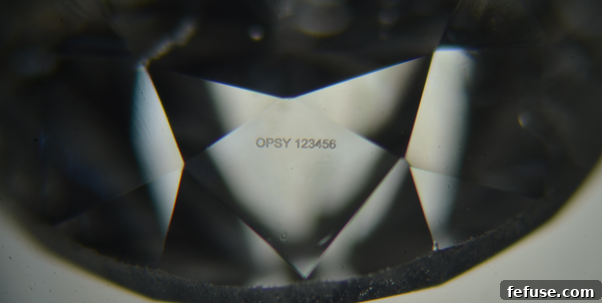
Loupe ID features can be placed at depths of up to 0.25 millimetres (250 microns) beneath the diamond’s surface. Their enhanced visibility provides a powerful tool for anti-counterfeiting measures and brand protection. For brands, embedding a Loupe ID offers a direct, verifiable signature within the diamond itself, strengthening their brand integrity and providing consumers with tangible proof of authenticity. This visible mark serves as an immediate deterrent to fraud and misrepresentation, enhancing transparency at every stage of the retail process.
Crucially, both Loupe ID and Nano ID identifiers are created beneath the diamond’s surface, meaning neither affects the surface polish or integrity of the stone. This innovative sub-surface placement ensures that security features can be integrated without compromising the diamond’s finish, optical performance, or ultimately, its market value. This technological breakthrough provides the natural diamond trade with unprecedented freedom to incorporate secure identifiers within its supply chain, upholding the factors that define rarity and value. By pioneering these techniques, Opsydia is introducing a unique methodology for tackling core industry challenges, including bolstering stone security, driving robust traceability initiatives, and providing an effective safeguard against fraud, non-disclosure, and various counterfeiting concerns.
The heart of this revolutionary capability lies within the Opsydia System, which employs a high-precision, ultrafast laser to embed logos, alphanumeric sequences, coded shapes, or even holographic features – collectively known as identifiers – beneath the diamond’s surface. The brilliance of this laser technology, developed through cutting-edge research at the University of Oxford, is its ability to focus tightly only *after* it passes the surface of the diamond. This precise control ensures that the identifier is created exclusively at a selected depth, leaving the diamond’s surface condition and polish completely unaffected. This unparalleled precision allows identifiers to be placed in a range of strategic locations, such as the table, girdle, or a specific facet, without any detrimental impact on the stone’s grading or appearance.
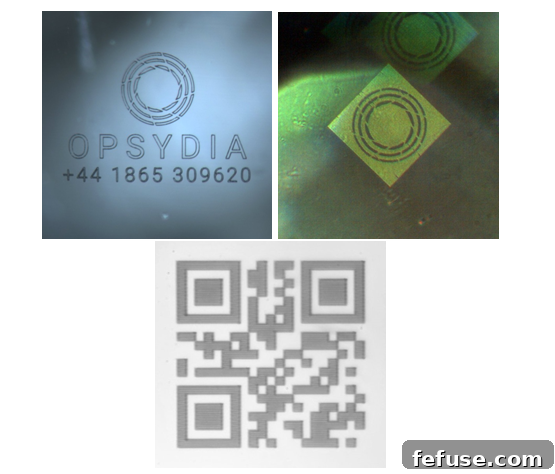
Clockwise from L-R: An alphanumeric identifier, a holographic feature inside a diamond, a QR code within a diamond. ID features can be customised to any width, pattern or shape to suit the user.
More than just a laboratory tool, the Opsydia System is engineered for industrial-scale deployment. With a compact footprint (approximately one metre wide and accessible through standard doorways), it boasts an impressive processing capacity, capable of marking between 50,000 and 100,000 stones per year in an industrial setting. Furthermore, the system incorporates advanced encryption techniques. This critical security measure ensures that each Opsydia system can only be used to write authorised logos or identifiers, creating an impenetrable barrier against counterfeiting and rigorously protecting brand integrity for companies utilising the technology. This combination of precision, speed, and security makes the Opsydia System a formidable asset for any entity serious about diamond authentication.
The global applicability of Opsydia technology is another key differentiator. It is deployable across the globe and can be utilised by both natural diamond and laboratory-grown diamond specialists, offering a universal solution for identification and traceability regardless of origin. This flexibility caters to the evolving needs of the entire diamond ecosystem, promoting fair trade and transparency across all segments. Looking ahead, Opsydia is committed to driving further innovation and collaboration within the industry. In the upcoming spring, the company is poised to announce significant new partnerships with international diamond industry bodies, further solidifying its position as a global leader in diamond security solutions.
In essence, Opsydia is not just offering a product; it’s providing a future-proof framework for trust and integrity in the diamond sector. By combining cutting-edge laser technology with immutable microscopic identifiers, Opsydia creates a physical link between a specific diamond and its entire provenance. This empowers all stages of the diamond supply chain – from miners and manufacturers to jewellers and grading laboratories – to protect the integrity of diamonds, enhance traceability, guard against counterfeiting, and clearly distinguish between natural and laboratory-grown stones. Opsydia’s pioneering sub-surface identifiers are actively tackling the future needs of the diamond industry today, attracting those ready to take the next bold step in ensuring diamond security and bolstering consumer confidence across the globe.
—
ENDS