
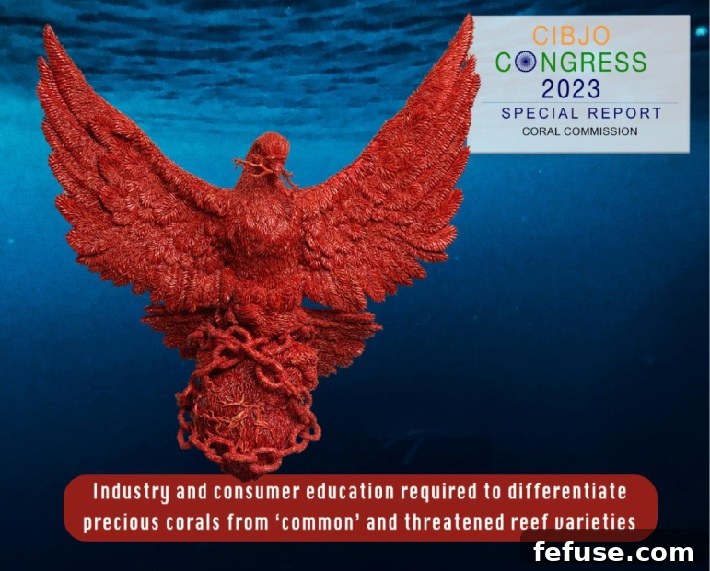
As the global jewellery industry prepares to convene for the highly anticipated 2023 CIBJO Congress in Jaipur, India, commencing on October 3rd, 2023, a critical new report has emerged. The ninth pre-congress Special Report, meticulously compiled by the CIBJO Coral Commission under the expert guidance of its President, Vincenzo Liverino, brings to the forefront a persistent and damaging misunderstanding within the sector: the widespread confusion between precious coral varieties and their climate-endangered reef counterparts. This report underscores the urgent necessity for precise terminology and enhanced education to safeguard both the integrity of the precious coral trade and the fragile marine ecosystems worldwide.
Navigating the Nuances: Unpacking Coral Terminology in the Jewellery Sector
The CIBJO Coral Commission’s latest report serves as a timely reminder of the profound ecological and commercial distinctions between various coral species. In an era marked by heightened environmental awareness and increasing scrutiny of supply chains, the clarity advocated by Liverino and his team is not merely academic; it is fundamental to responsible business practices and consumer confidence. The report highlights that misconceptions about coral origins can lead to misinformed purchasing decisions, unfair market restrictions, and, most critically, can inadvertently undermine genuine conservation efforts for truly threatened species.
Liverino emphasizes the indispensable role of the CIBJO Coral Blue Book as the authoritative guide for coral identification and classification. This internationally recognized standard is crucial for bringing much-needed clarity to a complex subject. According to this comprehensive document, precious coral, sought after for its beauty and rarity in high-end jewellery, is strictly defined and limited to just three distinct groups. All these groups fall exclusively under the Corallidae family: Corallium, Pleurocorallium, and Hemicorallium. This precise categorisation ensures that there is no ambiguity when referring to corals that are legitimately used in the jewellery trade.
Demystifying “Precious” vs. “Common” Corals
Under this stringent and scientifically backed definition, a significant number of coral species, even those occasionally found incorporated into jewellery pieces, are classified by CIBJO as ‘common corals’. This distinction is vital because it separates the vast majority of marine corals from the select few that possess the characteristics coveted for fine jewellery. Furthermore, the Blue Book’s meticulous categorisation intentionally excludes thousands of other coral species. Most notably, this includes the shallow-water reef corals that currently face severe existential threats due to the accelerating impacts of global climate change, such as ocean acidification and rising sea temperatures. These are the corals frequently featured in dire environmental news reports, and their plight should not be conflated with the sustainable sourcing of precious corals.
Vincenzo Liverino articulates the core challenge: “Effective communication of these trade definitions is paramount, given the widespread misconception among industry professionals and consumers alike that jewellery-grade corals originate from colonies situated in shallow waters, such as the Great Barrier Reef. The corals defined as precious by CIBJO inhabit entirely distinct ecosystems, thriving in much deeper and colder waters.” This statement directly addresses the root of the confusion, clarifying that the vibrant, accessible reefs beloved by divers and vulnerable to warming oceans are entirely separate from the deep-sea environments where precious corals flourish.
Ecological Divides: Where Precious Corals Thrive
The ecological separation between precious corals and shallow-water reef corals cannot be overstated. Precious corals, belonging to the Corallidae family, are typically found in bathyal zones, often hundreds of metres below the ocean surface, sometimes extending to depths exceeding 1,000 metres. These environments are characterized by stable, cold temperatures, absence of sunlight, and strong currents that deliver essential nutrients. They grow slowly, forming dense, tree-like colonies that can live for centuries. Their deep-water habitat provides a natural buffer against the surface-level environmental stressors like marine heatwaves and solar bleaching that devastate shallow reefs.
In stark contrast, shallow-water reef corals, which are often the focus of conservation campaigns due to their dramatic decline, inhabit sunlit, warmer waters, typically within 50 metres of the surface. These corals form the iconic, biodiverse ecosystems known as coral reefs, supporting a quarter of all marine life. Their symbiotic relationship with photosynthetic algae (zooxanthellae) makes them highly susceptible to temperature fluctuations. When waters warm, these corals expel their algae, leading to coral bleaching, which, if prolonged, results in coral mortality. This fundamental difference in habitat and biology underscores why the threats faced by shallow-water reefs do not directly apply to deep-water precious corals.
The Ripple Effect of Misinformation: A Case Study in Thailand
The tendency to group all types of coral under a single, undifferentiated umbrella has had tangible and often detrimental consequences for the precious coral industry. A particularly illustrative example of this occurred more than a decade ago in Thailand. Following the catastrophic magnitude 9.0 Great Tohoku earthquake off the coast of northeastern Japan on March 11th, 2011, a devastating tsunami swept across the Pacific. While the epicentre was far from Thailand, the ensuing tsunami considerably damaged the local reef coral ecosystems along Thailand’s coastlines. In response to the widespread ecological devastation and public outcry, Thai authorities implemented a blanket ban on all coral trading in the material, without distinguishing between affected reef corals and sustainably sourced precious corals.
This broad-stroke decision, while well-intentioned from an environmental perspective, had significant and unintended negative impacts on Thailand’s legitimate precious coral jewellery manufacturing sector. This industry, which relies on ethically sourced deep-water corals, found itself unfairly penalised by a regulation aimed at protecting entirely different species in different ecosystems. It highlighted the critical need for scientific accuracy in policy-making and the importance of clear communication channels between scientific bodies, industry stakeholders, and governmental authorities.
CIBJO’s Advocacy for Differentiation and Clarity
Recognizing the dire implications for the precious coral trade and the potential for misdirected conservation efforts, the CIBJO Coral Commission actively engaged with Thai authorities. The Commission’s President, Vincenzo Liverino, noted, “The Coral Commission at CIBJO has been actively engaging with authorities, urging them to acknowledge that the coral species affected by this natural disaster are not the ones coveted for gemstone purposes in the jewellery manufacturing sector, which represents a robust industry in Thailand. We have underscored that precious corals do not inhabit the same ecosystem as those impacted by the tsunami and, as affirmed by CITES, are not deemed endangered species.”
This intervention by CIBJO was crucial in distinguishing between the coral species that required urgent conservation due to their shallow-water habitat and those, like precious corals, that are sourced from deep, stable environments. The reference to CITES (the Convention on International Trade in Endangered Species of Wild Fauna and Flora) is particularly important here. CITES is an international agreement that aims to ensure that international trade in specimens of wild animals and plants does not threaten their survival. The fact that precious corals are not listed as endangered by CITES, unlike some other marine species, further supports the CIBJO’s assertion that their trade, when managed responsibly, does not pose a threat to their survival.
The Path Forward: Education, Sustainability, and Responsible Trade
The findings presented in the CIBJO Coral Commission’s special report are a call to action for the entire jewellery industry. To foster a sustainable and transparent future for precious coral, continuous education is paramount. This education must target not only industry professionals – from miners and cutters to designers and retailers – but also, crucially, the end consumers. Jewelers have an ethical responsibility to accurately inform their customers about the origin, species, and ecological status of the corals they sell, dispelling myths and promoting informed choices.
Promoting the CIBJO Coral Blue Book as the definitive standard for classification and terminology is a vital step. Adherence to these guidelines ensures consistency across the industry, facilitating responsible sourcing and mitigating the risk of confusion. Furthermore, the industry must continue to advocate for science-based policymaking, ensuring that regulations are nuanced and precise, distinguishing between genuinely threatened species and those that can be sustainably harvested under strict controls.
The CIBJO Congress 2023 in Jaipur will serve as a critical platform for these discussions, bringing together experts and stakeholders to chart a course for greater clarity and responsibility. By embracing transparency, prioritizing accurate information, and supporting organizations like CIBJO in their efforts, the jewellery sector can uphold its commitment to ethical practices while ensuring the long-term viability of the precious coral trade. Ultimately, a well-informed industry is better equipped to protect marine biodiversity, build consumer trust, and secure a sustainable future for all forms of coral, whether they adorn fine jewellery or form the vital backbone of our ocean’s ecosystems.