
Unveiling the Layers: GIA Identifies Rare Synthetic Ruby Overgrowth on Natural Sapphire
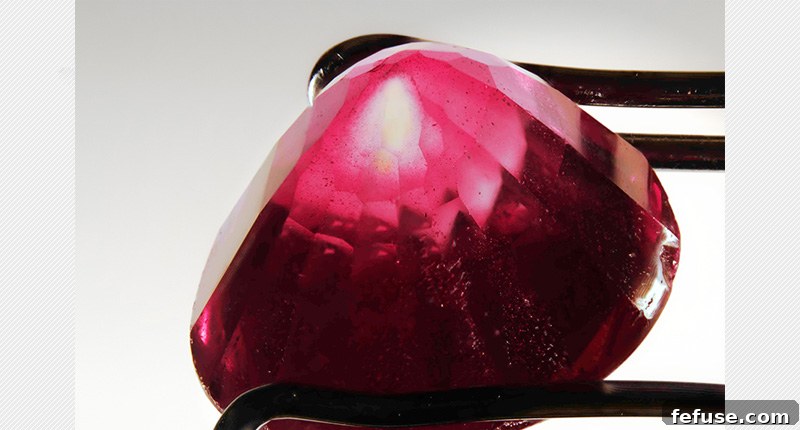
Carlsbad, Calif. – The world of gemology is a dynamic realm, constantly challenged by new treatments and sophisticated synthetic creations. Staying ahead of these developments is paramount for ensuring consumer confidence and maintaining transparency in the global gemstone trade. Recently, the Gemological Institute of America’s (GIA) New York laboratory encountered a truly remarkable specimen – a gemstone that initially appeared to be a common treated ruby but, upon closer inspection, revealed a fascinating and rare structure: a synthetic ruby overgrowth on a natural sapphire core.
This discovery, meticulously documented by Tyler Smith and Hollie McBride in the winter 2017 issue of “Gems & Gemology,” underscores the critical importance of advanced gemological testing and expert analysis. It serves as a vivid reminder that even seasoned professionals must continually adapt to the evolving landscape of gem enhancements and imitations.
The Initial Encounter: A Puzzling Pair of Red Gems
The GIA lab in New York received two loose, oval mixed-cut red gemstones for standard identification procedures. At first glance, these stones presented characteristics that suggested a known enhancement method. Initial testing revealed refractive indices (R.I.) that were slightly higher than typically observed for natural corundum, which encompasses both ruby and sapphire.
Historically, elevated refractive indices have been reported in chromium-diffused corundum. This treatment involves introducing additional chromium during a high-temperature heating process to intensify or alter the stone’s color. Such treatments are common in the industry, making the initial assessment seem plausible. To the naked eye, these submitted stones indeed appeared to be chromium-diffused, exhibiting characteristic red color concentrations at the intersections of their facets – a visual cue often associated with diffusion treatments.
However, the GIA’s commitment to thorough analysis means that initial assumptions are always subjected to deeper scrutiny. This rigorous approach proved invaluable in this particular case, preventing a misidentification that could have significant implications for the gemstone’s value and provenance.
Beyond the Surface: The Revelation of Synthetic Overgrowth
The true nature of the gemstones was unveiled during a more detailed microscopic examination, a crucial step in advanced gemological identification. Under high magnification, gemologists observed something entirely unexpected and far more complex than simple chromium diffusion. They detected a distinct, thin layer, approximately 0.3 mm thick, of “synthetic overgrowth.” This layer, composed of lab-grown ruby, was responsible for the vibrant red color of the stones. Beneath this synthetic veneer lay a natural, almost-colorless sapphire, serving as the core or “seed” crystal.
This structural arrangement was a clear departure from standard treatments. Instead of merely enhancing the color of an existing natural stone, a completely new layer of synthetic material had been grown onto a natural one. This intricate composition presents a unique challenge for identification, as it combines elements of both natural and laboratory-created materials within a single gem.
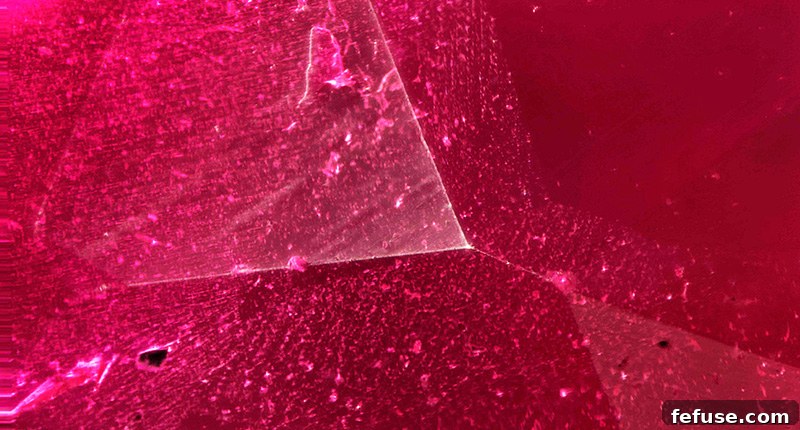
As illustrated in the accompanying image, the thin layer of synthetic ruby overgrowth, often characterized by the presence of microscopic flux particles, stands in stark contrast to the natural sapphire seed. These flux particles are residual materials from the synthetic growth process, acting as definitive indicators of a lab-created origin. The ability to visually discern these distinct layers and inclusions is a testament to the advanced microscopy techniques employed by the GIA.
A Blast from the Past: Echoes of Johann Lechleitner
The discovery immediately brought to mind the pioneering work of Johann Lechleitner, a name synonymous with early synthetic overgrowth techniques. In the 1960s, Lechleitner developed a process to grow a synthetic emerald overgrowth onto a near-colorless beryl seed, thereby creating what are now known as “Lechleitner synthetic overgrowth emeralds.” These creations provided a green hue to an otherwise pale stone, effectively creating a composite gem.
Coincidentally, around the same time these unusual rubies were submitted to the GIA’s New York lab, the GIA’s Carlsbad lab also received a Lechleitner emerald for identification, highlighting the resurfacing of these vintage, complex materials in the trade. Lechleitner’s innovative experiments weren’t limited to emeralds; he also explored ruby overgrowth, applying it to both synthetic and natural corundum seeds. His early specimens often contained a variety of chemical elements unique to his growth conditions.
However, a key distinction was noted between Lechleitner’s historical rubies and the newly submitted ones. The G&G article pointed out that the two rubies received by the GIA were missing molybdenum, an element commonly found in Lechleitner’s specimens. This absence suggested that while the technique of overgrowth was similar, the specific growth conditions or methods used for the recently discovered rubies were different, indicating either a variation of the Lechleitner process or an entirely separate origin for these particular overgrowth synthetics.
The GIA’s Unwavering Commitment to Gemological Science
This identification is not the first report of synthetic ruby overgrowth on natural sapphire seeds globally, but it marks the first instance of such material being submitted to the GIA’s New York and Carlsbad laboratories for official identification. This highlights the rarity of these specific types of composites appearing in the modern commercial market and the critical role of institutions like the GIA in authenticating and categorizing them.
The GIA employs a comprehensive suite of advanced analytical techniques to distinguish between natural gemstones, those that have been treated, and fully synthetic materials. These methods go far beyond simple visual inspection and refractive index measurements, including:
- Advanced Microscopy: Essential for observing growth patterns, inclusions, and distinguishing between layers of different materials.
- Spectroscopy (UV-Vis-NIR, Raman, FTIR): Used to analyze how light interacts with the gem’s atomic structure and chemical composition, revealing tell-tale signatures of natural origin, treatments, or synthetic growth.
- Chemical Analysis (e.g., LA-ICP-MS): Precisely measures trace elements present in the gem, which can pinpoint geographic origin, detect treatments, and differentiate between natural and synthetic materials.
- Luminescence: Observing how gems react under different light sources (e.g., UV light) can reveal internal characteristics and growth structures.
These sophisticated tools and the expertise of GIA gemologists are crucial for navigating the increasing complexity of the gem market. Without such rigorous examination, materials like these synthetic overgrowth rubies could easily be misrepresented, eroding consumer trust and market integrity.
Implications for the Gemstone Trade and Consumer Confidence
As Smith and McBride aptly stated, “The resurfacing of these vintage overgrowth synthetics shows that once a material is in the trade, it is here to stay.” This profound observation carries significant implications for various stakeholders within the gemstone and jewelry industry:
- Dealers and Jewelers: It reinforces the necessity for continuous education and an unwavering commitment to full disclosure. Dealers must be able to recognize these complex materials and accurately represent them to their clients. Misrepresenting such a composite gem, even unintentionally, can lead to severe reputational damage.
- Consumers: For buyers, this discovery underscores the paramount importance of purchasing gemstones with reputable third-party identification reports, especially from trusted laboratories like the GIA. These reports provide an objective, scientific assessment of a gem’s identity, natural origin, and any treatments it may have undergone.
- Gemological Research: It emphasizes the ongoing need for gemological institutes to conduct research, document new findings, and share this knowledge with the trade. The evolution of treatments and synthetics is a continuous process, requiring constant vigilance and innovation in detection methods.
- Market Integrity: The ability to accurately identify and disclose all forms of gem material is fundamental to maintaining trust and integrity within the global gem market. Without it, the value and perceived rarity of natural gemstones could be undermined.
The distinction between a natural ruby, a natural ruby with a standard treatment (like heat or diffusion), a synthetic ruby, and a composite stone like this overgrowth material is crucial for accurate valuation and ethical trade practices. Each category holds a different position in the market, often with vast differences in price and rarity.
Conclusion: A Continuous Pursuit of Truth
The identification of synthetic ruby overgrowth on a natural sapphire seed by the GIA’s New York lab is more than just a scientific curiosity; it’s a testament to the ever-evolving nature of gemological science and the unwavering dedication required to uphold the integrity of the gemstone industry. It highlights how historical techniques can resurface, sometimes in new iterations, continually challenging gemologists to refine their methods and deepen their knowledge.
In a world where technology constantly creates new possibilities for gem enhancement and synthesis, institutions like the GIA stand as guardians of truth, providing the essential expertise and independent analysis that underpins trust and transparency in the global trade of precious stones. For anyone involved with or passionate about gemstones, this discovery serves as a powerful reminder: the layers of beauty often hold deeper stories, and only through diligent scientific inquiry can those stories be fully and accurately told.