
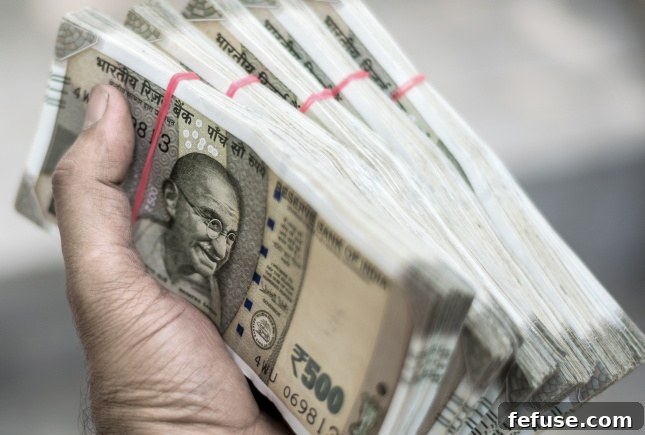
The Reserve Bank of India (RBI) has unveiled a groundbreaking mechanism, permitting the settlement of international trade transactions in rupees, a move enthusiastically welcomed by India’s pivotal diamond industry, particularly in Surat. This significant announcement paves the way for Indian diamond traders to pay for Russian diamonds using the national currency, effectively circumventing the formidable banking restrictions that have severely hampered trade following Russia’s actions in Ukraine.
A Paradigm Shift in India-Russia Diamond Trade Dynamics
For decades, the global diamond trade, including the robust exchanges between India and Russia, operated predominantly in US dollars. These transactions were meticulously routed through intermediary banks, primarily situated in the United States, forming an integral part of the interconnected global financial system. However, the geopolitical landscape shifted dramatically in February with Russia’s invasion of Ukraine, triggering a wave of stringent Western sanctions. These sanctions, designed to isolate Russia from the international financial system, instantaneously choked off traditional payment channels, bringing trade between India and Russia to a virtual standstill.
The impact on India’s diamond industry, centered in Surat, was profound. As the undisputed global hub for cutting and polishing diamonds, Surat relies heavily on a consistent supply of rough diamonds, a substantial portion of which originates from Russia, particularly from mining giant Alrosa. The sudden cessation of dollar-denominated payments threatened to disrupt supply chains, jeopardize countless livelihoods, and undermine India’s preeminent position in the global diamond market. It created an urgent need for an innovative solution that could bypass the rigidities of the existing financial architecture without falling afoul of international compliance requirements.
The RBI’s Strategic Intervention: Facilitating Rupee-Denominated Transactions
Responding to this critical challenge, the Reserve Bank of India announced a meticulously crafted framework designed to facilitate international trade transactions in Indian Rupees (INR). This measure, which came into effect immediately, is a strategic move to promote the growth of global trade, with a particular emphasis on bolstering exports from India, and to capitalize on the increasing global interest in the INR as a viable currency for international commerce.
The core of this new mechanism revolves around the establishment of ‘vostro accounts.’ For foreign banks, including those in Russia, wishing to settle international trade transactions in rupees with Indian entities, the directive is clear: they must open a vostro account with an authorized Indian bank. A vostro account is essentially an account that a correspondent bank holds on behalf of another bank. In this context, a Russian bank would open an INR-denominated vostro account with an Indian bank. This enables Indian importers to pay for Russian goods, such as rough diamonds, in rupees directly into this vostro account, and conversely, allows Russian entities to use the accumulated rupees to pay for Indian exports, fostering a balanced bilateral trade flow. Furthermore, Indian banks engaging in such transactions will require prior approval from the RBI, ensuring oversight and adherence to regulatory guidelines.
The RBI articulated its rationale, stating, “In order to promote growth of global trade with emphasis on exports from India and to support the increasing interest of global trading community in INR, it has been decided to put in place an additional arrangement for invoicing, payment, and settlement of exports/imports in INR.” This statement underscores India’s dual objectives: to secure its supply chains and export markets, and to enhance the international acceptance and usage of its national currency.
Surat’s Diamond Industry: A Lifeline Restored
The immediate and palpable relief felt across Surat’s diamond industry cannot be overstated. With an estimated 9 out of 10 diamonds globally being cut and polished in Surat, the industry is a cornerstone of India’s economy, employing millions directly and indirectly. The continuous supply of rough diamonds from Russia is crucial for maintaining this unparalleled efficiency and scale. The RBI’s rupee settlement mechanism offers a robust and sustainable solution to the payment dilemma, ensuring that the wheels of the diamond trade can continue to turn without interruption.
This move is particularly significant as it insulates a vital sector from the volatility of international sanctions and currency fluctuations that often accompany dollar-denominated trade in turbulent times. By transacting in rupees, Indian businesses gain greater predictability and control over their costs, reducing exposure to exchange rate risks associated with converting local currency to dollars and then back again. This financial stability is crucial for an industry with high capital requirements and tight margins.
Broader Economic and Geopolitical Implications
Beyond the immediate relief for the diamond industry, the RBI’s decision carries substantial economic and geopolitical weight. It signifies India’s strategic intent to diversify its payment mechanisms and reduce its reliance on the US dollar, aligning with a broader global trend towards de-dollarization among several emerging economies. By promoting the INR in international trade, India is taking a decisive step towards strengthening its currency’s global standing and fostering greater financial autonomy.
This arrangement also bolsters India’s ‘Act East’ policy and its commitment to maintaining strategic partnerships, even amidst complex global dynamics. It demonstrates India’s capacity to forge independent economic pathways that prioritize national interests while navigating the intricacies of international relations. The mechanism could potentially serve as a blueprint for other countries seeking to bypass dollar-centric payment systems for trade with sanction-hit nations or simply to promote their own national currencies globally. It offers a practical alternative that respects the sovereignty of nations to conduct trade in a manner that best suits their economic objectives.
Navigating Challenges and Charting the Future
While the implementation of the rupee settlement system is a monumental step, its long-term success will depend on several factors. The widespread acceptance of INR by Russian entities for a diverse range of exports to India, beyond just diamonds, will be critical. The mechanism is designed to be mutually beneficial, enabling Russia to use its accumulated rupees to purchase Indian goods and services. Ensuring a balanced trade flow, where Russia can effectively utilize its rupee reserves, will be key to the sustainability of this arrangement. Exchange rate management between the rupee and the ruble, and indeed against other major currencies, will also require careful monitoring by both central banks.
Furthermore, the evolving geopolitical landscape means that such alternative payment systems might attract scrutiny. However, by adhering strictly to a bilateral, local currency framework, India aims to mitigate potential risks and ensure compliance with international norms, albeit within a newly defined operational space. The RBI’s continuous oversight and responsiveness to market dynamics will be crucial in refining and expanding this framework.
Conclusion: A New Chapter for India’s Global Trade Ambitions
The Reserve Bank of India’s decision to allow rupee settlement for international trade marks a pivotal moment for India’s economic diplomacy and its position in global commerce. For the Surat diamond industry, it is nothing short of a lifeline, ensuring the continued supply of essential raw materials and safeguarding millions of jobs. More broadly, it signals India’s proactive approach to navigating a multipolar world, promoting the internationalization of the INR, and building resilient trade relationships independent of traditional Western financial channels.
This strategic move is a testament to India’s commitment to fostering a robust and diversified trade ecosystem, one that is less susceptible to external shocks and more attuned to its national economic priorities. As the world watches, India’s rupee gambit with Russia could well set a precedent, ushering in a new era of localized currency trade and reshaping the future of global financial transactions.