
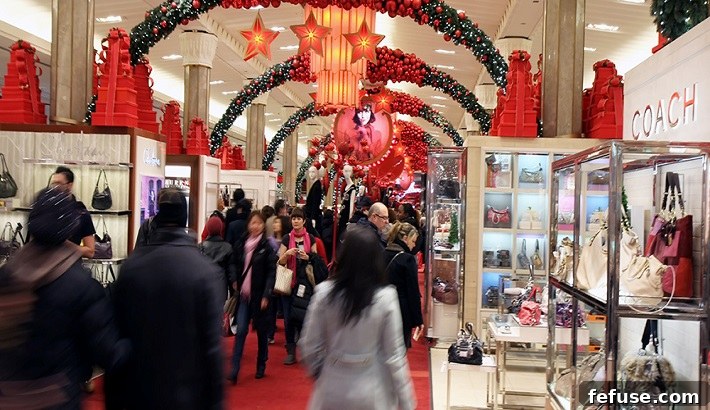
US Retail Sector Thrives: A Deep Dive into Record Holiday Spending Amidst Economic Shifts
The United States retail sector demonstrated remarkable resilience in November, maintaining a robust growth trajectory that propelled the 2021 holiday season toward unprecedented spending levels. This impressive performance unfolded against a backdrop of persistent economic challenges, including elevated inflation, widespread supply chain disruptions, and the emergence of the Covid-19 Omicron variant. Despite these formidable headwinds, American consumers exhibited a strong propensity to spend, a trend that the National Retail Federation (NRF) highlighted as a testament to the sector’s underlying strength and adaptability. This surge in consumer activity not only signifies a robust economic recovery but also underscores the evolving nature of retail in a post-pandemic world, where flexibility and consumer confidence play pivotal roles.
Unpacking November’s Stellar Retail Performance
November’s retail sales data offered compelling evidence of sustained consumer engagement and healthy market dynamics, positioning the critical holiday period for record-breaking outcomes. The NRF reported a significant 14% increase in sales year-over-year, a clear indicator that the momentum from strong early holiday shopping in October seamlessly carried into the crucial Black Friday and Cyber Monday period. This double-digit growth underscores not only the strength of current consumer demand but also the successful strategies employed by retailers to navigate a complex operating environment. The data suggests that consumers, armed with strong financial health, continued to prioritize their holiday purchases, viewing shopping as a valued activity even amid evolving economic landscapes. This sustained demand is a powerful signal of underlying economic stability and consumer optimism.
Matthew Shay, President and CEO of the NRF, articulated this sentiment, stating, “Despite economic headwinds, November retail sales data confirms that consumers continue to spend, as demonstrated by a 14% increase in sales year-over-year.” Shay further emphasized the expectation for continued strong demand through December, acknowledging that while many consumers initiated their holiday shopping earlier than usual, the latter half of the season was still poised for robust activity. This perspective is critical, as it indicates a broader shift in consumer behavior, where holiday purchasing is spread across a longer period rather than concentrated in the traditional December rush. The NRF’s leadership credits increased vaccination rates and retailers’ diligent safety protocols for fostering an environment where consumers feel confident shopping both online and in physical stores, thus contributing to this sustained spending and ensuring the 2021 holiday season becomes a benchmark for future retail performance.
Consumer Confidence and Healthy Finances Drive Sustained Spending
Adding further insight into the economic landscape, NRF Chief Economist Jack Kleinhenz underscored the robust financial position of American consumers as a primary driver for the sustained spending. “Consumers continued spending in November, building on momentum from strong early holiday shopping in October and setting the stage for a bright holiday season,” Kleinhenz observed. He highlighted that neither persistent inflation nor the looming threat of Covid-19 had managed to derail holiday spending, despite both issues remaining top-of-mind for many households. This resilience can be attributed to several critical factors, including recent progress in the labor market, which has fueled job creation and wage growth, thereby propelling incredibly strong demand. Many shoppers possess sufficient income and accumulated savings, enabling them to absorb the higher prices that have resulted from pandemic-induced supply chain disruptions and inflationary pressures.
Kleinhenz also provided a crucial clarification regarding the interpretation of retail sales data. While seasonally adjusted numbers might sometimes present a more modest picture, he stressed that seasonal patterns have been significantly disrupted by the pandemic. When examining unadjusted data, NRF’s calculations reveal that November’s sales were, in fact, the highest on record. This nuance is vital for a comprehensive understanding of the market’s true performance, indicating that traditional seasonal adjustments may not fully capture the unprecedented shifts in consumer behavior observed during this period. Such detailed analysis ensures that the true strength of the US retail sector is accurately represented, offering a clearer view of consumer resilience.
Navigating Headwinds: Inflation, Supply Chains, and the Omicron Variant
The 2021 holiday shopping season was undeniably unique, marked by a confluence of challenges that tested the adaptability of both retailers and consumers. Inflationary pressures, stemming from a combination of strong consumer demand and constrained global supply, meant that consumers were often paying more for goods than in previous years. This scenario presented a delicate balance for retailers, who had to manage pricing strategies while maintaining competitive appeal. Simultaneously, global supply chain disruptions led to widespread concerns about product availability, extended shipping times, and potential stockouts, forcing many retailers to advise customers to shop early. This proactive communication strategy clearly resonated with a significant portion of the consumer base, influencing purchasing patterns.
The emergence of the Omicron variant added another layer of complexity, raising concerns about renewed lockdowns, public health restrictions, and potential impacts on in-person shopping. However, the NRF’s analysis suggests that these fears did not significantly deter consumer spending. Instead, a combination of increased vaccination rates, the implementation of stringent safety protocols by retailers – including enhanced sanitation, social distancing measures, and contactless payment options – and a collective adaptation to living with the virus allowed consumers to proceed with their shopping plans. This adaptability speaks volumes about the evolving relationship between consumers, retailers, and public health realities, showcasing a powerful ability to adjust to new norms and prioritize convenience and safety.
The Revised Holiday Season Forecast: Setting New Spending Records
In light of the impressive performance in November and the early start to holiday shopping, the NRF has significantly revised its forecast for the entire 2021 holiday season, which officially spans from November 1st through December 31st. The organization now projects that holiday sales could grow by as much as 11.5% over 2020 figures. This updated forecast represents a substantial upward adjustment from NRF’s earlier prediction, which had estimated growth rates between 8.5% and 10.5%. Such a significant revision underscores the unexpected strength and remarkable resilience of consumer demand during this critical period, highlighting a truly exceptional year for the retail industry despite ongoing challenges.
This revised projection is particularly noteworthy because even at the lower end of the NRF’s initial forecast range, both the total amount spent and the growth rate would have established new records. The new, higher forecast of 11.5% growth implies an even more emphatic record-breaking season, solidifying 2021 as an unparalleled year for retail spending. This unprecedented surge in spending highlights the underlying economic strength and consumer confidence that prevailed despite external pressures. It reflects not only pent-up demand from previous years but also a willingness among consumers to spend on experiences and goods, making up for previous restrictions and uncertainties, thereby contributing significantly to overall economic vitality.
Year-to-Date Momentum and Full-Year Projections Confirm Robust Retail Health
The strong November performance was not an isolated incident but rather a continuation of robust retail activity throughout the year, signaling a broader and more enduring trend. For the first 11 months of 2021, sales, as calculated by the NRF, demonstrated an impressive 14.2% increase compared to the same period in 2020. This consistent growth trajectory is perfectly aligned with the NRF’s full-year forecast, which anticipates overall retail sales for 2021 to grow between 10.5% and 13.5% over 2020, translating to a staggering total between $4.44 trillion and $4.56 trillion. These figures underscore a truly transformative year for the retail industry, characterized by significant expansion, dynamic adaptation, and sustained consumer engagement across various sectors.
Such sustained growth throughout the year indicates a fundamental shift in consumer behavior and market dynamics, extending beyond just holiday enthusiasm. It suggests that economic recovery, coupled with adaptive retail strategies, created a fertile ground for consistent spending. This prolonged period of elevated sales performance provides a solid foundation for the retail industry as it moves into the new year, hinting at continued evolution and potential for innovation in how consumers shop and interact with brands. The consistent growth across nearly the entire year points to a deep-seated resilience in the American consumer market, capable of overcoming significant economic hurdles.
Beyond the Numbers: Factors Driving Unprecedented Consumer Spending
While the headline numbers are undeniably impressive, understanding the underlying factors driving this consumer spending spree provides a fuller and more nuanced picture. A strong labor market, characterized by consistent job creation and rising wages, has significantly bolstered household incomes across various demographics. This increased earning power, combined with savings accumulated during earlier phases of the pandemic (particularly for a segment of the population that experienced reduced spending opportunities), provided consumers with ample purchasing power despite rising prices. Furthermore, the psychological impact of returning to some semblance of normalcy, coupled with the desire to make up for restricted holiday celebrations in previous years, likely fueled a greater willingness to spend on gifts, festive items, and experiences, contributing to the overall celebratory mood.
The ongoing shift towards sophisticated omnichannel retail strategies also played a crucial role in facilitating and accelerating this spending. Retailers who successfully integrated seamless online shopping platforms with enhanced in-store experiences – offering convenient options like buy online, pick up in-store (BOPIS), efficient curbside pickup, and reliable, fast delivery services – were better positioned to capture diverse consumer preferences. This flexibility was particularly vital in an environment where health concerns and convenience continued to heavily influence shopping decisions. The remarkable adaptability of the retail sector, from small independent businesses to large multinational corporations, in meeting these evolving demands was undeniably key to sustaining the strong sales momentum and fostering enduring customer loyalty.
The Future of Retail: Lessons from a Resilient and Record-Breaking Year
The 2021 holiday season, culminating in record spending and unprecedented growth, offers invaluable lessons for the future trajectory of the retail industry. It definitively demonstrates the enduring power of consumer demand and the sector’s inherent ability to thrive, even in the face of significant economic and public health challenges. Retailers who prioritized agility, invested strategically in robust supply chain management, embraced comprehensive digital transformation, and focused intently on creating safe, personalized, and seamless shopping experiences were ultimately the most successful. The pronounced trend of early shopping also suggests a potentially permanent shift in consumer behavior, which could diffuse traditional peak shopping periods and necessitate retailers to plan their inventory, staffing, and promotional strategies over an extended, more fluid timeframe.
Looking ahead, the retail industry is poised to continue its rapid evolution, driven by technological innovation and shifting consumer expectations. Sustained investment in cutting-edge technology, highly personalized customer experiences, and diversified fulfillment options will remain absolutely critical for maintaining a competitive edge. The ability to quickly adapt to global disruptions, whether economic, environmental, or health-related, will be a defining characteristic of successful retail businesses in the coming years. The 2021 holiday season serves as a powerful and inspiring reminder of the American consumer’s remarkable resilience and the retail sector’s profound capacity for innovation, sustained growth, and triumphant adaptation in an ever-changing world.
In conclusion, the surge in US retail sales in November firmly cemented the 2021 holiday season as a period of exceptional consumer spending and unprecedented market performance. Despite a complex economic backdrop, consumers demonstrated remarkable confidence and purchasing power, significantly surpassing previous expectations and setting impressive new records. The National Retail Federation’s upward revision of its forecast reflects not just a momentary peak, but a broader narrative of a highly resilient retail sector poised for continued strength, strategic innovation, and adaptive growth in the years to come, solidifying its pivotal role in the national economy.