
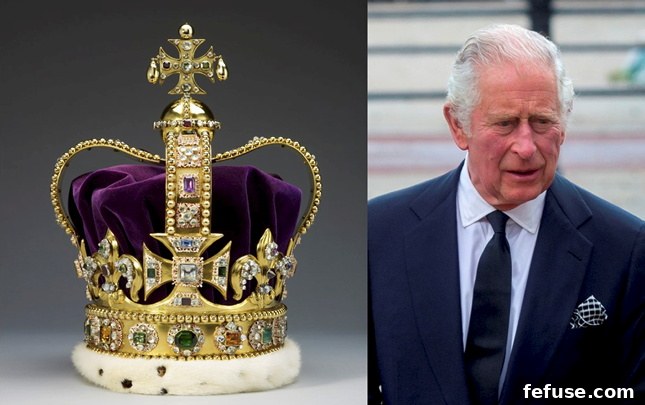
The British monarchy stands on centuries of tradition, pageantry, and powerful symbols. Among these, few objects encapsulate the enduring spirit of sovereignty more profoundly than St Edward’s Crown. As the nation prepares for the historic coronation of King Charles III, this magnificent emblem of royal authority has once again taken center stage, making headlines for its rare departure from the formidable Tower of London.
St Edward’s Crown: A Glimpse into King Charles III’s Coronation Centrepiece
In a move signaling the imminent grand ceremony, St Edward’s Crown, the very heart of the Crown Jewels collection, was recently removed from its secure display at the Tower of London. This momentous occasion marks the first time in an astonishing 60 years that the precious item has left its historic home, undertaking a journey for essential “modification work” ahead of the coronation on Saturday, May 6th. The careful transition of such an invaluable artifact underscores the meticulous preparations underway for a spectacle that will be watched by billions worldwide.
A Rare Departure and Essential Modifications
The news of St Edward’s Crown’s removal was met with significant public interest, highlighting the profound connection the British people, and indeed the global community, have with the monarchy’s enduring symbols. Buckingham Palace confirmed the crown’s relocation to an undisclosed, secure location for its preparatory work, though specific details regarding the modifications remain, predictably, under wraps. This discretion is standard practice for items of such immense historical and monetary value, ensuring both their security and the mystique surrounding royal traditions.
The need for modification work stems from the fact that the crown must be perfectly fitted for the new monarch. Each sovereign has a unique head size and preferences, and while the crown’s fundamental structure remains unaltered, adjustments ensure comfort and dignity during the solemn ceremony. The last time this venerable crown graced a monarch’s head was in 1953, when it was worn by the late Queen Elizabeth II during her own coronation. For seven decades, it has stood as a powerful reminder of her reign and the continuity of the royal lineage.
The Illustrious History of St Edward’s Crown
Rebirth After the Interregnum
The history of St Edward’s Crown is as rich and turbulent as the British monarchy itself. The current crown was crafted in 1661 for King Charles II, specifically for his coronation following the Restoration of the Monarchy. Its creation was a direct response to a period of unprecedented upheaval in English history: the English Civil War and the subsequent Interregnum.
During the tumultuous years under Oliver Cromwell and the Commonwealth (1649-1660), the original medieval crown, believed to date back to Edward the Confessor, along with much of the other royal regalia, was tragically melted down. This act, carried out in 1649, was a deliberate attempt to dismantle the symbols of monarchy and establish a new republican order. However, with the return of King Charles II to the throne, a new set of Crown Jewels was commissioned, designed to reflect the restored majesty and continuity of the royal line. St Edward’s Crown, named after the Anglo-Saxon saint and king, was fashioned to be a faithful, albeit grander, replica of its lost predecessor, serving as a powerful emblem of rebirth and enduring sovereignty.
A Symbol of Unwavering Authority
From its inception, St Edward’s Crown was intended for the most sacred and significant moment of a monarch’s reign: the act of crowning itself. While other crowns, like the Imperial State Crown, are used for state openings of Parliament and other ceremonial occasions, St Edward’s Crown is reserved solely for the moment of coronation, underscoring its unparalleled symbolic weight.
A Masterpiece of Precious Materials
Visually, St Edward’s Crown is nothing short of breathtaking. Crafted from solid gold, its sheer presence commands attention. It weighs an impressive 2.23 kilograms (approximately 4.9 pounds) – a tangible representation of the immense burden of responsibility that comes with the British throne. This substantial weight is a significant reason why it is only worn for a brief, yet profoundly symbolic, period during the coronation ceremony.
The crown’s intricate design is adorned with a dazzling array of 444 precious and semi-precious stones. These include lustrous sapphires, fiery rubies, deep amethysts, sparkling topaz, rich garnets, and vibrant tourmalines, each meticulously set to create an unparalleled spectacle of light and color. These jewels are not merely decorative; they contribute to the crown’s overall majesty and reflect the wealth and power associated with the British Crown.
Completing its traditional design, the crown features a lush velvet cap, typically purple, and an ermine band. The velvet adds a touch of regal softness, while the ermine – a fur traditionally associated with royalty and nobility – symbolizes purity and high status. Together, these elements combine to form a piece of regalia that is both an artistic marvel and a potent historical artifact.
The Coronation of King Charles III: A New Chapter
The upcoming coronation of King Charles III at Westminster Abbey promises to be an event steeped in history, tradition, and profound national significance. The ceremony, which dates back over a thousand years, is a symbolic anointing and crowning of the monarch, representing their spiritual and temporal authority.
At the very heart of this ancient ritual will be St Edward’s Crown. King Charles III will be presented with and crowned with this magnificent piece of regalia, signifying his formal ascent to the throne. This moment, when the Archbishop of Canterbury places the crown upon the monarch’s head, is arguably the most poignant and climactic point of the entire ceremony. It is a moment that resonates with centuries of continuity, connecting the new king directly to his illustrious predecessors, from William the Conqueror to Queen Elizabeth II.
Beyond St Edward’s Crown, the coronation involves a host of other Royal Regalia, including the Orb, Sceptres, and Swords, each carrying its own layer of symbolism regarding the monarch’s role as defender of the faith and dispenser of justice. The entire spectacle is a carefully choreographed dance between ancient rites and modern aspirations, designed to affirm the monarch’s position as Head of State and Head of the Commonwealth.
The Enduring Power of Royal Symbols
The removal and modification of St Edward’s Crown serve as a potent reminder of the enduring power and relevance of royal symbols in a contemporary world. In an era of rapid change, the Crown Jewels, and particularly St Edward’s Crown, offer a tangible link to history, tradition, and a sense of national identity. They represent not just the wealth of the monarchy, but also the deep-rooted cultural heritage of the United Kingdom and its Commonwealth realms.
As King Charles III prepares to receive this historic crown, he steps into a role shaped by centuries of precedent yet also tasked with navigating the challenges of the modern age. The modifications to St Edward’s Crown, however minor, symbolize this adaptation – a subtle adjustment of a timeless emblem for a new sovereign, ready to lead with a renewed sense of purpose and continuity. The world awaits the grand spectacle, eager to witness history unfold as King Charles III is formally crowned with this magnificent symbol of British enduring majesty.