
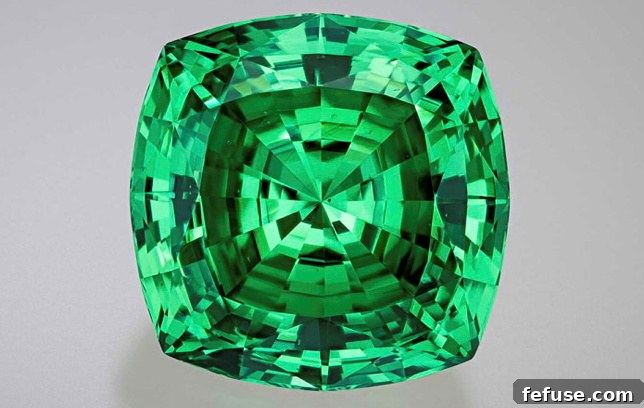
One of the world’s most spectacular and significant gemstones, the Lion of Merelani tsavorite garnet, has taken its rightful place among geological marvels at the Smithsonian’s National Museum of Natural History in Washington D.C., USA. This remarkable display marks a pivotal moment for gemstone enthusiasts and the scientific community alike, showcasing a true testament to nature’s artistry.
Behold the Lion of Merelani: A Masterpiece of Nature and Craftsmanship
The Lion of Merelani is not just any gemstone; it is an extraordinary specimen weighing an astounding 116.76 carats. What makes this particular tsavorite even more exceptional is its meticulous cut, featuring 177 facets that allow light to dance and reflect with unparalleled brilliance. It holds the prestigious title of being the largest precision-cut tsavorite in the entire world. Furthermore, it proudly stands as the largest tsavorite gem ever cut within the United States, a testament to the skill and dedication of American lapidary artists. Its presence at the Smithsonian elevates its status from a rare gem to a historical artifact, available for public admiration and study.
Unveiling Tsavorite: A Green Gemstone with a Storied Past
Tsavorite is a precious gemstone, celebrated for its vibrant green hue and exceptional brilliance. It belongs to the garnet mineral group, specifically identified as a grossular garnet. Chemically, it is a calcium-aluminum silicate mineral, with its striking green color attributed to trace amounts of vanadium or chromium. Unlike other garnets that come in a spectrum of colors, tsavorite is singularly known for its captivating green, ranging from a light, refreshing mint to a deep, intense forest green.
The story of tsavorite’s discovery is as fascinating as the gem itself, intricately linked to the legendary geologist and gem prospector Campbell Bridges. Bridges, a true pioneer in the world of gemstones, first brought this captivating green gem to global attention. His initial discovery of tsavorite occurred in 1967 in the remote wilderness of Tanzania. Following this initial find, he located another significant deposit in Kenya in 1970, which proved to be more commercially viable and led to the widespread recognition of tsavorite. It was indeed Bridges who proposed the name “tsavorite,” drawing inspiration from the Tsavo East National Park in Kenya, an area rich in wildlife and natural beauty, and geographically close to where the significant deposits were found. This name also beautifully echoes the Tsavo River, further cementing its East African roots.
Global Footprint of a Rare Gem
While Tanzania and Kenya remain the primary sources for gem-quality tsavorite, other smaller deposits have been identified across the globe. Notable occurrences include Madagascar, another island rich in unique minerals, where tsavorite has been found. In even smaller quantities, this elusive green garnet has been discovered in Pakistan, known for its diverse geological landscape, and even in the extreme environment of Queen Maud Land, Antarctica, underscoring the incredible reach of geological processes across continents. However, the East African Rift Valley, stretching through Kenya and Tanzania, continues to be the most prolific and significant region for tsavorite mining, yielding the finest and largest specimens, including the magnificent Lion of Merelani.
The Genesis of the Lion: From Rough to Refined
The journey of the Lion of Merelani began humbly as a rough tsavorite crystal, unearthed in 2017 near Merelani, a renowned mining area in Tanzania. This region is particularly famous for producing some of the world’s most exquisite gemstones, including tanzanite. In its natural, untouched state, the rough crystal weighed an impressive 283 carats, hinting at the monumental gem it was destined to become. The transformation from a raw, opaque crystal to a shimmering, multi-faceted masterpiece required immense expertise, precision, and an artistic vision that could unlock the stone’s inherent beauty. The decision to cut such a large and valuable specimen into a single, magnificent gem, rather than multiple smaller ones, was a bold move that paid off, yielding a gem of unparalleled size and splendor.
A Legacy of Generosity: The Gift to the National Gem Collection
The acquisition of the Lion of Merelani by the Smithsonian’s National Gem Collection is a story of generous philanthropy. This extraordinary gem was a collaborative gift from “Somewhere in the Rainbow,” a distinguished privately owned gem and jewelry collection renowned for its exquisite and rare pieces. Contributing equally to this monumental donation was Bruce Bridges, the esteemed CEO of the Bridges Tsavorite mining company. Bruce Bridges is not only a prominent figure in the gemstone industry but also the son of the legendary Campbell Bridges, the pioneering geologist who first discovered tsavorite. This gift carries profound symbolic weight, honoring Campbell Bridges’ enduring legacy and ensuring that one of the finest examples of the gem he discovered will be preserved for future generations to admire and study at a world-class institution.
The Significance of the Smithsonian’s National Gem Collection
The Smithsonian’s National Museum of Natural History houses one of the most comprehensive and important collections of gemstones and minerals in the world. Its National Gem Collection is globally recognized for its incredible array of spectacular gems, including the Hope Diamond, the Star of Asia Sapphire, and numerous other invaluable treasures. Displaying the Lion of Merelani at this prestigious institution means it will be seen by millions of visitors annually, from curious tourists to aspiring gemologists and seasoned researchers. Its inclusion not only enhances the collection but also serves as an educational tool, illustrating geological processes, the artistry of lapidary work, and the intricate supply chain of precious materials.
Tsavorite’s Appeal: Rarity, Brilliance, and Enduring Value
What makes tsavorite so highly coveted in the world of fine jewelry and gem collecting? Its rarity is a significant factor. Large, clean tsavorite crystals are exceedingly rare, making specimens like the Lion of Merelani truly exceptional. Its vibrant green color is often compared to that of emeralds, but tsavorite possesses distinct advantages. It is generally more durable than emeralds, with a hardness of 6.5-7.5 on the Mohs scale, making it more resistant to scratches and daily wear. Furthermore, tsavorite typically exhibits higher brilliance and fire than emeralds, meaning it sparkles with more intensity. Unlike many emeralds, tsavorite is rarely treated, meaning its stunning color is entirely natural, adding to its appeal and value. Its natural beauty, combined with its relative scarcity, ensures its enduring status as a highly prized gemstone.
Mining and Ethical Considerations
The mining of tsavorite, primarily concentrated in East Africa, is often carried out by artisanal and small-scale miners. While this provides livelihoods for local communities, it also highlights the importance of ethical sourcing and responsible mining practices. Efforts are continuously being made to ensure that tsavorite reaching the market is mined under fair labor conditions, with environmental considerations taken into account, contributing to the sustainable development of the regions where these magnificent gems originate. The journey of a gem like the Lion of Merelani from the earth to a museum display also underscores the complex network of individuals and processes involved in bringing such treasures to light.
Caring for Your Tsavorite
For those fortunate enough to own a tsavorite gemstone, proper care is essential to maintain its beauty. Due to its good hardness, tsavorite is suitable for everyday wear, but like all gemstones, it can benefit from gentle handling. It should be cleaned with warm soapy water and a soft brush. While tsavorite is generally robust, it’s advisable to avoid harsh chemicals and ultrasonic cleaners, which could potentially damage settings or other softer components of jewelry. Storing tsavorite jewelry separately from other pieces can also prevent scratches from harder gems.
A Lasting Legacy for Gemology
The installation of the Lion of Merelani at the Smithsonian’s National Museum of Natural History is more than just the display of a beautiful stone; it is an important moment for gemology and public education. It symbolizes the spirit of discovery, the meticulous craft of gem cutting, and the generosity that ensures such natural wonders are preserved and made accessible to all. As visitors gaze upon its brilliant facets, they will not only witness the unparalleled beauty of a world-class tsavorite but also connect with the rich geological history of our planet and the human endeavor to unearth and celebrate its hidden treasures. The Lion of Merelani stands as a proud emblem of East African geology and a beacon in the illustrious world of precious gems.