
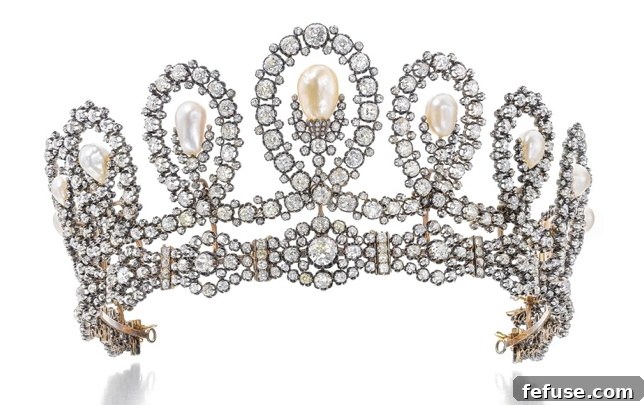
The Royal Legacy: Maria Vittoria’s Historic Pearl and Diamond Tiara Shines Bright at Sotheby’s Geneva
In a momentous event for the world of historic jewelry and royal artifacts, a magnificent pearl and diamond tiara, once gracing the head of Queen Maria Vittoria of Spain, achieved an impressive $1.6 million at Sotheby’s Geneva. This isn’t merely the sale of a stunning piece of jewelry; it’s the latest chapter in the compelling saga of a regal heirloom, a tangible link to 19th-century European monarchy, and a testament to exquisite craftsmanship.
A Gift of Love and Duty: The Tiara’s Royal Provenance
The tiara’s journey began in 1867, not as a symbol of power, but as a heartfelt wedding gift. It was bestowed upon Maria Vittoria dal Pozzo by her father, Carlo Emanuele dal Pozzo, 5th Prince of Cisterna, on the occasion of her marriage to Amedeo of Savoy, Duke of Aosta. This union was more than a personal alliance; it was a significant political event. Amedeo, a member of the illustrious House of Savoy, would later ascend to the Spanish throne as King Amadeo I, reigning from 1870 until his abdication in 1873. With his accession, Maria Vittoria, a noblewoman of considerable charm and intelligence, became Queen Maria Vittoria of Spain.
Her tenure as queen was brief but impactful. She died tragically young, at just 29 years old, only nine years after receiving this spectacular tiara. Her early demise left a profound mark on her family and the Spanish court, further imbuing the tiara with a sense of historical poignancy. The tiara thus serves as a beautiful, glittering reminder of a queen whose reign, though short, was marked by grace and a sincere commitment to her adopted nation. Its presence at Sotheby’s was a rare opportunity to own a piece directly connected to such a distinct and often tumultuous period of European history.
Crafted by Masters: The Artistry of Musy Padre e Figli
The creation of this exceptional tiara is widely attributed to Musy Padre e Figli, a name synonymous with unparalleled quality and artistic excellence in the realm of high jewelry. Based in Turin, Italy, Musy Padre e Figli held the prestigious title of court jeweler, serving the House of Savoy, a royal dynasty with deep roots in Italy and a significant influence across Europe. This firm, among the oldest goldsmiths on the continent, was renowned for its meticulous attention to detail, innovative designs, and the use of the finest precious materials.
Their expertise is brilliantly showcased in the tiara’s design. It features 11 stunning drop-shaped natural pearls, each a unique marvel formed by nature, celebrated for their iridescent luster and timeless elegance. These pearls are complemented by approximately 150 to 170 carats of diamonds, cut in various shapes including cushion-shaped, circular, and single-cut. The diamonds, typically exhibiting a J-K color with a slight yellowish tint, and SI-I clarity, shimmer with a soft, captivating brilliance, characteristic of antique jewels. The combination of natural pearls and historic diamond cuts creates a harmonious balance, reflecting the aesthetic sensibilities of the mid-19th century, a period often celebrated for its romantic and elaborate jewelry designs. The tiara is not just a collection of precious stones; it is a sculpted piece of art, a testament to the master jewelers who transformed raw materials into a symbol of royal splendor.
The Thrill of the Auction: Sotheby’s “Magnificent Jewels and Noble Jewels”
The sale of the tiara took place during Sotheby’s highly anticipated “Magnificent Jewels and Noble Jewels” auction in Geneva. These specialized sales are renowned globally for presenting some of the most extraordinary and historically significant jewels to collectors and connoisseurs worldwide. The pre-sale estimate for the tiara was set between $1 million and $1.5 million, a valuation that underscored its historical importance, royal provenance, and inherent material value. The final hammer price of $1.6 million exceeded the high estimate, signaling robust interest and competitive bidding, a common occurrence when pieces of such rarity and royal connection come to market.
Sotheby’s, with its centuries-long history of expertise in fine art and luxury goods, plays a crucial role in bringing such treasures to a global audience. Their rigorous authentication process and detailed cataloging provide buyers with confidence, while their marketing efforts generate significant international excitement. The “Magnificent Jewels and Noble Jewels” category, in particular, attracts an elite clientele fascinated by stories of royalty, romance, and unparalleled craftsmanship. The success of the tiara’s sale highlights the enduring allure of jewels with a demonstrable history, especially those tied to European royal families. Such auctions are not merely commercial transactions; they are cultural events, offering a rare glimpse into the opulence and narratives of bygone eras.
Beyond Adornment: The Tiara as a Historical Artifact
While the aesthetic beauty of the Maria Vittoria tiara is undeniable, its significance extends far beyond its sparkling appearance. It stands as a vital historical artifact, offering insights into the political marriages, social customs, and artistic tastes of the 19th century. Royal jewels, by their very nature, are imbued with the stories of those who wore them. They witness pivotal historical moments, from coronations and state dinners to personal celebrations and periods of turmoil. This tiara, having graced the head of a Queen of Spain, carries the weight of such history within its precious metals and gemstones.
The tiara remained in the possession of the House of Savoy for generations, a silent guardian of family heritage and tradition. Its eventual appearance at auction marks a transition from private family heirloom to an item of public fascination and a valuable commodity on the international market. This trajectory is common for many royal jewels as families adapt to modern times, and new generations make decisions about their inheritance. Yet, even in a new collection, the tiara retains its original identity as a symbol of Maria Vittoria’s brief but memorable queenship, her marriage, and the political landscape that elevated her husband to an unexpected throne.
The Enduring Allure of Natural Pearls and Royal Provenance
The exceptionally high value achieved by this tiara can be attributed to several key factors, chief among them the presence of natural pearls and its impeccable royal provenance. Natural pearls, unlike their cultured counterparts, are formed organically without human intervention, making them exceedingly rare and highly prized. Their unique luster and varied shapes have captivated humanity for millennia, and the demand for antique natural pearl jewelry remains robust among discerning collectors. The 11 drop-shaped pearls on the tiara are not just beautiful; they are a testament to nature’s artistry and a significant contributor to the piece’s rarity.
Furthermore, the connection to the Spanish royal family, specifically Queen Maria Vittoria and King Amadeo I, elevates the tiara from a beautiful piece of jewelry to a historical treasure. Provenance, or the documented history of ownership, significantly impacts the value of antique and rare items. Royal provenance adds an unparalleled layer of prestige, connecting the object directly to figures who shaped history. Collectors are often willing to pay a premium for items that have a direct link to royalty, not only for their intrinsic value but also for the intangible historical narrative they carry. This blend of rare natural materials, master craftsmanship, and undeniable royal lineage ensured the tiara’s status as a highly coveted item in the global auction market.
Maria Vittoria: A Queen of Compassion and Resilience
Delving deeper into Maria Vittoria’s life reveals a woman of considerable character. Born into a noble Italian family, her marriage to Amedeo was politically advantageous for the House of Savoy. When her husband was elected King of Spain, a nation then wracked by political instability and republican sentiment, Maria Vittoria faced immense challenges. She embraced her role as queen consort with dignity and compassion, despite the often hostile environment of the Spanish court and public. She was known for her philanthropic efforts, particularly in education and healthcare, establishing hospitals and schools that benefited the less fortunate in Spain.
Her gentle nature and dedication to charitable causes earned her affection from some segments of the Spanish population, contrasting sharply with the political turmoil surrounding her husband’s reign. Her premature death from tuberculosis at the age of 29 was a great loss, not just for her family, but for those whose lives she had touched through her humanitarian work. The tiara, a symbol of her wedding and brief period as queen, serves as a poignant reminder of a life dedicated to duty and compassion, cut short too soon.
Amadeo I: The King Who Couldn’t Stay
King Amadeo I’s reign in Spain was an exercise in political futility, despite his noble intentions. He was chosen by the Spanish Cortes (parliament) to rule following the Glorious Revolution of 1868 and the abdication of Isabella II. As a foreign monarch with little understanding of the complex and factionalized Spanish politics, he struggled immensely. His reign was plagued by Carlist uprisings, republican revolts, and a lack of support from the established Spanish aristocracy.
He famously declared Spain to be an “ungovernable” country. Frustrated by the constant political infighting, the endless coups, and the assassination of his prime minister, General Juan Prim, who had been his strongest supporter, Amadeo I ultimately abdicated in 1873. He returned to Italy, relinquishing a crown he had never truly desired, but had accepted out of a sense of duty. The tiara, a token of the marriage that led him to Spain, silently bore witness to these turbulent years, embodying the aspirations and ultimate disappointments of a well-meaning monarch thrust into an impossible situation.
Conclusion: A Tiara’s Lasting Legacy
The sale of Queen Maria Vittoria’s pearl and diamond tiara at Sotheby’s Geneva is far more than a transactional event; it is a celebration of history, artistry, and the enduring allure of royal provenance. From its beginnings as a cherished wedding gift to a queen whose life was tragically cut short, to its journey through generations of a noble family, this tiara encapsulates a rich narrative of European royalty.
It stands as a remarkable example of Musy Padre e Figli’s master craftsmanship and a rare collection of natural pearls and antique diamonds. Its journey from a private royal collection to the global auction stage underscores the timeless appeal and significant market value of such historic jewels. As this magnificent piece finds its new custodian, its legacy as a symbol of love, duty, and a fleeting moment in Spanish royal history will undoubtedly continue to captivate and inspire, reminding us of the profound stories that can be held within the sparkling embrace of a truly extraordinary tiara.