
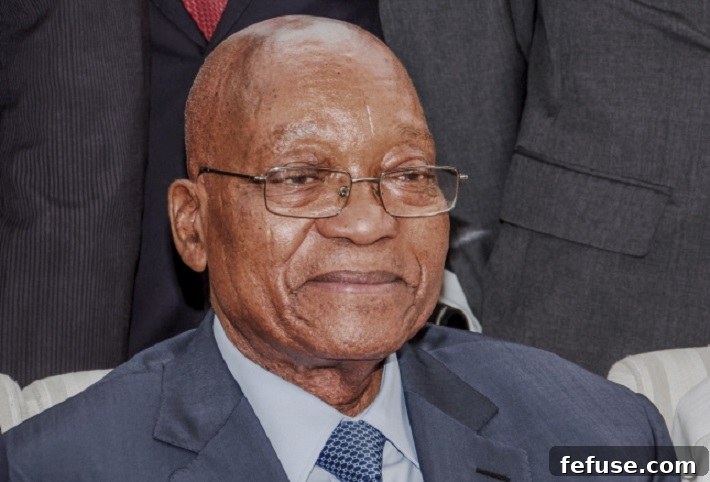
Jacob Zuma Ordered to Repay Controversial Legal Donation from Diamond Dealer Louis Liebenberg
Former South African President Jacob Zuma finds himself embroiled in yet another significant legal and financial challenge, as he has been explicitly ordered to repay a substantial donation made by prominent diamond dealer Louis Liebenberg. This ruling casts a fresh spotlight on the intricate funding mechanisms behind Zuma’s numerous legal battles and raises questions about financial transparency in high-profile political figures’ affairs. The directive stems from an insolvency inquiry related to Liebenberg’s business dealings, marking a pivotal moment in the ongoing saga surrounding the former president.
The Repayment Order and its Financial Implications
The order mandates Jacob Zuma to return nearly $170,000 (equivalent to R3.2 million) that Louis Liebenberg provided. This significant sum was specifically earmarked to cover the legal expenses for Zuma’s private prosecutions against several prominent individuals: journalist Karyn Maughan, state advocate Billy Downer, and even the current President, Cyril Ramaphosa. The funds were disbursed by Liebenberg to support Zuma in these cases, which were initiated following the alleged leakage of confidential medical records pertaining to the former president. The ruling, reported by the business news website Fin24, emanated from an insolvency inquiry, which concluded that “money dished out liberally by Mr Liebenberg” must be recuperated, directly impacting Zuma’s legal war chest.
This development comes at a time when Zuma’s financial resources for his myriad legal challenges are under constant scrutiny. For years, the former president has relied on a combination of state funds (which were later contested and ordered to be repaid), private donations, and public contributions to sustain his prolonged engagements with the justice system. The current order to repay Liebenberg’s donation highlights the precarious nature of such private funding and underscores the legal system’s increasing focus on the origins and accountability of money used in high-stakes litigation, particularly involving public figures.
Context: Zuma’s Private Prosecutions and Alleged Medical Leak
The donation in question was explicitly channeled towards funding Zuma’s contentious private prosecutions. These legal actions target individuals Zuma alleges were complicit in or benefited from the leakage of his confidential medical records. The case against Karyn Maughan, a seasoned journalist, and Billy Downer, a veteran state prosecutor, has drawn considerable attention for its implications for media freedom and the integrity of the prosecutorial system. Zuma contends that the release of his medical information constituted a breach of privacy, an accusation that has fueled intense legal sparring and public debate.
The inclusion of current President Cyril Ramaphosa as a target in one of Zuma’s private prosecutions further complicates the political landscape. While the specific nature of Ramaphosa’s alleged involvement in the medical leak has been less clearly articulated than the claims against Maughan and Downer, it signifies Zuma’s broader strategy of using legal avenues to challenge his political adversaries. These private prosecutions, often seen by critics as a form of “lawfare,” have placed immense strain on the individuals involved and have been widely viewed as an attempt by Zuma to divert attention from his own legal woes and to discredit those perceived as opposing him.
Understanding Private Prosecutions in South Africa
In South African law, private prosecutions allow an individual to initiate criminal proceedings against another party when the National Prosecuting Authority (NPA) declines to prosecute. This mechanism is designed to be a safeguard, ensuring that justice can still be pursued even if the state opts not to act. However, in high-profile cases like Zuma’s, questions often arise regarding the motive behind such actions—whether they are genuine attempts to seek justice or tactical maneuvers to exert pressure and settle political scores. The substantial legal costs associated with private prosecutions make them accessible primarily to individuals with significant financial backing, making donations like Liebenberg’s crucial.
Jacob Zuma’s Enduring Legal Saga: A Brief Overview
Jacob Zuma, aged 81, has been a central figure in South African politics for decades, but his post-presidency years have been largely defined by an unrelenting series of legal battles. These range from long-standing corruption allegations related to the 1990s arms deal to more recent charges stemming from the State Capture Commission of Inquiry (Zondo Commission).
The 2021 Contempt of Court Sentence and Aftermath
A particularly tumultuous period occurred in June 2021 when Zuma was sentenced to 15 months in jail for refusing to testify about corruption during his term in office before the Zondo Commission. This unprecedented move — jailing a former head of state for contempt of court — triggered widespread unrest. His incarceration ignited deadly riots, predominantly in his home province of KwaZulu-Natal and parts of Gauteng. These riots resulted in over 300 deaths, billions of rand in economic damage, and significantly destabilized the nation, underscoring the deep political and social divisions that continue to plague South Africa. The violence served as a stark reminder of Zuma’s enduring influence and the fervent loyalty he commands among a segment of the population.
Zuma was subsequently released after just two months on medical parole, citing an undisclosed medical condition. This decision by the then-head of correctional services, Arthur Fraser, proved highly controversial. Critics argued that the parole was politically motivated and lacked transparency, sparking legal challenges and further eroding public trust in state institutions. The secrecy surrounding his condition and the swiftness of his release contrasted sharply with the initial court order, fueling perceptions of selective justice and preferential treatment for the politically powerful.
Louis Liebenberg and the Tariomix Diamond Company
The individual at the center of this donation, Louis Liebenberg, is a prominent figure in the diamond industry, known as the founder and co-director of the Tariomix diamond company. Liebenberg’s business empire, however, has recently faced its own significant challenges. In February, Tariomix was placed into provisional liquidation following a barrage of complaints from clients. Provisional liquidation is a serious legal step, indicating that a company is temporarily being wound up due to its inability to pay its debts. This process typically involves an insolvency inquiry, which aims to assess the company’s financial state and determine how its assets should be distributed to creditors.
The complaints against Tariomix reportedly centered on allegations of financial mismanagement and unfulfilled obligations to clients, casting a shadow over Liebenberg’s business practices. It is within the context of this insolvency inquiry that the decision was made regarding the repayment of funds “dished out liberally” by Liebenberg, directly affecting the donation made to Jacob Zuma. The inquiry’s findings suggest a scrutiny of all financial outflows from Liebenberg, ensuring that creditors receive their due as the company navigates its liquidation process. This intertwining of personal donations with corporate insolvency adds another layer of complexity to an already intricate legal and political narrative.
Broader Implications for Political Funding and Accountability
This order for Jacob Zuma to repay a significant legal donation carries broader implications for the landscape of political funding and accountability in South Africa. It underscores the increasing demand for transparency regarding how public figures, especially those facing serious legal charges, finance their defense. The ruling could set a precedent for greater scrutiny of private donations made to politicians, particularly when the donors themselves are facing financial distress or legal challenges.
For Zuma, this financial setback means a potential recalculation of his ongoing legal strategy. With numerous cases still pending and the considerable costs associated with high-level litigation, the loss of R3.2 million from his legal fund will undoubtedly necessitate alternative arrangements. It reinforces the notion that even powerful political figures are not entirely immune to the intricacies of financial regulations and insolvency laws, especially when their benefactors come under the legal microscope.
Ultimately, this development serves as a powerful reminder of the complex interplay between law, politics, and finance in modern South Africa. It highlights the persistent efforts to ensure accountability, not only for public officials but also for those who fund their legal battles. As the country continues to grapple with issues of corruption and governance, every such ruling contributes to shaping the future standards of transparency and ethical conduct within its political and economic spheres.