
India’s Gold Market Navigates Challenges: A Deep Dive into 2022 Trends and 2023 Outlook
India, a nation with a profound cultural and economic affinity for gold, experienced a dynamic year in its gold market in 2022. While overall gold demand saw a slight dip, the sector demonstrated remarkable resilience in the face of escalating prices, fluctuating sentiment, and evolving economic landscapes. According to the World Gold Council’s (WGC) latest Gold Demand Trends report, the Indian gold market navigated various headwinds, showcasing its inherent strength and the enduring appeal of the precious metal across the subcontinent.
Understanding Jewellery Demand in 2022: Resilience Amidst High Prices
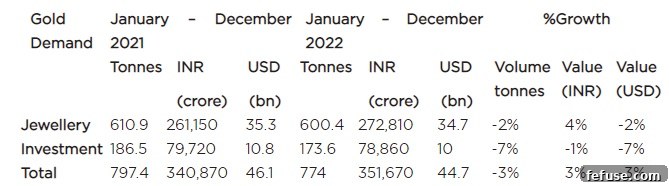
Jewellery demand, a cornerstone of India’s gold consumption, exhibited a nuanced performance in 2022. The total jewellery demand for the year registered a marginal decrease of 2%, settling at 600.4 tonnes compared to 610.9 tonnes in 2021. This modest decline in volume, however, tells only half the story. In value terms, Indian gold jewellery demand saw a healthy increase of 4%, reaching ₹272,810 crores in 2022, up from ₹261,150 crores in the preceding year. This divergence between tonnage and value growth primarily reflects the significant rise in domestic gold prices throughout the year, indicating that consumers were spending more rupees to acquire a slightly smaller quantity of gold.
The fourth quarter of 2022 played a crucial role in shaping these annual figures. While demand in Q4 2022 was down by 17% year-on-year to 219.7 tonnes (from 265 tonnes in Q4 2021), it is essential to contextualize this against the backdrop of an “unprecedented high level” achieved in Q4 2021. Despite this comparative decline, the 220 tonnes demanded in Q4 2022 represents the fourth-highest quarterly demand since 2000, signifying a robust resurgence of consumer interest in gold. This performance even surpassed pre-pandemic levels, potentially setting a new benchmark for demand in a high-price environment post-demonetisation, as highlighted by Somasundaram PR, Regional CEO, India, World Gold Council.
The resilience of jewellery demand, even with domestic gold prices reaching lifetime highs, underscores the deep-rooted cultural importance of gold in Indian households. Gold jewellery is not merely an adornment but also a traditional store of wealth, a critical component of bridal trousseaus, and an essential gift during auspicious occasions and festivals. Despite challenges such as duty hikes and general consumer sentiment being weaker at the start of the year, the market demonstrated remarkable stability, surprising many industry observers.
Investment Demand: A Shift in Focus
India’s gold investment demand also experienced a downturn in 2022, though less pronounced than the jewellery sector’s volume dip. Total investment demand for the year was down by 7%, registering 173.6 tonnes compared to 186.5 tonnes in 2021. In value terms, the decline was marginal, just 1%, with demand valued at ₹78,860 crores, down from ₹79,720 crores in 2021. This again points to the impact of higher gold prices, which cushioned the value drop despite a tonnage reduction.
The annual decline in investment demand was largely attributed to a significant 28% year-on-year drop in the fourth quarter. Although Q4 2022 saw a healthy investment demand of 56 tonnes, it couldn’t match the exceptionally strong performance of Q4 2021, which recorded 79 tonnes. Mr. Somasundaram noted that while festivities at the beginning of Q4 initially boosted investment demand, consumer attention progressively shifted towards gold jewellery with the onset of the wedding season. This trend suggests a prioritization of ceremonial and celebratory purchases over pure investment vehicles when household budgets are strained or choices need to be made.
Investment in gold in India typically takes various forms, including gold bars, coins, and increasingly, digital gold, Gold Exchange Traded Funds (ETFs), and Sovereign Gold Bonds (SGBs). The slight retreat in physical investment demand could also be attributed to investors seeking alternative avenues or perhaps waiting for price corrections, especially given the rapid appreciation of gold prices during the year. The higher domestic gold price, while benefiting sellers, can also act as a deterrent for new buyers entering the investment segment.
Gold Imports and Recycling: Supply Side Dynamics
On the supply side, India’s total gold imports in 2022 witnessed a substantial decline of 27%, settling at 673.3 tonnes compared to 924.6 tonnes in 2021. This significant reduction in imports reflects several factors, including the moderation in overall demand, the impact of import duties, and perhaps a strategic reduction in inventory by traders anticipating price volatility or policy changes. Lower imports can influence domestic supply dynamics and market liquidity, but the increasing role of recycled gold helped balance the market.
In contrast to imports, gold recycling in India saw a robust increase of 30% in 2022, reaching 97.6 tonnes compared to 75.2 tonnes in 2021. This surge in recycling activity is a direct response to the higher rupee-denominated gold price, which makes selling existing gold holdings more lucrative for consumers. In Q4 specifically, recycling increased by nearly 40% year-on-year and about 6% quarter-on-quarter. Indian households often view their gold holdings as a financial reserve, and when prices are high, they are more inclined to monetize their old gold, either to fund new purchases (often trading in old gold for new jewellery) or to meet other financial needs. This growing trend in recycling underscores gold’s role as a liquid asset in the Indian economy and its ability to act as a self-correcting mechanism in the supply chain.
Reserve Bank of India’s Gold Strategy
Beyond consumer and investment demand, the Reserve Bank of India (RBI) also plays a significant role in the country’s gold market through its reserve management. In 2022, the RBI added 33.5 tonnes of gold to its reserves. While this represents a considerable accumulation, it was 57% lower than its purchases in 2021, when it acquired 77.5 tonnes. The RBI’s gold purchasing decisions are influenced by various macro-economic factors, including currency diversification, global economic stability, and inflation hedging. A moderation in central bank purchases can reflect a broader shift in monetary policy or a response to global market conditions. Nevertheless, the continued accumulation highlights gold’s ongoing importance as a strategic reserve asset for the nation.
Overall Gold Demand Trends and Q4 Performance Specifics
Consolidating all segments, India’s overall gold demand for the full-year 2022 fell by 3% to 774 tonnes, compared to 797.3 tonnes in 2021, according to the WGC report. This relatively modest overall decline, especially when considering the significant price hikes and global economic uncertainties, truly speaks to the inherent strength of the Indian gold market.
Focusing on the fourth quarter, overall gold demand in India for Q4 2022 was 276.1 tonnes, marking a 20% decrease compared to Q4 2021 demand of 343.9 tonnes. In value terms, India’s Q4 2022 gold demand amounted to ₹125,910 crore, a 15% decrease from Q4 2021’s ₹148,780 crore. As previously noted, the jewellery segment within Q4 2022 saw demand fall by 17% to 219.7 tonnes, with its value decreasing by 13% to ₹100,180 crores. These Q4 figures, while showing a decline year-on-year, must be seen in the context of the exceptionally high base of Q4 2021, which was a period of strong post-pandemic recovery and pent-up demand. The underlying consumer interest and purchasing power remained robust, even at elevated price points.
Looking Ahead: The 2023 Outlook for India’s Gold Market
Peering into 2023, the World Gold Council offers a mixed but cautiously optimistic outlook for India’s gold market, particularly for the first quarter. Several positive factors are expected to bolster demand. A significantly higher number of auspicious wedding days in Q1 2023 (28 compared to just 11 in Q1 2022) is projected to be a strong catalyst for jewellery purchases. Furthermore, higher market prices for primary Kharif crops are expected to improve rural incomes, which historically translates into increased gold demand from India’s vast rural population.
However, the market is also anticipated to face several headwinds. The persistently high domestic gold prices will continue to be a challenging factor, potentially dampening volume growth. Additionally, high rural inflation could erode purchasing power, making gold less affordable for some segments of the population. Despite these challenges, Mr. Somasundaram PR expresses confidence that 2023 will be a favorable year for gold demand. He forecasts a long-term trajectory that could see demand reset to the range of 800-850 tonnes, primarily driven by India’s strong economic growth, which significantly influences consumer spending capacity and investment appetite.
The realization of this forecast, however, remains subject to a few critical short-term factors, most notably the performance of the monsoons, which are vital for agricultural output and rural prosperity, and a near-term revival of rural demand. Gold is expected to maintain its pivotal role in household savings and wealth preservation in India. Therefore, industry leaders advocate for continued reforms focused on building trust and integrating gold investments more seamlessly into the mainstream financial system. Initiatives such as exchange trading and robust hallmarking regulations are crucial for enhancing transparency and making gold a more accessible and trusted asset class for all Indians.
Conclusion: A Market of Enduring Appeal and Strategic Importance
In summary, 2022 was a year that tested the resilience of India’s gold market. While overall demand saw a slight contraction, particularly in tonnage terms, the underlying strength of consumer interest and the cultural significance of gold ensured that the market remained surprisingly robust. The increase in gold recycling underscored the adaptability of the supply chain and the practical role of gold as a financial asset. Looking ahead, the blend of traditional drivers like wedding seasons and rural income improvements, coupled with strong economic growth, positions India’s gold market for a potential rebound in 2023. However, stakeholders must remain vigilant about the impact of high prices and inflation. The continuous efforts towards transparency and mainstreaming gold investments will be key to unlocking the full potential of this enduring and strategically important market.