
The Art Institute of Chicago proudly presented a breathtaking exploration into the rich tapestry of Asian artistic heritage with the acclaimed exhibition, Vanishing Beauty: Asian Jewelry and Ritual Objects from the Barbara and David Kipper Collection. This expansive display, drawn from a promised gift to the esteemed museum, showcased over three hundred meticulously curated objects. Far from focusing solely on dominant cultural narratives, the exhibition thoughtfully spotlighted the artistic expressions and spiritual traditions of often marginalized and outlying Asian communities. Visitors embarked on an immersive journey across diverse religions and cultures, encountering a dazzling array of artifacts—from intricately woven textiles to resplendent, gem-encrusted jewels. These pieces once adorned monks, high-ranking officials, and laypeople from all social strata, each object telling a unique story of faith, status, and aesthetic devotion. The collection itself stood as a testament to the profound artistry and spiritual significance embedded within the adornments of various Asian societies, offering an unparalleled glimpse into the beauty that emerged from diverse human experiences and beliefs.
The Kipper Collection: A Visionary Pursuit of Cultural Preservation
At the heart of this extraordinary exhibition lies the singular vision of Barbara and David Kipper, whose expansive collection totals more than 1,300 items, a significant portion of which graced their Chicago home. Barbara Kipper, a distinguished professional photographer, revealed the discerning nature of her acquisition process, stating, “I turned down double the number of items I collected over the years.” Her philosophy for collecting was deeply personal and intuitive, driven by an immediate, “visceral and visual” connection to an object rather than a purely academic or intellectual assessment. As the Kippers traversed the globe, they bore witness to a profound transformation. The vibrant, traditional cultures Barbara had first encountered during her travels in Asia in the 1960s were rapidly evolving, facing the inexorable march of modernity and significant geopolitical shifts. Recognizing this pivotal moment, Mrs. Kipper embraced a more expansive and urgent mission: to meticulously acquire and preserve these irreplaceable artifacts, ensuring their survival and appreciation for future generations. This foresight imbued their collection with a profound purpose, transforming it from mere accumulation into a vital act of cultural stewardship.
The Enduring Legacy of the Silk Road: A Confluence of Materials and Meanings
The narrative of Asian jewelry and ritual objects is inextricably linked to the legendary Silk Road, the ancient network of trade routes that once connected the Mediterranean Sea with the far reaches of China and India. This colossal conduit facilitated not only the exchange of goods but also the vibrant intermingling of cultures, ideas, and artistic techniques. Along its bustling pathways, precious commodities such as exquisite gems, lustrous pearls, and shimmering glass beads journeyed eastward into the heart of Asia. Here, these coveted foreign materials were not merely adopted but masterfully integrated with locally sourced materials, giving rise to entirely new forms of spiritual and personal adornment. This fusion birthed objects that were rich in cultural synthesis, embodying a dialogue between distant lands and local traditions. The Silk Road thus served as a crucible where diverse influences converged, shaping the aesthetic and symbolic language of Asian jewelry into the multifaceted splendor seen throughout the Kipper Collection.
The Spiritual Resonance of Gemstones: From Turquoise to Carnelian
The exhibition profoundly illustrates how gemstones are far more than mere decorative elements in Asian cultures; they are imbued with deep spiritual significance and perceived as potent conduits of protection, healing, and fortune. The choice of stone often reflected not only aesthetic preference but also specific beliefs, societal status, and regional availability, creating a vibrant lexicon of symbolic adornment.
Turquoise: A Sacred Hue Across Asia
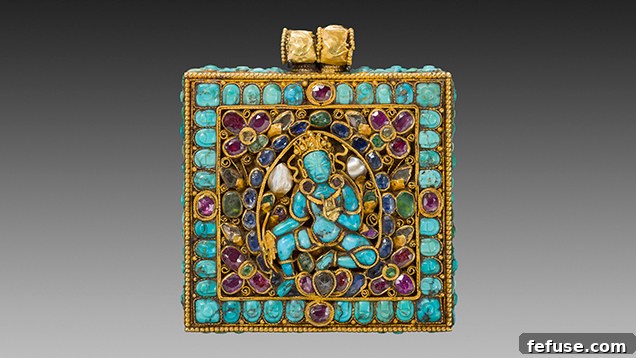
Among the myriad of precious stones, turquoise holds a particularly revered status throughout Asia, featuring prominently in both elaborate jewelry and sacred ritual objects. Its omnipresence is especially notable in Tibetan traditions, where approximately 70% of all gems used in jewelry are turquoise, underscoring its immense spiritual meaning within the region. Tibetan medicine, for instance, attributed a wide array of healing properties to turquoise, believing it could serve as an antidote for poisoning and even cure liver ailments. Further west, in the heart of Central Asia, turquoise symbolized chastity, purity, prosperity, piety, and courage, reflecting its multi-faceted importance in daily life and ceremonial practices. The natural variations in the stone were also significant. Turquoise quarried in Tibet and China typically exhibited serene shades of green and was widely incorporated into jewelry and ritual objects for the general populace. In contrast, the highly prized vivid blue variety originating from Iran (Persian turquoise) was reserved for more elaborate pieces, frequently adorning the highborn and powerful, symbolizing their elevated status and divine favor. The exquisite jantar showcased in Figure 2 offers a stunning example of such a distinction.
Beyond Turquoise: A Spectrum of Protective and Potent Stones
While turquoise features prominently, the collection also boasts a rich diversity of other precious and semi-precious stones, each with its own unique cultural resonance. Emeralds, sapphires, rubies, amber, coral, carnelian, and pearls are masterfully combined, creating breathtaking displays of color and texture. Intriguingly, colored glass and plastic beads also find their place among these precious materials. In their initial introduction from the West, these vibrant, reflective commodities were regarded as highly valuable and potent, not merely as substitutes for more expensive gems. Their inclusion speaks to the innovative spirit of Asian artisans and the importance placed on luminosity and perceived power. Across various cultures, a wide spectrum of healing, luck-bestowing, and protective qualities were ascribed to these diverse stones. For instance, among the Tajik and Uzbek peoples, coral was cherished for its believed ability to strengthen the eyes and heart, while also offering protection against forgetfulness and stomach ailments. Similarly, the Islamic tradition holds carnelian (also known as sard) in high esteem, with the Prophet Mohammad reportedly citing its protective qualities against poverty and its role in ensuring happiness. These beliefs highlight the profound integration of material culture with spiritual and everyday well-being throughout Asian societies.
Masterful Metalwork: Crafting Sacred Art
The underlying artistry of Asian jewelry extends profoundly to the metals themselves, which served not merely as settings for precious stones but as integral components imbued with symbolic weight and cultural significance. The choice of metal was as diverse as the cultures that produced these magnificent objects, often dictated by religious texts, long-standing traditions, and the social status of the wearer. From lustrous silver to the opulent gleam of gold, and the distinctive beauty of gilt copper and gilt iron, each metal carried its own set of associations and applications. The techniques employed by the master craftsmen were equally sophisticated and varied. Whether metals were meticulously cast into intricate forms, delicately chased with fine details, adorned with the ancient art of granulation—where tiny spheres of metal are fused onto a surface—or worked into relief through repoussé, each process required immense skill and dedication. These artisans were not simply skilled laborers; they were often seen as engaged in a holy endeavor, transforming raw materials into objects of spiritual power and profound beauty. Consequently, the most talented gold and silversmiths were highly revered figures, their expertise sought after by royalty, religious institutions, and the affluent, reflecting the intrinsic value placed on their meticulous craftsmanship and the sacred nature of their creations.
Amulets: Guardians of Spirit and Fortune
Among the most captivating categories within the Kipper Collection are the diverse forms of amulets, objects imbued with spiritual power and intended to protect, bless, or empower their wearers. These items provide an intimate window into the deeply personal spiritual practices prevalent across Asian societies.
Gaus: Portable Shrines and Protective Charms
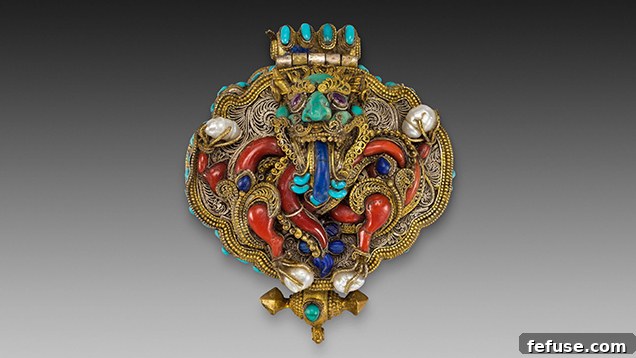
A particularly prominent and powerful assemblage in the exhibition comprises the exquisite amulet boxes known as gaus. Ranging from elegantly simple, diminutive designs to remarkably large and opulent masterpieces, gaus are ubiquitous across many, if not most, Asian cultures. Functioning as portable shrines, these sacred containers are typically worn around the neck, or meticulously sewn and attached to clothing or elaborate headwear. Their primary purpose is manifold: to actively ward off malevolent spirits and negative energies, to invoke benevolent or auspicious spirits, to honor esteemed teachers or revered deities, and to safely carry precious religious relics or sacred texts. The Kipper collection is exceptionally rich in Himalayan gaus, which showcase an impressive range of materials including gold, silver, iron, and copper, frequently adorned with a vibrant array of set gemstones. A prime example, visually represented in Figure 1, is a magnificent gau crafted from filigreed gilt silver. This particular piece is sumptuously set with luminous pearls, rich coral, deep lapis lazuli, and fiery rubies. It features the powerful and auspicious guardian monster Kīrtimukha, often referred to as the “Face of Glory,” whose intricately rendered claws delicately cradle natural pearls, symbolizing protection and divine power.
Jantars: Symbolic Adornments of Devotion
Distinct yet spiritually akin to the gau is another type of amulet case known as the jantar. The key difference lies in its construction: unlike the hollow gau designed to hold sacred contents, the jantar is a solid piece of devotional artistry. The striking jantar featured in Figure 2, for instance, depicts a serene Buddhist goddess and was conceived as a necklace, specifically designed for a Nepalese woman who held deep reverence for this particular deity. This exquisite piece demonstrates meticulous craftsmanship, incorporating intricately carved turquoise inlay alongside a vibrant selection of bezel-set rubies, corals, pearls, emeralds, and sapphires. Further enhancing its beauty are delicate granulation details, where tiny metallic beads form decorative patterns, and finely executed rope-edge embellishments, all contributing to an object that is both a stunning piece of jewelry and a profound statement of faith.
Headdresses and Crowns: Symbols of Status, Power, and Spirituality
The Barbara and David Kipper Collection offers an exceptional glimpse into the rich world of Asian headdresses and crowns, objects that transcended mere adornment to become powerful symbols of identity, status, spiritual authority, and ethnic affiliation. The Kippers were enthusiastic collectors of these magnificent pieces from across the vast continent, resulting in an assemblage that showcases an astonishing variety of materials, artistic styles, and symbolic imagery.
Cultural Contrasts in Headwear
A compelling aspect of the exhibition is the fascinating comparison presented between distinct forms of headwear. On one hand, visitors encounter the exquisitely refined Chinese Imperial headwear, often meticulously fashioned from the iridescent feathers of kingfishers, resulting in creations of vibrant turquoise and indigo hues that spoke of imperial elegance and prestige. In stark contrast, the collection features the dramatically ornate silver headdresses worn by various southwestern Chinese minorities. While both categories frequently share common imagery inspired by flora and fauna, their ultimate expression, the rarity of the materials employed, and the social stations of their wearers diverge significantly, underscoring the vast cultural tapestry within China itself.
Sacred Crowns of Oracles and Deities
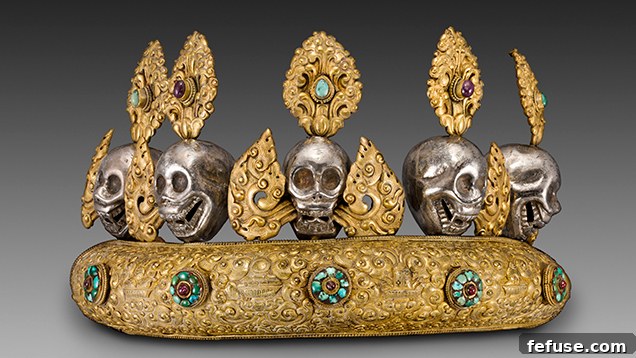
The collection also prominently features an array of sacred crowns, designed not only for the venerated Tibetan oracles and priests but also as elaborate adornments for statues of deities. These crowns, predominantly crafted from gilt copper, are masterworks of intricate chasing and engraving, reflecting the profound spiritual devotion embedded in their creation. A particularly striking example is a Tantric priest’s crown, which commands attention with its pigmented decoration set above a riotous, abstracted arrangement of skulls, symbols of impermanence and the transcendent. This crown is further enhanced by more fearsome skull motifs, their eye sockets dramatically emphasized by large, red glass inserts, creating a powerful visual impact. These elements are cleverly offset by the serene, decorative placement of flat turquoise ovals, creating a dynamic interplay of life, death, and spiritual wisdom. Another breathtaking piece is a repoussé gilt copper diadem, which elegantly incorporates floral elements featuring cabochon ruby centers surrounded by delicate turquoise petals, demonstrating a sophisticated fusion of natural beauty and profound symbolism. These crowns are not just objects; they are vital components of spiritual practice, embodying centuries of tradition and belief.
Everyday Elegance: Adornments Reflecting Life and Legend
Beyond the ceremonial grandeur of crowns and protective power of amulets, the Kipper Collection also beautifully illuminates the role of jewelry in everyday life and social customs across Asia. A diverse array of earrings, for instance, showcases the artistry and cultural narratives woven into personal adornment.
Indonesian Togé: Echoes of Mythology
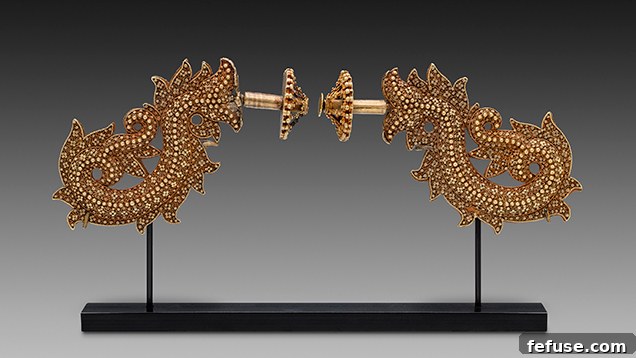
Among these captivating pieces, a pair of Indonesian togé earrings, highlighted in Figure 4, stands out for its intricate craftsmanship and rich symbolism. These remarkable ear studs are fashioned from finely granulated gold, a sophisticated metallurgical technique where tiny beads of gold are meticulously fused onto a surface. This particular granulation is employed to stunning effect, meticulously simulating the distinct snakeskin texture of a Naga. In Southeast Asian mythology, the Naga is a revered and powerful serpentine deity, often associated with water, rain, fertility, and the protection of treasures. Such earrings were not merely aesthetic; they carried profound cultural weight, often worn by young women of marriageable age as a reflection of their readiness for union and their connection to fertility symbols, embodying hope for a prosperous future. This specific example vividly demonstrates how deeply intertwined mythology and daily adornment were within these societies, with jewelry serving as a constant reminder of cultural narratives and spiritual beliefs.
An Immersive Experience: Bringing Asian Cultures to Life
The presentation of Vanishing Beauty was meticulously crafted to be both dazzling and profoundly informative, offering visitors an unforgettable journey through the vibrant cultures of Asia. The successful mounting of this exhibit was the culmination of more than a year of intensive labor and dedication by the Art Institute’s curatorial and conservation teams. This monumental effort involved the invaluable expertise of a professional gemologist, tasked with painstakingly confirming the identity and authenticity of hundreds of individual gems. Extensive conservation efforts were undertaken to stabilize, clean, and prepare each delicate artifact for display, ensuring their beauty could be appreciated without compromise. Furthermore, comprehensive photography documented every detail, preserving the objects visually for both scholarship and public access.
Beyond the physical display, the exhibition masterfully created an immersive context, designed to deepen the visitor’s understanding and enhance their experience. Thoughtfully integrated elements such as documentary film clips, evocative soundscapes that transported one to distant lands, and carefully selected vintage photographs all contributed to painting a vivid picture of the cultures from which these objects originated. Crucially, Mrs. Kipper’s personal photographs were also featured, offering a unique and authentic perspective by illustrating precisely how these intricate items were worn and utilized within their original cultural settings. These visual narratives provided an essential human context, bringing the “vanishing” aspects of these traditions to life. The curatorial team’s thoughtful arrangement of the collection into thematic groupings allowed for wonderful cross-cultural comparisons, transforming the exhibit into a rich, jeweled ethnographic travelogue. Ultimately, Vanishing Beauty promised to captivate a broad audience, offering something truly special for every visitor, but proving an absolute delight for connoisseurs and enthusiasts of gemstones.
A Lasting Legacy: The Future of the Kipper Collection
While the special exhibition of Vanishing Beauty concluded in August 2016, the profound impact and educational legacy of the Barbara and David Kipper Collection at the Art Institute of Chicago are designed to endure for many years to come. In a testament to the museum’s commitment to sharing this invaluable cultural treasury, a dedicated plan was established for the ongoing display of these extraordinary artifacts. Following the initial exhibition, a carefully selected rotation of fifty to sixty items from the Kipper Collection is scheduled to be on continuous view for an impressive period of ten to fifteen years. This ensures that a wider array of objects can be appreciated by future museum-goers, providing sustained access to these unique insights into Asian adornment and ritual. The initial rotation of this long-term display was planned to feature the particularly rich and diverse Himalayan material, underscoring the collection’s strength in this area and offering a deep dive into the artistic traditions of the region. This forward-thinking approach ensures that the Kipper Collection will continue to inspire, educate, and captivate visitors, cementing its place as a cornerstone of the Art Institute’s Asian art holdings for generations.
Visitor Information: Experience “Vanishing Beauty”
The special exhibition, Vanishing Beauty: Asian Jewelry and Ritual Objects from the Barbara and David Kipper Collection, was on view through Sunday, August 21, 2016. Located at the prestigious Art Institute of Chicago, situated at 111 Michigan Avenue in the heart of downtown Chicago, the museum offered ample opportunities for visitors to explore this magnificent collection. The Art Institute operated daily from 10:30 AM to 5:00 PM, with extended hours on Thursdays until 8:00 PM, allowing for a more leisurely evening visit. General admission for adults was priced at $25, while a reduced admission fee of $19 was available for seniors, students, and teenagers aged 14 to 17, ensuring broader accessibility to the cultural treasures within. Children under the age of 14 were welcomed free of charge, encouraging young minds to engage with and appreciate the diverse artistic heritage on display. While the temporary exhibition has concluded, parts of the invaluable Barbara and David Kipper Collection continue to be presented in rotating displays within the museum, inviting ongoing discovery.
News Source: gia.edu