
Shaping India’s Jewellery Future: Key Policy Dialogues for a US$25 Billion Export Vision
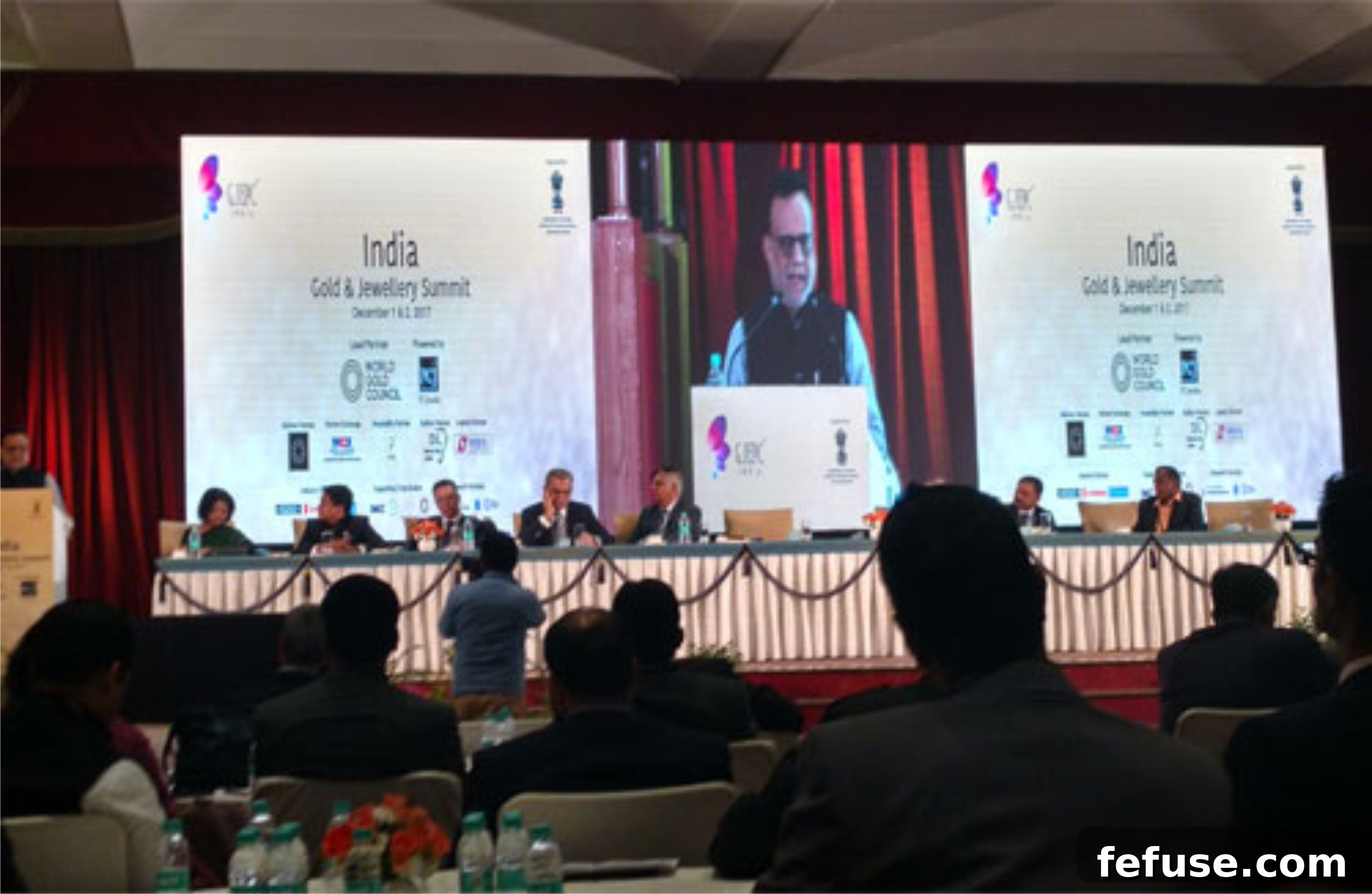
The Indian jewellery industry is on an ambitious trajectory, aiming for a staggering US$25 billion in exports by 2025. Following an initial day that set this bold vision, the second day of a crucial industry conclave pivoted to meticulously define the policy framework essential for achieving this target. This pivotal day witnessed an unprecedented level of open and constructive dialogue between government officials and industry leaders, fostering genuine optimism for the emergence of a progressive and supportive policy environment in the near future.
Highlighting the significance of these discussions, two key sessions were fronted by prominent government figures. Dr. Hasmukh Adhia, the Hon’ble Finance Secretary, led the discourse on a proposed comprehensive gold policy, a topic of immense importance to the sector. Concurrently, deliberations concerning the Prevention of Money Laundering Act (PMLA) were spearheaded by Mr. Balesh Kumar, Principal ADG & DG of GSTI. Further underscoring the collaborative spirit, panels for each session also featured other senior officials, including Mr. J.K. Dadoo, AS&FA, and Mr. Manoj Kumar Dwivedi, JS, both from the Ministry of Commerce, alongside Mr. D.K. Gupta, Special Director, Enforcement Directorate, ensuring a holistic governmental perspective.
Charting a Path for Gold: The Proposed Gold Policy
The session dedicated to India’s Gold Policy commenced with opening remarks from GJEPC Chairman Praveenshankar Pandya, who set a powerful context for the discussions. He acknowledged the transformative impact of recent bold policy measures, particularly demonetisation, which has successfully integrated nearly all transactions within the diamond industry into the formal banking sector. This achievement, he noted, was something the industry had struggled to realize over four decades, underscoring the potential for similar reforms in the gold segment.
Industry Demands for a Robust Gold Policy
Pandya emphasized that traditional informal transaction systems, such as the ‘angadia system’, were rapidly becoming obsolete, with even smaller industry players now conducting business through formal banking channels. He asserted that the gold jewellery segment stood to gain significantly from forward-looking and clearly defined policies. To this end, he outlined several critical areas requiring urgent policy modification. His proposals included the implementation of a Five-Year Plan designed to ensure a steady and predictable supply of gold for exporters, a measure vital for consistent production and global competitiveness. Furthermore, he advocated for the development of a transparent and unambiguous framework enabling companies to undertake job-work, which would streamline manufacturing processes and foster efficiency. To bolster India’s manufacturing prowess, Pandya called for strengthening the sector’s infrastructure through initiatives like dedicated jewellery parks and Common Facility Centres (CFCs), which offer shared access to advanced technology, training, and support services.
A central request made by Pandya to the Finance Secretary was a significant reduction in the import duty on gold, proposing a cut from the existing 10% to a more competitive 4-5%. He argued that the high duty inadvertently fuels the grey market, creating an unfair playing field for legitimate businesses. Additionally, he proposed establishing a mechanism that would allow Non-Resident Indians (NRIs) and members of the Indian diaspora to purchase jewellery within the country by directly paying in foreign exchange. Such transactions, he suggested, should be treated on par with exports and consequently be duty-free, attracting foreign currency and boosting legitimate trade.
Global Perspective and Economic Impact
Adding weight to the discussions, Aram Shishmanian, CEO of the World Gold Council, passionately advocated for a cogent and protective policy for gold. He urged the government to “guard and protect the eco-system around gold as a commodity” while simultaneously “ensuring it is safeguarded against unintended consequences of policy change.” Shishmanian articulated a vision for India to assume its rightful global position by cultivating a dynamic gold industry founded on principles of product integrity and price transparency. He optimistically projected that with the correct policy approach, the industry could rapidly mainstream within a few years, potentially doubling employment and significantly boosting both exports and domestic consumption.
Government’s Response and Future Outlook
Responding to the comprehensive presentations, Dr. Adhia offered three pivotal observations that set the tone for the government’s perspective. Firstly, he affirmed the paramount importance of the gem and jewellery industry to the government, recognizing its critical role as a large-scale generator of employment. Secondly, he highlighted the effectiveness of the two major economic reforms of the past year—demonetisation and GST—in curbing the parallel economy, asserting that these measures would ultimately benefit legitimate trade across all industries. Thirdly, Dr. Adhia reiterated the government’s unwavering commitment to fostering export growth, expressing anticipation for a future where jewellery exports surpass domestic demand, signifying a truly globalized industry.
Addressing specific concerns, Dr. Adhia clarified that a review of the import duty on gold would only be feasible once a clear and stable trend regarding GST revenue collections emerged. He also pointed out that the recent imposition of a 5% VAT on jewellery in Dubai was expected to naturally narrow the price differential between the two regions, potentially mitigating some of the issues associated with high import duties in India. Crucially, he assured the industry that the government would remain mindful of the jewellery sector’s significant contribution to employment generation when it undertakes any future review of the duty structure. While welcoming the suggestion for a dedicated gold policy and a Gold Board, Dr. Adhia indicated that the Ministry of Commerce would be the appropriate body to advance these discussions, underscoring the collaborative and departmental approach required.
Furthering the governmental input, Mr. Dadoo, from the Ministry of Commerce, emphasized that the industry’s initial step should be to articulate a clear and actionable strategy to realize its growth vision. He stressed that establishing proper infrastructure for training designers and ensuring small-scale units have access to modern technology were fundamental keys to unlocking this growth. Reassuring the industry, Mr. Dadoo stated, “The ministry will work closely with the industry to develop such institutions, and is also finalising plans to set up about 20 Common Facility Centres (CFCs) across the country,” signaling concrete steps towards infrastructure development and skill enhancement.
Navigating Regulation: PMLA and GST Implications
The session on the Prevention of Money Laundering Act (PMLA) and GST opened with a detailed presentation by Mr. Balesh Kumar, who elucidated that the PMLA legislation is an integral part of a broader global initiative aimed at combating the laundering of illicit money and its use in financing international crime and terrorism. Following this, Advocate Rohan Shah, a distinguished legal expert renowned for his advisory role to the diamond and jewellery industry on complex taxation and policy matters, articulated the industry’s perspective.
The Industry’s Compliance Challenges
Shah acknowledged the government’s desire for the industry to act as a partner in curbing illegal transactions. However, he conveyed that jewellers often perceive these measures as an additional layer of regulation, rather than a collaborative effort. He highlighted the deep-seated apprehension within the sector, stating, “This is an industry that carries the scars of the Gold Control regime and after many decades of non-regulation, has now faced a number of new regulatory measures in recent years including Excise, PMLA and GST.” This historical context, he argued, makes the industry particularly sensitive to new compliance burdens. Shah underscored the significant challenges faced by numerous small players, many of whom are keen to comply but lack even basic infrastructure like computers or reliable web connectivity, let alone the more sophisticated systems required for stringent regulatory adherence.
Shah further articulated the widespread fear among jewellers of unwarranted inspections and harassment. He noted that while such intentions might not originate from the highest levels of government, the actions of even a single dishonest officer on the ground can significantly damage industry perception and trust across the board. To address these concerns, Shah proposed that the government actively work towards building a consensus with the industry, a suggestion that received broad approval from all panellists.
Building Consensus for Practical Solutions
Echoing the need for a balanced approach, Mr. Manoj Dwivedi suggested that policy-making required carefully weighing both the desirability of an action and its practical implications. He expressed hope that the successful model adopted by the Ashok Lahiri committee, which had effectively forged a consensus on the contentious excise issue, could serve as a blueprint for navigating the complexities of PMLA and GST implementation within the jewellery sector. This approach would prioritize practical solutions that foster compliance without unduly burdening the industry.
A Vision for Standardisation: The Indian Gold Exchange
Another crucial session of the day centered on the imperative need for a Gold Exchange in India. A distinguished panel unanimously concluded that such an exchange was not merely beneficial but “extremely necessary.” The establishment of a regulated Gold Exchange would offer multi-faceted advantages. It would not only usher in a new era of standardization and significantly enhance price transparency across the domestic market but also crucially establish indigenous Indian price benchmarks for global trade, reducing reliance on international benchmarks and strengthening India’s position in the world gold market. While there was universal agreement on the fundamental necessity, panellists concurred that the immediate priority would be to define a clear and robust regulatory framework. Subsequent details, such as the specific types of products eligible for trading, and the intricate logistics of physical deliveries, could then be systematically developed. The discussions were enriched by valuable insights from panellists representing Dubai and Turkey, who shared the successful experiences and lessons learned from the gold exchanges established in their respective countries, providing practical guidance for India’s forthcoming venture.
Concluding the Dialogue: A Unified Step Forward
The two-day conclave culminated in an engaging Open House session, providing a platform for representatives from various regional associations to present their diverse viewpoints on the discussions and propose concrete follow-up actions. The dialogue was expertly guided by representatives from leading trade bodies including the Gem & Jewellery Export Promotion Council (GJEPC) and the All India Gem & Jewellery Domestic Council (GJF), ensuring that a wide spectrum of industry voices was heard and acknowledged. A prevailing sentiment emerging from the conference was that it had successfully injected a renewed sense of purpose and thrust into the industry, not only at the regional level but also across the entire national landscape. The collaborative spirit and candid discussions held during the conclave are expected to lay a solid foundation for the policy changes needed to propel the Indian jewellery sector towards its ambitious US$25 billion export target by 2025.