
Transforming India’s Gold Market: A Unified Vision for Economic Growth and Stability
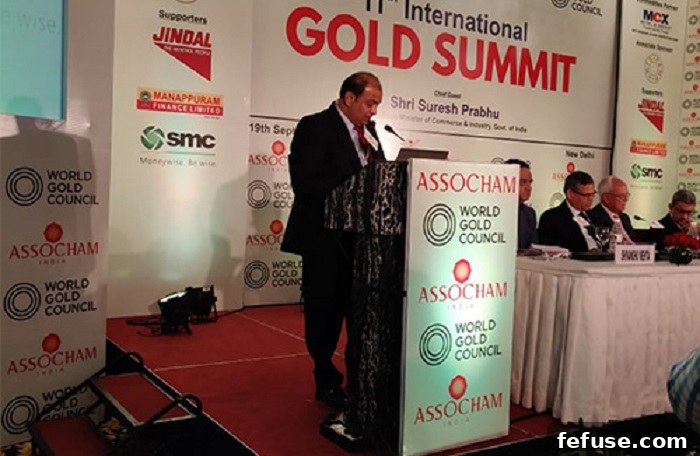
India, with its deep-rooted cultural affinity for gold, stands as one of the world’s largest consumers of the precious metal. Beyond its traditional and ceremonial significance, the gold industry plays a pivotal role in the nation’s economy, influencing trade balances, employment, and investment patterns. Recognizing this profound impact, the Gem & Jewellery Export Promotion Council (GJEPC) has consistently championed initiatives aimed at strengthening the sector and aligning its growth with national economic objectives. In a significant call to action at the 11th International Gold Summit, organized by ASSOCHAM in New Delhi, GJEPC Chairman Pramod Agrawal underscored the critical need for collaborative efforts among all stakeholders to address pressing national economic challenges, particularly the Current Account Deficit (CAD).
Addressing the Current Account Deficit: A Strategic Imperative for India’s Gold Industry
The Current Account Deficit (CAD) represents a nation’s shortfall in its foreign currency earnings compared to its outflows. For an import-dependent economy like India, a persistent and high CAD can lead to currency depreciation, inflation, and reduced foreign exchange reserves, ultimately impacting overall economic stability. Gold imports traditionally constitute a significant portion of India’s import bill, directly contributing to the CAD. It is within this critical economic landscape that GJEPC Chairman Pramod Agrawal’s appeal for collective action resonated deeply with industry leaders, policymakers, and experts gathered at the prestigious 11th International Gold Summit.
Agrawal’s address highlighted the strategic imperative for the gold industry to actively participate in mitigating this national economic challenge. While India’s love for gold is undeniable and centuries-old, the reliance on imports to meet this demand creates a fiscal burden. The Chairman’s call was not merely for introspection but for tangible, collaborative strategies that would reduce this reliance by fostering domestic gold mobilization and enhancing the value chain within the country. This proactive stance by the GJEPC leadership signals a clear commitment from the industry to move beyond purely commercial interests and contribute meaningfully to India’s macroeconomic health. The collective goal is to find innovative ways to meet domestic gold demand through indigenous resources, thereby easing the pressure on the nation’s foreign exchange reserves and strengthening its economic resilience.
Revitalizing India’s Gold Monetization Scheme: Tapping Into Dormant Wealth
One of the most promising avenues for reducing gold imports and enhancing domestic supply lies in harnessing India’s vast, largely untapped reserves of household and institutional gold. Estimates suggest that Indian households alone hold thousands of tonnes of idle gold, a significant portion of which could be brought into the formal economy. To this end, the Gold Monetization Scheme (GMS) was introduced with the ambitious goal of mobilizing this dormant wealth, channeling it into productive uses, and reducing the nation’s dependence on gold imports.
However, despite its noble intentions, the GMS has faced several challenges since its inception, leading to a sub-optimal mobilization of gold. Issues such as low awareness, procedural complexities, sentimental attachment to physical gold, a perceived lack of trust in the banking system for gold deposits, and delays in the issuance of maturity bonds have collectively hampered its widespread adoption. Addressing the distinguished audience at the summit, Chairman Agrawal passionately advocated for a comprehensive revamping of the Gold Monetization Scheme. This revamp, he suggested, must focus on increasing the scheme’s attractiveness and accessibility, simplifying deposit and redemption procedures, and enhancing the overall confidence of potential depositors.
Furthermore, a critical point raised by Agrawal was the government’s active engagement in resolving the delays in the release of pending bonds by nominated agencies and banks. These operational bottlenecks have been a significant deterrent for participants, eroding trust and hindering the scheme’s efficiency. The government’s commitment to streamlining these processes is a crucial step towards rebuilding confidence and making the GMS a more viable and attractive option for individuals and institutions alike. A successful revitalization of the GMS could unlock billions in economic value, transform idle assets into productive capital, bolster the formal financial system, and significantly reduce India’s CAD by mitigating the need for foreign gold imports.
Charting the Future: Niti Aayog’s Vision and GJEPC’s Pioneering Initiatives
The discussions at the summit delved deeper into the current landscape of India’s gold sector, acknowledging both its immense potential and the inherent challenges. A pivotal document guiding the future trajectory of the industry is the Niti Aayog Report on “Transforming India’s Gold Market.” This comprehensive report provides a strategic roadmap for policy reforms, market development, and infrastructure enhancements necessary to formalize, regulate, and boost the competitiveness of India’s gold sector on a global stage. Agrawal referenced this vital report, emphasizing its role in shaping policy discourse and guiding collaborative efforts.
In alignment with the Niti Aayog’s vision, the GJEPC has proactively undertaken several key initiatives designed to uplift and modernize the gold and jewellery sector. A cornerstone of these efforts is the establishment of Common Facility Centres (CFCs) across various jewellery clusters in the country. These CFCs provide small and medium-sized enterprises (SMEs) and individual artisans with access to state-of-the-art machinery, advanced technology, design expertise, and training facilities that would otherwise be prohibitively expensive. By democratizing access to modern tools and techniques, CFCs foster innovation, improve product quality, and enhance the overall efficiency of the jewellery manufacturing process, thereby strengthening regional clusters and empowering local talent.
Beyond infrastructure, the GJEPC is intensely focused on increasing and strengthening value addition within the sector. This involves a strategic shift from merely processing raw gold to creating high-value, design-led jewellery products that command better prices in both domestic and international markets. Emphasizing design innovation, skill enhancement, branding, and ethical sourcing, the drive for value addition aims to elevate India’s status from a gold consumer to a global leader in sophisticated jewellery manufacturing and design. This focus directly contributes to higher export revenues, more skilled employment opportunities, and a more robust and sustainable industry. Chairman Agrawal explicitly acknowledged the unwavering support of the Ministry of Commerce & Industry in these endeavors, highlighting the crucial synergy between industry vision and governmental backing that underpins these transformative initiatives.
The India Gold and Jewellery Summit: A Catalyst for Progress and Dialogue
Building on the momentum generated by ongoing reforms and strategic initiatives, the GJEPC, with the full backing of the Ministry of Commerce & Industry, is set to host the Second Edition of the India Gold and Jewellery Summit. Scheduled for November 2018, this summit serves as a premier platform for stakeholders across the entire gold value chain – from miners and refiners to manufacturers, retailers, policymakers, and financial institutions – to converge, deliberate, and forge a common path forward.
These high-profile summits are indispensable for fostering open dialogue, addressing industry-specific challenges, showcasing innovation, and formulating actionable strategies. The second edition’s organization underscores the growing recognition of the gold sector’s strategic importance and the commitment of both the industry and the government to continuous improvement and sustainable growth. It provides an invaluable opportunity to review progress, discuss emerging trends, deliberate on policy frameworks, and catalyze investments, ultimately propelling India’s gold and jewellery sector towards global leadership and greater economic contribution.
Conclusion: A Golden Future Built on Collaboration and Innovation
The collective efforts spearheaded by GJEPC Chairman Pramod Agrawal and supported by the Ministry of Commerce & Industry illustrate a clear and ambitious vision for India’s gold sector. By addressing critical national economic concerns like the Current Account Deficit, revitalizing schemes such as the Gold Monetization Scheme, and implementing strategic initiatives like Common Facility Centres and enhanced value addition, the industry is poised for transformative growth. The ongoing dialogue facilitated by platforms like the India Gold and Jewellery Summit ensures that this vision is continually refined and translated into concrete actions.
The path to a more robust, transparent, and globally competitive Indian gold market hinges on sustained collaboration, innovative policy frameworks, and the unwavering commitment of all stakeholders. Through these concerted efforts, India aims not only to solidify its position as a global leader in the gold and jewellery industry but also to ensure that this vital sector plays an increasingly significant role in the nation’s overall economic prosperity and stability, paving the way for a truly golden future.
News Source: gjepc.org