
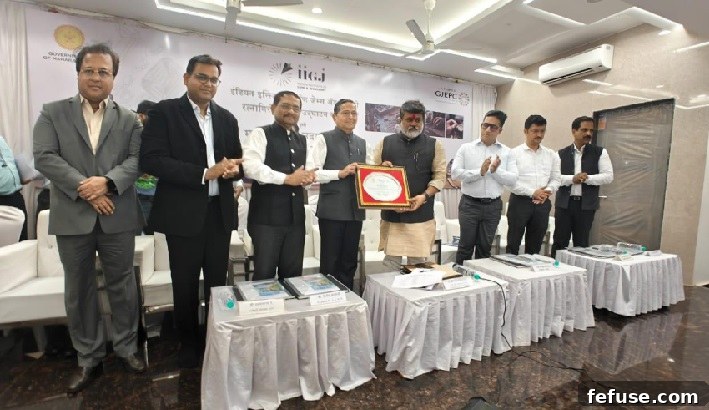
The Indian Institute of Gems & Jewellery (IIGJ) in Ratnagiri officially opened its doors on September 24th, marking a pivotal moment for skill development and economic empowerment in Maharashtra’s gem and jewellery sector. The grand inauguration ceremony was graced by an array of distinguished personalities, led by Shri Uday Samant, the esteemed Hon’ble Minister for Industries, Government of Maharashtra. His presence underscored the state government’s unwavering commitment to fostering growth and innovation within this crucial industry. Joining him were key figures instrumental in driving the sector forward, including Shri Kirit Bhansali, Vice Chairman of the Gem & Jewellery Export Promotion Council (GJEPC), whose vision has been central to this initiative. Also present were Shri M. Devender Singh, District Collector of Ratnagiri, Shri Kirthi Kiran Pujar, CEO of Zilla Parishad, Ratnagiri, Shri Sabyasachi Ray, Executive Director of GJEPC, Shri Siddhartha, COO of GJEPC, and Shri Debasish Biswas, CEO of IIGJ, among other notable attendees. This collective presence highlighted the collaborative spirit and strategic importance of the new training and skilling centre.
The establishment of the IIGJ Ratnagiri represents a monumental leap forward in the GJEPC’s enduring mission to provide comprehensive education and unparalleled skill development opportunities across India. Specifically, this new institution is poised to ensure that Maharashtra not only maintains but further solidifies its preeminent position at the vanguard of India’s thriving gem and jewellery industry. By equipping the local workforce with cutting-edge skills and industry-relevant knowledge, the IIGJ Ratnagiri is set to be a significant contributor to the region’s economic vitality and the broader national ambition for excellence in jewellery craftsmanship and design.
During the inauguration, Shri Uday Samant, the Minister of Industries for the Government of Maharashtra, delivered a compelling address that resonated deeply with the audience. He articulated a profound truth about the gem and jewellery industry, stating, “The gem and jewellery industry is far more than just luxury and aesthetics; it is a crucial economic engine that significantly contributes to a country’s economy.” This statement encapsulated the sector’s vital role in national development, employment generation, and foreign exchange earnings. Expressing his sincere gratitude to the GJEPC for pioneering the training and skilling centre in Ratnagiri, Minister Samant shared his optimistic outlook. “Although it started on a small scale,” he remarked, “I am optimistic that it will evolve into a major institute in the coming years.” He further emphasized the transformative potential of the centre for the region, asserting that “The youth of Ratnagiri and neighbouring districts will play a pivotal role in the growth of India’s gem and jewellery industry.” His words painted a vivid picture of a future where local talent, honed by world-class training, would propel India’s presence on the global stage, fostering both economic prosperity and individual empowerment.
Echoing the Minister’s sentiments, Shri Kirit Bhansali, Vice Chairman of the GJEPC, underscored the critical importance of a skilled workforce in sustaining the industry’s upward trajectory. “The growth and success of the gem and jewellery sector will heavily depend on skilled manpower,” he stated with conviction. Bhansali highlighted the strategic significance of institutions like IIGJ Ratnagiri and the wider network of IIGJs spread across India, recognizing them as indispensable pillars for future growth. He elaborated, “Institutes like IIGJ Ratnagiri and other IIGJs across India will play a crucial role in equipping our youth with the necessary skills to meet this rising demand and drive the industry’s future growth.” This perspective reinforces the GJEPC’s proactive approach to talent development, ensuring a steady supply of highly competent professionals ready to innovate and excel in an increasingly competitive global market. The vision is clear: to transform aspiring individuals into master craftspeople and designers, thereby securing the industry’s legacy and future.
Delving deeper into Maharashtra’s indispensable contribution, Shri Bhansali proudly affirmed the state’s dominant role in India’s gem and jewellery sector. “Maharashtra plays a pivotal role in India’s gem and jewellery sector, contributing 70% of India’s total gem and jewellery exports of USD 32 billion in FY 2023-24,” he revealed. This staggering figure not only highlights Maharashtra’s economic prowess but also its strategic importance as a global hub for jewellery manufacturing and trade. Bhansali further articulated his confidence in the industry’s projected growth, attributing it to strategic policy initiatives. “With initiatives like the India-UAE CEPA and other free trade agreements, the industry will see further growth in the coming years,” he predicted. These agreements are designed to reduce trade barriers, enhance market access, and ultimately bolster India’s export capabilities, solidifying its position as a preferred source for high-quality gems and jewellery worldwide.
The GJEPC’s strategy extends beyond simply boosting exports; it also encompasses robust domestic development. According to a comprehensive study conducted by the National Council of Applied Economic Research (NCAER), India is home to an impressive total of 390 gem and jewellery clusters. Significantly, Maharashtra leads the nation with 29 such clusters, which collectively employ approximately 5 lakh people. This concentration of specialized talent and infrastructure underscores the state’s inherent strengths. Bhansali elaborated on the ongoing efforts, stating, “Efforts are being made to further develop these clusters as export-oriented hubs.” This strategic focus aims to enhance productivity, foster innovation, and streamline export processes within these specialized zones, thereby maximizing their contribution to both national and global trade. Furthermore, the burgeoning domestic market presents a massive opportunity. “Domestically, the rapid expansion of over 3,000 jewellery retail stores across India in the next three years will create a tremendous demand for skilled talent,” he added. This expansion signals a robust consumer base and a growing need for trained professionals, from designers and manufacturers to sales and marketing specialists, all of whom will be crucial for catering to evolving consumer preferences and market trends.
To bolster manufacturing capabilities and ensure India remains at the forefront of global jewellery production, the GJEPC is actively pursuing several key initiatives. Among these, the development of the India Jewellery Park in Mumbai stands out as a flagship project, envisioned as a state-of-the-art facility that will bring together various facets of the industry under one roof, fostering synergy and efficiency. Additionally, the already established Mega Common Facility Centre (CFC) in Mumbai serves as a testament to the GJEPC’s commitment to providing shared resources and advanced infrastructure to manufacturers, thereby empowering small and medium-sized enterprises (SMEs) with access to modern technology and expertise. This facility is further enhanced by its team of “well-trained and skilled workers and designers,” who embody the pinnacle of craftsmanship and innovation. These strategic investments in infrastructure and human capital are designed to elevate the quality, design, and manufacturing standards of Indian jewellery, ensuring its competitiveness on the world stage.
The cumulative impact of these initiatives is projected to be transformational for Maharashtra. Shri Bhansali highlighted an ambitious yet achievable goal: “With these initiatives, GJEPC aims to generate around 2 lakh jobs in Maharashtra alone, empowering the local workforce and driving sustained growth in the jewellery industry.” This commitment to job creation is not merely about numbers; it represents a tangible effort to uplift communities, provide stable livelihoods, and foster economic inclusion. By investing in training, infrastructure, and market access, the GJEPC is cultivating an environment where talent can flourish, businesses can thrive, and the jewellery sector can continue to be a powerful engine of prosperity for the state and the nation.
Further elaborating on the Council’s unwavering commitment to India’s broader skilling agenda, Shri Kirit Bhansali eloquently connected the GJEPC’s efforts to the nation’s strategic objectives. He emphasized the government’s ambitious targets, noting, “With the 2024-25 budget setting a target to skill 20 lakh youths over the next five years, GJEPC remains aligned with the Hon’ble Prime Minister’s Shri Narendra Modi’s Skill India mission.” This alignment underscores the GJEPC’s role as a vital partner in national development, actively contributing to the vision of a skilled and empowered workforce. The Council facilitates this mission “by facilitating the industry with training and advanced technology,” ensuring that vocational education is both relevant and future-ready. As a tangible demonstration of this commitment, he proudly shared that “IIGJ Jaipur and IIGJ Udupi have commenced goldsmith training under the PM Vishwakarma scheme.” This scheme is specifically designed to support traditional artisans and craftspeople, providing them with modern tools and training to enhance their skills and economic prospects. Bhansali articulated the dual benefits of these initiatives: “This will not only help us to ensure sustainable growth of the industry but also achieve the export target of USD 75 billion by 2030.” The synergy between skill development, traditional crafts, and ambitious export goals forms the bedrock of India’s strategy for global leadership in the gem and jewellery sector.
The newly established IIGJ centre in Ratnagiri is poised to make a substantial and direct contribution towards these ambitious national goals. “Ratnagiri’s new IIGJ centre will contribute significantly towards this goal, training 350 students annually with specialised courses in jewellery design and manufacturing,” Bhansali confirmed. This annual intake signifies a consistent pipeline of skilled professionals, ready to invigorate the industry with fresh perspectives and contemporary techniques. The IIGJ Ratnagiri is meticulously designed to offer a diverse and industry-relevant curriculum, including specialized courses in critical areas such as metal setting, Computer-Aided Design (CAD) for jewellery, advanced filling and polishing techniques, and precise casting machine operation. By offering such a wide array of modern, industry-relevant skills, the centre ensures that its graduates are not only proficient in traditional craftsmanship but also adept at leveraging technological advancements, making them highly sought-after professionals in the dynamic global jewellery market. This comprehensive training approach bridges the gap between traditional artistry and modern manufacturing demands, creating truly versatile artisans.
The IIGJ Ratnagiri seamlessly integrates into an expansive and highly regarded network of existing IIGJ facilities. These facilities, expertly operated by the GJEPC, are strategically located across India, including prominent centers in Mumbai, Jaipur, and Delhi. Each of these institutions has consistently set benchmarks in jewellery education, leading the way in nurturing talent and fostering innovation within the sector. Complementing this core network, the Council has also established satellite training centers in other significant craft hubs, such as Varanasi and Udupi, further extending its reach and impact. The ongoing expansion of this network underscores the GJEPC’s commitment to decentralized skill development, ensuring that high-quality training is accessible to aspiring artisans across different regions of India. This holistic approach strengthens the entire ecosystem of jewellery education and production.
In a further demonstration of its commitment to nurturing regional talent and traditional craftsmanship, Shri Bhansali provided insightful updates on the GJEPC’s proactive initiatives aimed at supporting traditional jewellery clusters within Maharashtra. A prime example is the illustrious Hupari Cluster in Kolhapur, which has rightfully earned a Geographical Indication (GI) status for its exquisite and renowned silver jewellery. Recognizing the unique heritage and economic significance of this cluster, the GJEPC is actively extending its support. Furthermore, the Council is playing a crucial role in assisting the local organization in Hupari with the establishment of a Common Facility Centre (CFC). This CFC will serve as a shared resource hub, providing access to modern machinery, technology, and expertise, thereby enabling local artisans to enhance their production capabilities, maintain quality standards, and access wider markets, preserving their unique craft while embracing modern efficiencies.
Expanding its national footprint and commitment to skill development, the GJEPC took another momentous step on September 23rd. On this date, the Gem & Jewellery Export Promotion Council (GJEPC) and the North Eastern Handicrafts and Handlooms Development Corporation Limited (NEHHDC) formally signed a Memorandum of Understanding (MoU). This landmark agreement paves the way for the establishment of an Indian Institute of Gems & Jewellery (IIGJ) in Guwahati. This strategic move is profoundly significant, as it marks a dedicated effort towards empowering the talented gem and jewellery artisans and aspiring entrepreneurs nestled within India’s vibrant North East region. By bringing world-class training facilities closer to home, the Guwahati IIGJ will unlock immense potential, fostering local craftsmanship, stimulating entrepreneurship, and integrating the rich cultural heritage of the North East into the national and global gem and jewellery landscape, thereby creating sustainable livelihoods and contributing to regional economic growth. This comprehensive approach to skill development and cluster support across India truly showcases the GJEPC’s holistic vision for the industry’s future.