
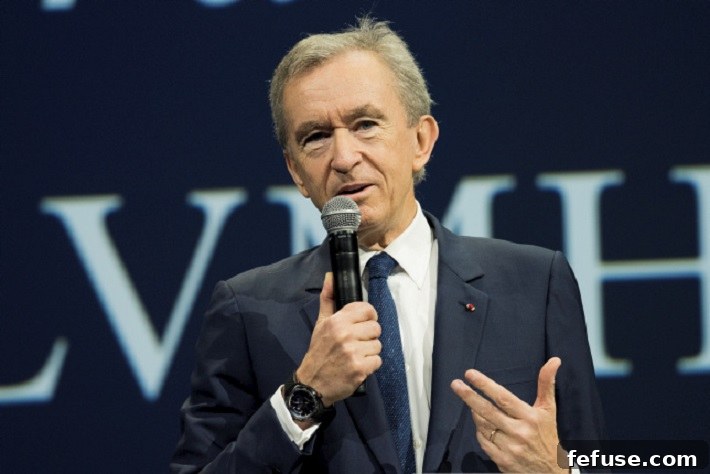
The luxury world is once again abuzz with fervent speculation following reports that Bernard Arnault, the visionary chairman and CEO of the formidable LVMH Moët Hennessy Louis Vuitton conglomerate, has acquired a personal stake in Swiss rival Richemont. This development has inevitably reignited whispers of a potential takeover bid, casting a spotlight on the future landscape of the global luxury market and the power dynamics at play between its titans.
Bernard Arnault, frequently dubbed “the wolf in cashmere” for his relentless and strategic acquisitions, commands an estimated net worth of $194 billion, according to Forbes. Bloomberg reports confirm his individual investment in Richemont, though the stake is currently considered too minor to warrant public disclosure in regulatory registers. Despite its modest size, the revelation has been enough to intensely refocus attention on Arnault’s long-standing interest in Richemont as a whole, and particularly its crown jewel, the iconic high-end jewelry brand Cartier.
Bernard Arnault: The Master Strategist of Luxury Acquisitions
Bernard Arnault’s track record speaks volumes about his ambition and strategic prowess. Under his leadership, LVMH has evolved into the world’s largest luxury group, boasting an unparalleled portfolio of over 75 distinguished maisons across fashion, jewelry, watches, wines & spirits, and selective retailing. His approach is characterized by a blend of audacious vision and patient, calculated execution. The acquisition of Tiffany & Co. in 2021 serves as a quintessential example of Arnault’s tenacity.
The pursuit of Tiffany & Co. was a saga marked by prolonged haggling, initial rejections, and even threats of legal action from both sides, spanning several tumultuous months. Ultimately, Arnault prevailed, securing the legendary American jeweler for a staggering $15.8 billion. This landmark deal significantly bolstered LVMH’s already formidable presence in the hard luxury sector, adding a globally recognized name synonymous with exceptional craftsmanship and timeless elegance. It was during the protracted “on-off-on again” period of uncertainty preceding the Tiffany purchase that initial rumors began to circulate within the industry that LVMH might set its sights on Richemont next, particularly eyeing its preeminent jewelry assets.
Richemont: A Unique Portfolio and a Prized Jewel
Compagnie Financière Richemont SA, headquartered in Bellevue, Switzerland, is a global leader in luxury goods with a distinct focus on high-end jewelry, watches, and fashion. Unlike LVMH’s broad diversification, Richemont’s core strength lies deeply rooted in its hard luxury divisions, making its jewelry and watch maisons particularly coveted. The group controls an impressive stable of 26 prestigious maisons, each with its own rich heritage and distinct identity. These include renowned names such as Chloé, Montblanc, IWC Schaffhausen, A. Lange & Söhne, Van Cleef & Arpels, Jaeger-LeCoultre, Panerai, Piaget, and Vacheron Constantin.
However, at the heart of Richemont’s unparalleled value and allure is Cartier. With a history stretching back to 1847, Cartier is not merely a jewelry brand; it is an institution. Its iconic designs – from the Tank watch to the Love bracelet and the Panthère collection – have adorned royalty, celebrities, and discerning connoisseurs for generations. Cartier’s global brand recognition, impeccable reputation, and consistent financial performance make it an exceptionally valuable asset. Integrating Cartier into the LVMH portfolio would not only dramatically increase LVMH’s dominance in the jewelry sector but would also solidify its undisputed leadership in the entire luxury goods industry.
The Resurgence of Takeover Talk: Why Now?
The recent news of Arnault’s personal stake, however small, breathes new life into the perennial speculation. A similar wave of rumors swept through the luxury sector in October 2020, as reported by the Swiss newspaper Finanz und Wirtschaft. At the time, the paper stated, “It’s still little more than a whisper. But in the luxury industry, there is whispered talk that Bernard Arnault wants to take over Swiss competitor Richemont. More specifically, he is said to be targeting Richemont’s industry-leading jewelry brand, Cartier.” This historical context underlines Arnault’s persistent fascination with Richemont’s assets, suggesting a long-term strategic interest that extends beyond mere casual observation.
The timing of the renewed speculation is also pertinent. The luxury market has shown remarkable resilience post-pandemic, with strong growth driven by robust demand from affluent consumers. This environment emboldens leading conglomerates like LVMH, which possess ample financial firepower, to pursue strategic acquisitions that further consolidate their market positions and enhance their brand portfolios. Furthermore, the trend of consolidation within the luxury sector continues unabated, as larger groups seek economies of scale, greater brand synergy, and enhanced global distribution networks to maintain competitive edges.
Johann Rupert’s Unwavering Stance and Richemont’s Defenses
Despite the constant buzz and LVMH’s well-known acquisitive nature, Johann Rupert, the charismatic and influential chairman of Richemont, has consistently maintained a firm stance: the company is not for sale. Rupert, whose family retains significant control over Richemont through a dual-class share structure, has repeatedly emphasized his commitment to the independence and long-term vision of the group’s maisons. This strong family control acts as a significant deterrent to any hostile takeover attempts, making an unsolicited bid considerably more challenging than a simple market transaction.
Richemont’s diversified yet concentrated portfolio also provides a measure of defense. While Cartier and Van Cleef & Arpels are undeniably its strongest assets, the group’s other maisons, particularly in high watchmaking, represent significant value and strategic importance. Any potential suitor would need to not only overcome Rupert’s resolute opposition but also navigate the complexities of integrating such a diverse and historically rich collection of brands, each with its unique culture and operational requirements.
The Stakes for the Global Luxury Market
A potential LVMH acquisition of Richemont, or even just Cartier, would send seismic waves through the entire global luxury market. It would undoubtedly reshape the competitive landscape, leaving fewer independent players and further concentrating power in the hands of a few mega-conglomerates. For LVMH, adding Cartier would solidify its position as the undisputed leader in high jewelry, arguably surpassing even its own formidable acquisitions like Tiffany.
Beyond the immediate financial implications, such a move would spark crucial discussions about brand identity, heritage preservation, and the balance between creative independence and corporate synergy. While LVMH is known for allowing its acquired brands a degree of autonomy, the sheer scale of integrating a powerhouse like Cartier would be a monumental undertaking, watched closely by analysts, consumers, and competitors alike.
For now, Bernard Arnault’s quiet stake in Richemont serves as a powerful reminder of his ceaseless ambition and the relentless pursuit of growth that defines LVMH. While Johann Rupert holds firm to his vision of an independent Richemont, the luxury world remains captivated, anticipating the next move in this high-stakes game of strategic chess. The question is not if the luxury landscape will continue to evolve, but rather who will ultimately shape its next chapter.