
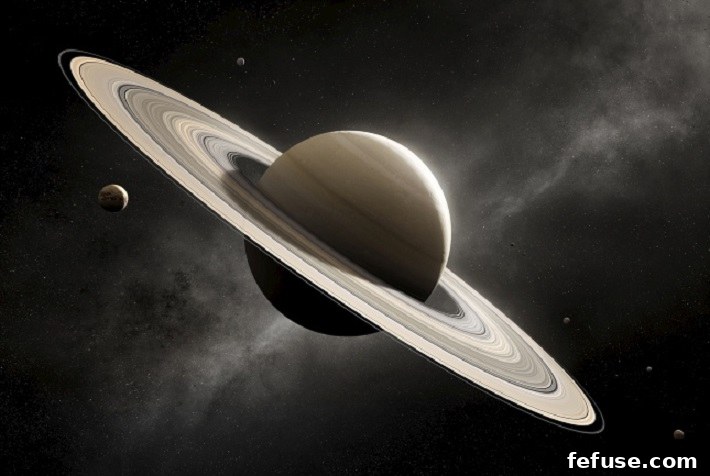
The Astounding Phenomenon of Diamond Rain on Saturn and Jupiter
Imagine a world where precious gems fall from the sky, not as rare geological finds but as an everyday meteorological event. This seemingly fantastical notion is, according to leading scientists, a startling reality on the gas giants of our solar system: Saturn and Jupiter. Far from the terrestrial understanding of rainfall, these colossal planets host an incredible phenomenon where vast quantities of diamonds literally rain down through their turbulent atmospheres, a testament to the universe’s boundless wonders and extreme conditions.
Unveiling the Cosmic Gem Factories
For years, the intricate compositions and dynamic processes within the atmospheres of gas giants have fascinated astronomers. The discovery of diamond precipitation on Saturn and Jupiter provides an exhilarating glimpse into these enigmatic worlds. Researchers, including Dr. Kevin Baines from the University of Wisconsin-Madison and NASA’s Jet Propulsion Laboratory, alongside Mona Delitsky of California Specialty Engineering, have meticulously analyzed the extreme conditions present within these planets. Their groundbreaking work suggests that these distant realms are not just giant balls of gas, but active chemical factories producing one of Earth’s most coveted substances on an astronomical scale.
The Science Behind the Sparkle: From Methane to Millions of Carats
The process begins high in the upper atmospheres of Saturn and Jupiter, where powerful lightning storms, far more intense and frequent than any seen on Earth, ignite the transformation. These immense electrical discharges strike methane, a hydrocarbon gas abundant in the atmospheres of both planets. The colossal energy from the lightning bolts breaks down the methane molecules, releasing carbon atoms.
Once liberated, these carbon atoms begin their descent through the planets’ dense, turbulent atmospheres. As they fall, they clump together, forming particles of soot – essentially, a primitive form of carbon. This soot then undergoes a remarkable metamorphosis driven by the increasingly extreme conditions it encounters. Dr. Baines explains, “As the soot falls, the pressure on it increases. And after about 1,000 miles it turns to graphite – the sheet-like form of carbon you find in pencils.”
The journey doesn’t end there. As the graphite continues its plunge into the deeper layers of the planets, the pressure intensifies to unimaginable levels, combined with escalating temperatures. Under these extraordinary forces, the graphite atoms are compressed and restructured into their most stable crystalline form: diamonds. These stable crystals then “hail down over a huge region,” particularly on Saturn, forming a continuous deluge of extraterrestrial gems.
A Deluge of Diamonds: Quantifying the Cosmic Downpour
The scale of this phenomenon is truly staggering. Scientists estimate that thousands of tonnes of diamonds are constantly being produced and raining down on these gas giants. Specifically, Dr. Baines estimates, “The bottom line is that 1,000 tonnes of diamonds a year are being created on Saturn.” To put this into perspective, global diamond production on Earth averages around 26,000 kilograms (26 tonnes) per year for gem-quality stones and about 100,000 tonnes for industrial use. Saturn alone is manufacturing diamonds at a rate that dwarfs Earth’s entire industrial output annually, making it an unimaginably prolific gem producer.
While the exact size of these diamonds is still a subject of scientific modeling, the conditions suggest they could range from microscopic dust to larger, pebble-sized crystals, falling continuously through immense atmospheric depths. This constant precipitation means that deep within these planets lie vast reservoirs of diamonds, stretching for thousands of miles beneath layers of exotic gases and fluids.
The Research That Revealed the Riches
The groundbreaking conclusions reached by Dr. Baines and Mona Delitsky stem from an intricate analysis of the temperature and pressure profiles within the interiors of Saturn and Jupiter. They utilized advanced models that predict atmospheric conditions at various depths, combining this data with our understanding of how carbon behaves under extreme laboratory conditions. By extrapolating these behaviors to the predicted planetary environments, they were able to confidently theorize the transformation of methane into carbon, then graphite, and finally, diamond.
This research not only confirms the possibility but highlights the high probability of diamond formation, painting a vivid picture of planetary dynamics far removed from Earth’s more familiar geological cycles. It underscores the power of theoretical astrophysics and planetary science in unveiling phenomena that are currently beyond direct observation.
Profound Implications for Planetary Science
The discovery of diamond rain has profound implications for our understanding of gas giants and planetary formation across the cosmos. It suggests that the interiors of such planets are even more dynamic and chemically active than previously imagined. This process could play a crucial role in the energy balance and atmospheric circulation of these planets, influencing their magnetic fields and overall evolution.
Furthermore, this phenomenon isn’t necessarily unique to our solar system. The insights gained from Saturn and Jupiter can be applied to the study of exoplanets – planets orbiting other stars. Many exoplanets discovered are gas giants, and it’s highly plausible that similar diamond-forming processes are occurring on them, potentially making diamond rain a common occurrence throughout the galaxy on worlds with specific atmospheric compositions and extreme conditions.
The Dream of Harvesting Cosmic Gems: A Distant Reality
While the thought of such abundant diamonds might spark dreams of interstellar mining, the reality of obtaining these cosmic gems is currently an insurmountable challenge. The sheer distances involved are staggering: Jupiter is approximately 498 million miles from Earth, and Saturn is an even more distant 852 million miles away. Traveling to these planets requires years of transit and advanced spacecraft technology.
Beyond the journey itself, the environments of these gas giants are incredibly hostile. The pressures and temperatures deep within their atmospheres, where diamonds are formed, are beyond anything human technology can currently withstand. Any probe attempting to descend into these layers would be crushed and vaporized long before it reached the diamond-producing regions. The intense radiation belts around Jupiter also pose significant threats to any spacecraft. For now, the diamond rain on Saturn and Jupiter remains a fascinating, untouchable treasure, a testament to the raw power and chemical complexity of the universe.
Beyond Diamonds: A Universe of Exotic Phenomena
The diamond rain on Saturn and Jupiter serves as a potent reminder that our universe is filled with phenomena far grander and stranger than we can often conceive. From lakes of liquid methane on Titan, Saturn’s largest moon, to oceans of metallic hydrogen deep within Jupiter, our solar system alone presents a dazzling array of exotic materials and geological processes. These discoveries push the boundaries of our knowledge, inspiring new generations of scientists to look beyond the familiar and uncover the many hidden secrets of space.
Conclusion: A Glimmering Testament to Cosmic Wonders
The revelation of diamond rain on Saturn and Jupiter is a breathtaking scientific discovery that transforms our perception of these majestic gas giants. It illustrates the incredible power of atmospheric physics and chemistry under extreme conditions, creating a continuous precipitation of one of the most valuable substances known to humanity. While these cosmic treasures remain out of reach, their existence enriches our understanding of planetary dynamics and broadens our view of the universe’s potential for wonder. It solidifies Saturn and Jupiter’s status not just as distant, mysterious worlds, but as active, glittering factories of cosmic diamonds.