
The Enduring Allure of 1970s Jewelry: Bonhams Predicts a Resurgence in Demand
Beyond the nostalgic caricatures of pogo sticks and Tang-fueled childhoods, the 1970s possessed an undeniable, captivating glamour. It was an era of shimmering lamé gowns, sophisticated Warren Beatty types with Les Must de Cartier lighters, and a vibrant cultural tapestry woven from the threads of Max’s Kansas City’s avant-garde scene, Andy Warhol’s pop art brilliance, Diana Ross’s iconic style in Mahogany, and Faye Dunaway’s enigmatic allure in Eyes of Laura Mars. This decade, often misunderstood, is now being recognized for its profound influence on fashion and, increasingly, on the world of fine jewelry.
The magnetic pull of the 1970s is not merely a personal fascination; it’s a sentiment echoing across the collecting landscape. According to a significant announcement from the esteemed auction house Bonhams, we are on the cusp of a major resurgence in consumer interest for the era’s most iconic jewels. Bonhams anticipates a substantial spike in demand throughout 2017 and beyond, particularly among discerning connoisseurs and seasoned collectors.
Why the 1970s Are Back in Vogue: An “Anti-Bling” Philosophy
“Jewelry design from the 1970s is now firmly established as a recognized collecting area, and one that Bonhams anticipates will grow further,” affirms Jean Ghika, director of jewelry for Bonhams UK and Europe. Ghika pinpoints a fundamental shift in perception that defines this era’s appeal: “It was a decade that saw the emergence of jewelry ‘to wear’ rather than jewelry ‘to put away.'” This insight is crucial. Unlike the more conservative and often rigid jewelry traditions of preceding decades, where pieces were frequently seen as investments to be locked away for special occasions, 1970s jewelry was designed for dynamic self-expression and daily adornment.
The value proposition of 1970s jewelry also underwent a significant transformation. Ghika notes, “Unlike the more restrained jewelry of previous decades, the value lay in a piece’s aesthetic composition rather than the carat weight of expensive diamonds and gemstones used.” This marked a radical departure from the traditional emphasis on sheer monetary worth derived from large, perfectly cut diamonds or singular, rare gemstones. Instead, the focus shifted towards innovative design, artisanal craftsmanship, the interplay of textures, and the creative use of diverse materials. This prioritization of artistic merit over overt ostentation gave rise to what some now affectionately term an “anti-bling” stance. It is precisely this understated yet sophisticated approach that continues to captivate a growing legion of 21st-century collectors, who seek pieces with character, history, and a distinct design narrative.
Defining Characteristics: The Bold and Beautiful Aesthetics of the 70s
The 1970s presented a fertile ground for designers to experiment, breaking free from convention and forging a new aesthetic language. Several hallmarks define jewelry from this extraordinary decade:
- Unconventional Materials: While yellow gold remained paramount, it was often used in new and exciting ways – textured, hammered, brushed, or intricately woven. Designers also embraced a broader palette of natural and semi-precious gemstones, including coral, turquoise, lapis lazuli, malachite, tiger’s eye, and moonstone. These were often chosen for their inherent beauty, vibrant color, and unique patterns rather than their traditional “precious” status.
- Organic and Sculptural Forms: Inspired by nature, brutalist architecture, and abstract art, 1970s jewelry often featured bold, three-dimensional, and sculptural designs. Pieces were less about delicate adornment and more about making a statement, embracing asymmetry and fluidity.
- Textural Experimentation: The decade saw a fascination with surface quality. Gold was often heavily textured, engraved, or combined with other materials to create tactile interest. This added a sensory dimension to the jewelry, inviting interaction and close examination.
- Warm Color Palettes: Reflecting a return to nature and earthy tones, the gemstone choices often leaned towards rich greens, blues, oranges, and browns, frequently set in warm yellow gold. This created a cohesive and luxurious, yet grounded, aesthetic.
- Transformable Pieces and Versatility: Reflecting a more dynamic lifestyle, many pieces were designed for versatility. Necklaces could often be reconfigured into bracelets, pendants could be detached, and rings could be stacked, offering multiple ways to wear and enjoy a single piece.
- Statement Pieces: Long sautoir necklaces, chunky gold chains, wide cuff bracelets, oversized cocktail rings, and elaborate pendant necklaces were all quintessential 70s statements, designed to be noticed and admired.
A Modern Echo: The 70s Influence on Contemporary Design
The cyclical nature of fashion and design means that the past is an endless wellspring of inspiration for the present. Based on Bonhams’ prediction, and observing the inherent tendency of jewelry designers and makers to draw from recent history, we can expect to see the defining palettes, gemstones, and silhouettes of the 1970s significantly influencing forthcoming collections. Designers like Roberto Coin, with his vibrant Carnaby Street collection, or Bulgari, with their ’70s-inflected Serpenti sautoir, have already demonstrated how successfully the spirit of the decade can be reinterpreted for a contemporary audience. This ongoing dialogue between past and present ensures that the innovative spirit of the 70s continues to shape modern aesthetic sensibilities.
Today’s designers are not merely copying; they are re-imagining. They take the core principles of 70s design – the emphasis on texture, the embrace of bold forms, the love for natural stones – and infuse them with modern techniques and sensibilities. This creates pieces that feel both nostalgic and utterly relevant, appealing to a generation that values individuality and artistic expression.
Spotlight on Iconic Designers and Masterpieces from the Bonhams Archives
The Bonhams sale archives are a treasure trove of magnificent 1970s-era jewelry designs, showcasing the decade’s unparalleled creativity. Among the most celebrated names is Andrew Grima, often hailed as “the doyen of modern jewelry design in Britain” by Jean Ghika. Grima’s work epitomized the era’s avant-garde spirit, characterized by organic, often brutalist textures, the innovative use of unusual and rough-cut gemstones, and sculptural goldwork that transformed precious metals into wearable art. His pieces are not just jewelry; they are miniature abstract sculptures, each telling a unique story through its form and material.
The French masters, known for their timeless elegance, also adapted to the bold new wave of the 1970s, producing pieces that combined their heritage of exquisite craftsmanship with the decade’s daring aesthetics. Brands like Van Cleef & Arpels and Cartier, while deeply rooted in tradition, showcased remarkable adaptability, creating pieces that reflected the changing tastes and lifestyles of their clientele.
Below, we delve into some inspiring examples from the Bonhams sale archives, illustrating the distinctive charm and enduring appeal of 1970s jewelry:
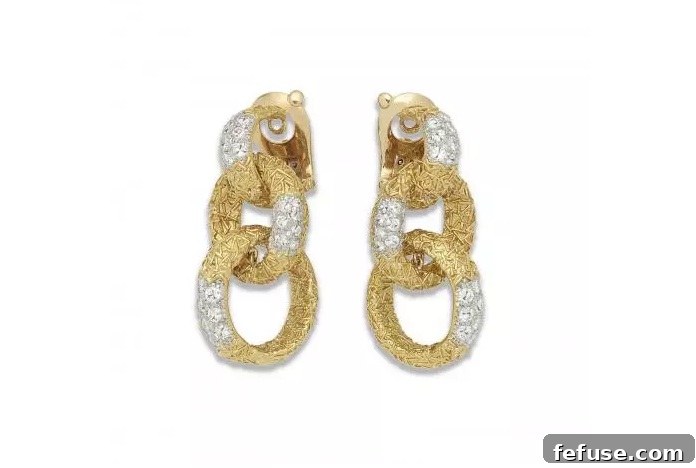
Van Cleef & Arpels Gold and Diamond Necklace/Bracelet Combination, Ear Clip, and Ring Suite, circa 1970: This exquisite suite from Van Cleef & Arpels perfectly encapsulates the versatility and sophisticated glamour of the early 70s. The necklace, designed to transform into a bracelet, highlights the era’s demand for adaptable, multi-functional jewelry. Crafted in rich yellow gold, likely textured or intricately woven, and accented with strategically placed diamonds, the set exudes a quiet luxury. The accompanying ear clips and ring complete a cohesive look, demonstrating the brand’s mastery in combining traditional elegance with contemporary design, focusing on form and the warm glow of gold rather than an overwhelming display of large stones. Each piece likely boasts the meticulous craftsmanship for which VCA is renowned, with subtle details that reflect the era’s preference for tactile and sculptural elements.
Andrew Grima Gold, Gem-set, and Diamond Bracelet, 1973: A quintessential example of Andrew Grima’s groundbreaking work, this bracelet from 1973 showcases his signature style. Expect highly textured, possibly hammered or brushed yellow gold, forming an organic, almost raw aesthetic. Grima was celebrated for his audacious use of naturally shaped, often un-faceted gemstones, which he integrated into his designs with an artistic flair. The “gem-set” aspect here likely implies a curated selection of colorful, natural stones – perhaps tourmalines, citrines, or peridots – chosen for their unique hues and forms rather than their conventional value. Diamonds, if present, would serve as subtle accents, enhancing the overall sculptural composition without dominating it, perfectly embodying the “anti-bling” ethos.
Cartier Black Opal, Gemstone, and Enamel Brooch, 1975: This Cartier brooch from 1975 is a testament to the brand’s ability to innovate within the decade’s stylistic parameters. The use of black opal immediately points to the 70s’ appreciation for unique, iridescent stones with a natural allure. Black opal, known for its mesmerizing play-of-color, would have been the focal point, perhaps set in a bold, geometric, or abstract gold frame. The inclusion of additional “gemstones” suggests a colorful medley complementing the opal, while enamelwork would add vibrant accents or intricate patterns. This piece hints at Cartier’s more adventurous designs from the ‘Les Must de Cartier’ era, moving towards bold statement pieces. The thought of David Bowie’s Pierrot clown moment from “Ashes to Ashes” (though released in 1980) is indeed apt; the brooch likely possesses a theatrical, artistic quality that aligns with the decade’s fearless embrace of self-expression.
Van Cleef & Arpels Cultured Pearl, Turquoise, Sapphire, and Diamond Necklace and Ear Clip Suite, circa 1975: Another magnificent suite from Van Cleef & Arpels, this circa 1975 creation beautifully blends traditional elements with the 70s’ love for color and texture. Cultured pearls, a classic, are recontextualized alongside the vibrant hues of turquoise and sapphires. Turquoise was a particularly popular stone in the 70s, often paired with gold for its striking contrast. Sapphires would add a touch of deep blue elegance, and diamonds would provide sparkle without overshadowing the colorful gemstones. The design likely features a sculptural arrangement of these elements, perhaps in a cluster or articulated form, offering a blend of opulence and natural beauty that was characteristic of VCA’s 70s output, emphasizing both preciousness and wearability.
Andrew Grima Gold, Moonstone, and Diamond Pendant Necklace, 1977–78: This late 70s pendant necklace by Andrew Grima is a superb example of his continuing influence throughout the decade. The presence of moonstone, with its ethereal adularescence, speaks to the period’s appreciation for mystical and organic elements. Grima would have likely encased the moonstone in a dramatically textured or sculptural gold setting, creating a focal point that is both earthy and otherworldly. The diamonds would be sparingly used, perhaps as subtle accents to draw attention to the moonstone’s unique glow or to highlight the intricate goldwork. This piece embodies the sophistication and artistic integrity that made Grima a titan of modern jewelry, offering a balance of raw beauty and refined craftsmanship.
The prediction from Bonhams serves as a timely reminder that the influence of the 1970s jewelry is far from waning. For collectors, it presents an exciting opportunity to invest in pieces of significant artistic and historical value. For enthusiasts, it’s a chance to embrace a style that championed individuality, bold design, and a unique form of glamour that continues to resonate today.
News Source: jckonline.com