
From Forest Floor to Fortune: An Indian Villager’s Remarkable Diamond Discovery
In a story that perfectly encapsulates the serendipity of nature and the transformative power of unexpected fortune, an Indian villager has stumbled upon a significant rough diamond, turning a routine daily chore into a life-altering event. This incredible discovery, made during a simple firewood collection expedition, not only highlights the rich mineral potential of India’s central regions but also provides a poignant example of how a single find can drastically reshape an individual’s destiny and future aspirations.
The Fortuitous Discovery: A Daily Chore Transformed
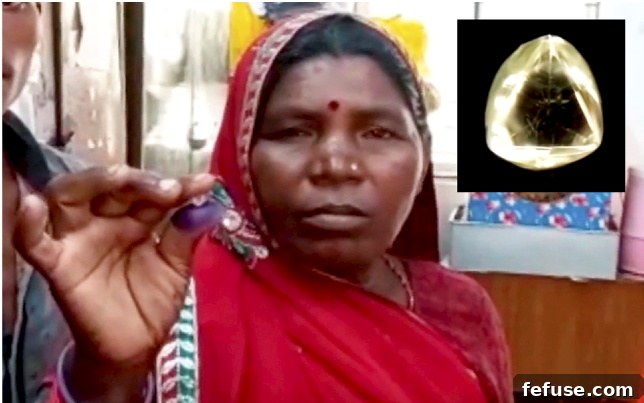
The protagonist of this compelling narrative is 45-year-old Genda Bai, a villager residing in the Purusottampur area of Madhya Pradesh, a central Indian state renowned for its diamond reserves. For Genda Bai, like countless other rural inhabitants, venturing into the local forest to gather firewood is not a pastime but a fundamental necessity, an integral part of her daily struggle for survival and sustenance. On this particular day, however, her arduous routine took an unprecedented turn, forever altering the trajectory of her life.
While meticulously collecting twigs and branches amidst the dense foliage, her eyes caught an unusual sparkle on the ground. Initially, she might have dismissed it as a piece of glass or a common stone, but something about its luster and form prompted a closer inspection. What she held in her hand was not an ordinary pebble, but a raw, unpolished gem – a 4.39-carat rough diamond, a treasure valued at approximately $25,000. This valuation underscores the substantial nature of her find, particularly in the context of a rural Indian economy where such an amount represents a monumental sum.
What makes Genda Bai’s discovery particularly extraordinary is the manner in which it occurred. In many diamond-rich regions, particularly in Madhya Pradesh, the search for these precious stones often involves arduous and often formalized digging efforts. Local informal diggers frequently pay a fee to authorities for the right to excavate small, allocated patches of land, hoping to unearth a hidden gem. Genda Bai’s find, however, bypassed this conventional, labor-intensive process entirely, as the diamond was simply lying on the surface, a testament to nature’s unpredictable gifts and the sheer unlikelihood of such a happenstance.
Unearthing a Gem: The Diamond’s Significance
The 4.39-Carat Rough Diamond
A rough diamond, unlike the polished, faceted gems seen in jewelry stores, appears much like a dull, glassy stone, often resembling a piece of quartz. Its true beauty and value are only revealed after expert cutting and polishing. Genda Bai’s discovery of a 4.39-carat stone is noteworthy not just for its weight but also for its initial valuation of $25,000. This valuation is a preliminary assessment, reflecting its quality, clarity, and potential yield once it undergoes the transformation from a raw mineral to a sparkling jewel. For a rough diamond found on the surface, this carat weight represents a substantial and rare discovery.
Madhya Pradesh: A Hub for Diamond Discoveries
Madhya Pradesh holds a distinguished position on India’s geological map, primarily for its rich reserves of diamonds, particularly concentrated in the Panna district. The region’s unique geological formations, stemming from ancient volcanic activities, have created kimberlite pipes, which are the primary source of diamonds. For centuries, Panna has been synonymous with diamond mining, contributing significantly to India’s gemstone wealth. While much of the mining activity in Panna is now regulated, the allure of finding diamonds continues to draw individuals, both formally and informally, to its promising earth.
The discovery in Purusottampur, within this larger diamond-bearing state, reaffirms Madhya Pradesh’s status as a vital source of these precious stones. It underscores that while large-scale mining operations dominate, there remains a potential for individual, smaller-scale finds, adding an element of romanticism and hope to the daily lives of local villagers. Genda Bai’s discovery, though exceptional in its ease, is thus situated within a broader historical and geological context that makes such finds, while rare, not entirely unheard of in this specific part of India.
The Ecosystem of Informal Diamond Digging
The practice of informal diamond digging is a deeply entrenched part of the local economy and culture in diamond-rich regions like Madhya Pradesh. For many impoverished villagers, it represents one of the few avenues through which they might escape the cycle of poverty. The system typically involves individuals or small groups obtaining temporary leases or permits from the local government to prospect for diamonds in designated areas. These permits allow them to dig small patches of land for a specified period, often with the hope that a stroke of luck will lead them to a valuable find.
This decentralized approach to mining, while offering opportunities, also comes with inherent challenges and risks. The work is physically demanding, often undertaken in harsh conditions, and success is far from guaranteed. Many diggers toil for months, even years, unearthing nothing more than ordinary stones. Yet, the persistent glimmer of hope, fueled by success stories like Genda Bai’s, keeps the practice alive. The economic drivers behind this practice are stark: a lack of alternative employment, widespread poverty, and the distant promise of life-changing wealth. It’s a testament to human resilience and the powerful draw of a precious resource.
Genda Bai’s experience stands out precisely because it sidesteps this entire, often arduous, process. Her diamond was not found through planned excavation or a paid permit but was a surface find, a rare geological phenomenon where natural forces have brought the gem close enough to the surface to be simply picked up. This rarity amplifies the extraordinary nature of her fortune, distinguishing her story from the more common narratives of hard-won diamond discoveries.
The State’s Role: Auction, Royalty, and Regulation
In India, all mineral resources, including diamonds, are considered state property. Therefore, any significant discovery, even by an individual, must be declared to the government. This regulatory framework ensures that the state can manage its natural wealth transparently and for the benefit of all citizens. Following Genda Bai’s discovery, the diamond will now proceed to auction, overseen by the state government.
The auction process is a standardized mechanism designed to ensure fair market value for the gem. Once the diamond is successfully auctioned, a portion of the proceeds is retained by the state government. Specifically, 11.5 per cent of the auction value will be deducted as royalty and taxes. This revenue plays a crucial role in funding public services, infrastructure development, and various welfare programs within the state. It represents the government’s rightful share in the country’s mineral wealth, balancing individual gain with collective benefit.
The remainder of the auction proceeds, after the state’s deduction, will be disbursed to Mrs. Bai. This system ensures that while the state benefits from its resources, the individual who made the discovery is also substantially rewarded for their fortuitous find. The transparency and regulatory oversight of this process are vital in preventing illicit trade and ensuring that such valuable resources are handled responsibly, contributing positively to the regional economy and the welfare of its people.
A Life Transformed: Genda Bai’s Dreams and Aspirations
For Genda Bai, the substantial sum she will receive, even after the government’s deductions, represents more than just money; it is a gateway to a life she could only dream of. In a region where economic hardship is a daily reality, an amount nearing $22,000 (after the 11.5% deduction from $25,000) is truly life-changing. Her plans, articulated to reporters, reveal the profound impact this discovery will have on her family’s future, addressing two of the most significant aspirations in many rural Indian households.
First, she plans to use a portion of the funds to acquire a house. For families living in poverty, securing a permanent, safe, and comfortable home is often a lifelong struggle. A house provides not just shelter but also stability, security, and a foundation upon which to build a better future. This immediate goal underscores a universal human desire for dignity and a place to call one’s own, free from the precariousness of temporary living arrangements.
Second, and equally significant, is her intention to use the money to facilitate the marriages of her two daughters. In many Indian cultures, the marriage of daughters is a paramount parental responsibility, often accompanied by considerable financial outlays for dowries, ceremonies, and associated expenses. This financial burden can be a source of immense stress for poor families, sometimes leading to debt or delayed marriages. Genda Bai’s ability to ensure her daughters’ marriages without financial strain represents an immense alleviation of a deeply felt cultural and personal obligation, securing their future and upholding family honor.
Her story is a powerful symbol of hope, demonstrating how a simple act of collecting firewood can lead to an extraordinary change in circumstances, transforming the fortunes of an entire family and enabling the fulfillment of long-cherished dreams.
Beyond the Sparkle: Broader Implications and Similar Stories
Genda Bai’s extraordinary discovery echoes countless stories of individuals throughout history who have stumbled upon natural treasures, from gold nuggets to rare minerals. These anecdotes serve as a powerful reminder of the earth’s hidden bounties and the element of pure chance that can sometimes dictate human destinies. Such finds not only bring individual prosperity but also highlight the untapped potential of certain geographic regions.
While large-scale industrial mining operations are crucial for economic development, these personal stories of discovery often capture the public imagination more vividly. They represent the ultimate underdog narrative, where an ordinary person, through no special skill or effort, becomes an overnight sensation. For communities in mineral-rich but economically challenged areas, every such tale rekindles hope, encouraging others to remain vigilant and perhaps, in their own daily routines, discover a similar fortune hidden beneath their feet.
Conclusion: A Testament to Nature’s Surprises
Genda Bai’s discovery of a 4.39-carat rough diamond while gathering firewood in the forests of Madhya Pradesh is more than just a news item; it is a captivating tale of fortune, resilience, and the unexpected generosity of nature. From the forest floor to a forthcoming state auction, her journey encapsulates a profound transformation that will provide a secure home and the opportunity for her daughters to marry, fulfilling long-held aspirations.
This remarkable incident not only underscores the rich diamond potential of India’s central states but also serves as a poignant reminder that even in the most mundane of daily tasks, extraordinary possibilities can emerge. Genda Bai’s story will undoubtedly inspire many, becoming another cherished legend in the ongoing human quest for prosperity and the enduring allure of earth’s hidden treasures.