

Trade Wars, Rate Cuts, and the Resurgence of Gold: A Strategic Investor’s Guide
In recent months, while the broader precious metals sector has experienced a noticeable downtrend, gold has remarkably managed to hold its ground. This resilience highlights gold’s inherent role as a safe-haven asset amidst economic uncertainties. The yellow metal, along with other components of the precious metals market, received a notable boost following China’s retaliatory tariffs, igniting fresh discussions about its future trajectory. However, the initial enthusiasm saw little sustained follow-through, prompting investors and analysts alike to ponder a crucial question: Could an escalating global trade war genuinely usher in a new bull market for precious metals?
The succinct answer, supported by historical patterns and economic theory, is a resounding yes, but with critical caveats. Such a bullish scenario is highly contingent on the trade conflict leading to a significant global economic downturn and, consequently, prompting the Federal Reserve to implement interest rate cuts. This confluence of events—rate reductions coupled with an uptick in inflation directly attributable to tariffs—presents an exceptionally bullish combination for precious metals, particularly gold.
The Macroeconomic Landscape: Trade Wars and Their Ripple Effects
A trade war, characterized by nations imposing tariffs and other trade barriers on each other, can have far-reaching consequences that extend beyond mere import costs. It disrupts global supply chains, increases manufacturing expenses, and can lead to reduced international trade volumes. Businesses face heightened uncertainty, which often translates into delayed investments, hiring freezes, and diminished consumer confidence. The cumulative effect of these disruptions can slow economic growth, potentially pushing major economies towards a recessionary environment. In such a climate, traditional assets like equities might falter, driving investors towards more stable, less volatile alternatives.
Gold traditionally thrives in periods of economic instability. It is perceived as a reliable store of value when fiat currencies face devaluation or when geopolitical tensions escalate. The current geopolitical landscape, marked by persistent trade disagreements, has undoubtedly injected a degree of nervousness into financial markets. This underlying anxiety provides a fertile ground for gold to demonstrate its safe-haven attributes, attracting capital from risk-averse investors seeking refuge from turbulent markets.
The Federal Reserve’s Role: Rate Cuts and Monetary Policy
Central banks, most notably the U.S. Federal Reserve, play a pivotal role in shaping economic conditions through their monetary policy decisions. When an economy shows signs of slowing or entering a recession, the Fed typically responds by easing monetary policy, primarily through reducing benchmark interest rates. The goal of rate cuts is to stimulate economic activity by making borrowing cheaper for businesses and consumers, thereby encouraging investment and spending. However, lower interest rates have a profound impact on the appeal of non-yielding assets like gold.
When interest rates are high, investors can earn attractive returns from interest-bearing assets such as bonds or savings accounts, making gold, which offers no yield, less appealing. Conversely, when rates fall, the opportunity cost of holding gold diminishes significantly. The relative attractiveness of gold increases as the returns from traditional fixed-income investments decline. This makes rate cuts a powerful catalyst for gold prices, as investors reallocate capital towards assets that can preserve or grow wealth in a low-yield environment.
Inflationary Pressures: Tariffs and the Consumer Price Index
Beyond interest rates, inflation is another critical factor for gold. Tariffs, by their very nature, are taxes on imported goods. When these goods enter a country, their cost increases, which is then often passed on to consumers. This can lead to a general rise in the price level of goods and services, a phenomenon known as inflation. The Consumer Price Index (CPI) is a key metric used to measure inflation, tracking the average change over time in the prices paid by urban consumers for a market basket of consumer goods and services.
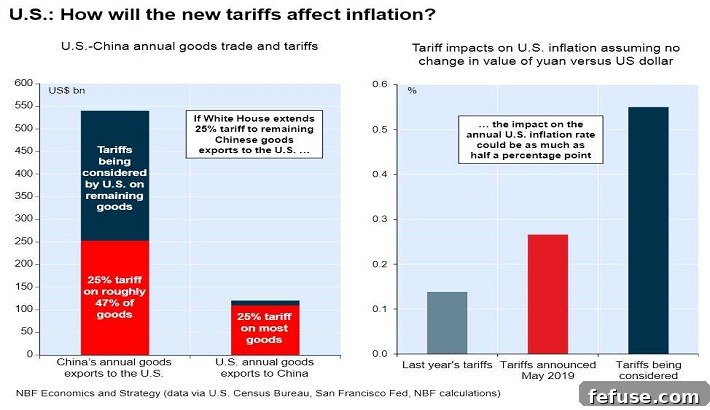
According to analyses, even the current and announced tariffs could potentially boost the CPI by approximately 0.25%. Should additional tariffs currently under consideration be implemented, this boost could further increase to about 0.55%. While these figures might seem modest individually, their cumulative impact can contribute to broader inflationary pressures within the economy. Gold is widely regarded as an effective hedge against inflation, as its intrinsic value tends to be more stable when the purchasing power of fiat currencies erodes. Investors often turn to gold to preserve their wealth during periods of rising prices, making any tariff-induced inflation a significant positive for the precious metal.
The Dollar’s Influence: A Crucial Variable for Gold Prices
It is crucial to note that the currency market can either amplify or diminish the overall economic impact of tariffs, particularly on inflation and, by extension, on gold prices. A stronger U.S. dollar, for instance, can mitigate the inflationary effects of tariffs. When the dollar is strong, imported goods become relatively cheaper for U.S. consumers, offsetting some of the price increases caused by tariffs. Conversely, a weaker dollar could significantly amplify inflation, making imports more expensive and exacerbating the tariff-induced price hikes. This dynamic also directly affects gold, as the yellow metal is typically priced in U.S. dollars.
An inverse relationship often exists between the value of the U.S. dollar and the price of gold. A stronger dollar makes gold more expensive for holders of other currencies, potentially dampening international demand. Conversely, a weaker dollar makes gold cheaper and more attractive to international buyers, which can drive up its price. Therefore, the trajectory of the dollar in response to trade wars and Fed policy changes is a critical variable for precious metals investors to monitor. Should a trade war ultimately weaken the dollar due to economic uncertainty or capital flight, it would add another layer of bullish support for gold.
Navigating Uncertainty: Market Expectations vs. Reality
Certainly, the current economic and market landscape is riddled with several “ifs,” which likely explain why gold has not yet made a decisive, sustained move upwards, and why gold stocks and Silver remain relatively subdued. A Fed rate cut, while increasingly anticipated, is not an absolute certainty, nor is a full-blown, prolonged global trade war. Economic data can shift rapidly, influencing central bank decisions and trade negotiations. The market is a complex ecosystem constantly processing new information, leading to periods of hesitation and consolidation.
However, current market sentiment reveals a growing expectation of monetary easing. As of recent assessments, the market is pricing in a strong likelihood of a rate cut by January 2020, with a significant 52% chance of a cut even earlier, by September. Given this forward-looking information, one might reasonably conclude that precious metals, and especially gold stocks and Silver, could be currently undervalued. If these market expectations materialize, investors who position themselves early could stand to benefit significantly from the subsequent upward revaluation of these assets.
Historical Context: Gold’s Performance During Rate Cut Cycles
Historical analysis often provides valuable insights into future market behavior. It’s worth noting that precious metals have shown a remarkable pattern of outperformance coinciding with the initiation of previous rate-cutting cycles by the Federal Reserve. In the past two such cycles, the sector typically bottomed out before the very first rate cut was announced. The truly robust performance and subsequent bull run for precious metals then began precisely with those initial rate reductions. This suggests that the market tends to anticipate Fed actions, with a definitive upward trend often commencing once those actions are confirmed. This historical precedent lends strong support to the argument that a forthcoming rate cut could indeed be the pivotal catalyst for a new bull market in gold and related assets.
The Trade War as a Catalyst: Bullish and Bearish Scenarios
Circling back to the central theme, a trade war could indeed prove to be a profoundly significant catalyst for gold, particularly if it leads to two key developments: immediate monetary easing by the Federal Reserve and a sustained increase in inflation expectations. The combination of lower interest rates (reducing the opportunity cost of holding gold) and rising prices (enhancing gold’s appeal as an inflation hedge) creates a powerful tailwind for the yellow metal. Such an environment would likely see investors flocking to gold as a primary defense against economic instability and currency devaluation, driving its price substantially higher.
Potential Downside Risks for Precious Metals
Conversely, the downside risk for gold and other precious metals primarily resides in the dissipation of the trade war tensions. If trade disputes de-escalate, leading to renewed optimism and a potential resolution, the underlying need for safe-haven assets would diminish. In such a scenario, the stock market could break out to new highs, signaling robust economic health. Consequently, talk of Fed easing would likely die down as economic indicators improve, and bond yields would rebound, making interest-bearing assets more attractive. This combination of reduced uncertainty, stronger economic growth, and rising bond yields would remove much of the impetus for gold’s upward movement, potentially leading to a correction or a period of underperformance for the precious metals sector.
Strategic Investing in Precious Metals: A Two-Fold Approach
Given the intricate interplay of these factors, the optimal strategy for precious metals investors should be carefully considered and two-fold. The first part of this strategy involves identifying and acquiring value, especially within the junior mining sector. Junior gold producers often represent significant value opportunities due to their inherent leverage to the gold price and their potential for substantial growth. Many of these companies possess promising exploration projects or early-stage development assets that are currently undervalued by the market.
Unearthing Value: The Case for Junior Gold Producers
A key metric for evaluating junior gold producers is the price to Net Asset Value (NAV). This ratio compares a company’s market capitalization to the estimated value of its underlying assets, including proven and probable reserves. Intriguingly, the price to NAV metric for many junior gold producers is currently as low as it was in early 2013, a period when the entire precious metals sector and its valuations experienced a significant downturn. This suggests that there is ample value to be found in these smaller, often overlooked companies. Investing in quality juniors with strong management teams and viable projects at these depressed valuations offers considerable upside potential once the gold price begins its anticipated ascent.
Timing is Key: Optimizing Purchases for Higher Gold Prices
The second crucial component of the investment strategy is to exercise patience and wait for confirmation of Fed rate cuts before investing in assets that require a higher gold price to become truly profitable. This includes certain “optionality plays,” which are typically companies with significant untapped resources that only become economically viable at higher gold price thresholds. It also encompasses assets like Silver, which often performs with greater volatility and leverage to gold prices, and other lower-margin assets within the mining space. By waiting until the Federal Reserve actually begins cutting rates, investors can confirm the bullish catalyst is in motion, thereby reducing risk and optimizing their entry points into these more sensitive investments. This measured approach balances proactive value hunting with strategic, confirmation-based allocation.
Conclusion: A Measured Approach to Precious Metals Investing
In summary, while the path to a new bull market in precious metals is paved with economic uncertainties and conditional “ifs,” the prevailing macroeconomic forces, particularly the potential for escalating trade wars leading to Fed rate cuts and increased inflation, present a compelling case for gold. Historical precedents reinforce the idea that central bank easing provides a strong impetus for the sector. Investors who adopt a two-pronged strategy—first, securing value in undervalued junior producers now, and second, patiently awaiting confirmed rate cuts to deploy capital into more gold-price-sensitive assets—are best positioned to capitalize on the unfolding dynamics within the precious metals market. Vigilance, strategic timing, and a deep understanding of market drivers will be paramount for success in this evolving landscape.
Source: mining