
In a startling revelation that casts a shadow over the booming market for affordable accessories, a comprehensive survey conducted by London Trading Standards has exposed alarming levels of toxic materials in over half of low-cost necklace jewellery components. This investigation highlights a critical public health concern, particularly for consumers who might unknowingly expose themselves to hazardous substances simply by wearing inexpensive adornments.
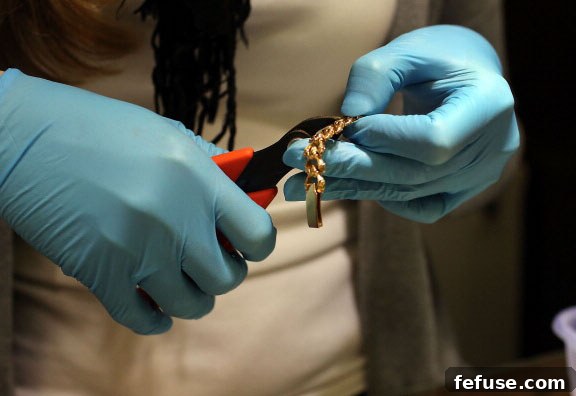
The survey, a collaborative effort involving fifteen London authorities, meticulously sampled thirty non-precious metal necklaces. These items were purchased from a diverse range of stalls and shops across London, reflecting the widespread availability of such products. Each necklace was then disassembled, and individual components were subjected to rigorous testing to ascertain their lead and cadmium content, alongside evaluating their nickel release levels. The findings underscore a systemic failure in compliance within a significant segment of the jewellery supply chain.
At the heart of regulating these hazardous substances lies the European Union’s REACH (Registration, Evaluation, Authorisation and Restriction of Chemicals) regulation. This crucial legislation is designed to protect human health and the environment from the risks posed by chemicals, including those used in consumer products like jewellery. REACH sets stringent limits on the permissible levels of metals such as nickel, lead, and cadmium in items intended for prolonged skin contact. For lead, the maximum allowed content is a mere 0.05% by weight, while for cadmium, this limit is even stricter at 0.01%.
The survey’s results painted a grim picture of non-compliance. In the most egregious instances, parts of the tested jewellery were found to contain a staggering 82% lead and 56% cadmium. These figures are not just statistics; they represent an alarming disregard for established safety standards and potentially serious health risks. Lead, a well-documented neurotoxin, can have severe developmental impacts, especially in children, and chronic exposure can lead to a range of health problems affecting the nervous system, kidneys, and blood. Cadmium, equally dangerous, is a known carcinogen linked to kidney damage, bone degradation, and respiratory issues.
Out of the thirty items put under the microscope, a shocking nineteen samples—representing 63.3% of the total—were found to be non-compliant with EU regulations. This means that only eleven variants, or 36.7%, had acceptable levels of lead, cadmium, and nickel release. Specifically concerning lead, half of all samples were found to exceed the legal limit, with one component registering an astonishing 82.4% lead content. This widespread non-compliance suggests that the problem is not isolated but rather indicative of broader issues within the low-cost jewellery manufacturing and import sectors.
The Industry’s Perspective and Compliance Challenges
The revelations from the London Trading Standards survey, while alarming to the public, came as no surprise to industry veterans like John Milligan, chairman of The Jewellery Distributors’ Association (JDA). Milligan articulated the frustrations of responsible businesses that diligently adhere to regulations. He noted, “These results come as no surprise to my organisation which supports responsible jewellery businesses.” He further elaborated on the significant financial burden associated with REACH compliance, particularly the costs incurred through mandatory testing and quality assurance processes.
Milligan underscored the immense pressure placed on local trading standards to enforce these complex regulations, often with limited resources. He highlighted the “temptation to cut corners by less scrupulous suppliers,” which creates an unfair competitive landscape. This predatory behavior, where some manufacturers and importers knowingly bypass safety standards to reduce costs, directly threatens the survival of law-abiding jewellery manufacturers and importers. Ethical businesses, investing in compliant materials and thorough testing, find themselves at a major competitive disadvantage when cheap, non-compliant products flood the market.
Understanding the Health Risks Associated with Toxic Metals
While the presence of lead and cadmium is universally concerning, the immediate risks for end-users can vary. For cadmium, the most acute risks typically arise during the manufacturing or alteration phases of items. This is when cadmium-containing materials might be heated, causing the metal to vaporize. Inhalation of these vapors can be extremely dangerous, leading to severe health complications. While direct skin contact with finished cadmium-containing jewellery poses a lesser immediate threat to the end-user compared to inhalation, prolonged contact can still lead to skin irritation or, over time, contribute to systemic exposure, particularly if the skin barrier is compromised. Therefore, while end-users should not be unduly alarmed, vigilance remains crucial, and the removal of such products from sale is a vital protective measure.
Nickel, another metal frequently found in inexpensive jewellery, presents a different but equally pervasive health challenge. It is widely recognized as the most common cause of contact allergy in Europe, affecting a significant portion of the population. Exposure to nickel can trigger allergic contact dermatitis, manifesting as itchy rashes, redness, and inflammation on the skin where the jewellery makes contact. EU safety regulations strictly limit the rate of nickel release from jewellery to 0.88 micrograms per square centimeter per week (0.88μg/cm²/week). Disturbingly, one sample discovered in the London Trading Standards survey had a nickel release rate that exceeded this limit by over 60%, indicating a high potential for allergic reactions among wearers.
Corrective Action and the Path Forward
In response to these sobering findings, London Trading Standards has swiftly initiated corrective actions. Their immediate focus is to ensure that suppliers responsible for distributing non-compliant products face appropriate consequences and that these hazardous items are promptly removed from sale. This proactive approach is critical not only for safeguarding public health but also for sending a clear message to the industry that flouting safety regulations will not be tolerated.
Steve Playle, spokesperson for London Trading Standards, emphasized the necessity for systemic change within the industry. He stated, “Some manufacturers and importers of low-cost jewellery clearly need to improve their quality standards to ensure legal requirements are met.” Playle issued a strong appeal to all suppliers, urging them to prioritize responsible sourcing. He advised them to “make sure they source stock from reputable traceable sources and ask for proof of compliance.” This call to action highlights the importance of due diligence throughout the supply chain, from raw material acquisition to the final product reaching the consumer.
The broader implications of this survey extend beyond immediate product recalls. It underscores the urgent need for heightened consumer awareness regarding the potential hidden dangers in seemingly innocuous products. Consumers are often drawn to low-cost jewellery for its affordability and fashion appeal, unaware of the compromises made in material safety. This incident serves as a stark reminder that price alone should not be the sole determinant in purchasing decisions. Instead, consumers should consider the reputation of the retailer and, where possible, inquire about product compliance and material safety.
The problem of toxic metals in jewellery is not unique to London or the UK; it is a global challenge exacerbated by complex international supply chains where oversight can be difficult. The ongoing efforts by regulatory bodies like London Trading Standards are crucial in holding manufacturers and importers accountable. Their work helps to level the playing field for ethical businesses and, most importantly, protects vulnerable consumers from potentially life-altering health issues.
Protecting Consumers: A Shared Responsibility
Moving forward, a multi-faceted approach is essential to tackle this pervasive issue. Enhanced enforcement by trading standards and other regulatory bodies, coupled with increased collaboration across international borders, will be vital to stem the flow of non-compliant products. Manufacturers and importers must embrace their corporate responsibility, investing in robust quality control systems and transparent supply chain management. This includes rigorous testing of materials, working only with verified suppliers, and maintaining detailed records of compliance.
For consumers, awareness is their strongest shield. While it can be challenging to discern the chemical composition of an item by appearance alone, choosing reputable retailers who demonstrate a commitment to product safety can significantly reduce risk. Consumers should also be mindful of adverse reactions, such as skin irritation or allergic responses, and discontinue wearing any jewellery that causes such symptoms. Reporting concerns to trading standards or consumer protection agencies can also contribute to identifying and removing hazardous products from the market.
In conclusion, the findings of the London Trading Standards survey serve as a critical wake-up call for the entire low-cost jewellery industry and its consumers. The pervasive presence of excessive levels of lead, cadmium, and nickel in affordable necklaces is a serious public health matter that demands immediate and sustained attention. While regulatory bodies are actively working to address the issue, a collective effort from manufacturers, importers, retailers, and consumers is required to ensure that fashion does not come at the cost of health. Safeguarding consumers from toxic materials in jewellery is not merely a matter of compliance; it is a fundamental aspect of consumer protection and ethical trade practices, ensuring that everyone can accessorize safely and with peace of mind.