
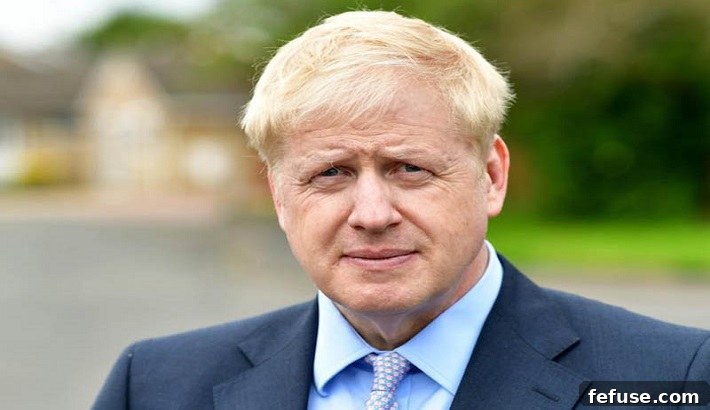
UK on the Brink: Boris Johnson Poised to Announce Third National Lockdown Amid Surging Variant Threat
The United Kingdom finds itself at a critical juncture, with Prime Minister Boris Johnson reportedly on the verge of announcing a third national lockdown for England. The decision, expected to be swift, comes as the nation grapples with an alarming surge in COVID-19 cases, primarily driven by a highly transmissible new variant of the virus. This impending measure threatens to plunge the country back into stringent restrictions, profoundly impacting daily life, businesses, and the national economy.
Should the Prime Minister proceed with this decision, the immediate consequence would be the closure of all non-essential retail across England. This move would mirror the previous lockdowns, where only vital services such as supermarkets, pharmacies, and essential healthcare providers were permitted to operate. The ripple effects are anticipated to extend beyond England’s borders, with Wales, Scotland, and Northern Ireland also likely to implement or tighten their own respective lockdown measures in a bid to contain the accelerating pandemic.
The Rationale: Confronting a More Contagious Variant
At the heart of this urgent need for tighter controls is the rapid spread of a new, more contagious strain of the COVID-19 virus. Scientific reports have consistently highlighted this variant’s increased transmissibility, making it significantly more challenging to control with existing tier-based systems. This scientific consensus has put immense pressure on the government to act decisively, prioritizing public health over other considerations.
Experts warn that without immediate and stringent intervention, the National Health Service (NHS) risks being overwhelmed, facing unprecedented demand for critical care beds and staff. The exponential growth in daily cases and hospital admissions has underscored the variant’s potency, making a national lockdown a grim but seemingly unavoidable necessity to safeguard healthcare capacity and save lives.
Economic Fallout: The Plight of Non-Essential Retailers
While the health implications are paramount, the economic repercussions of a third national lockdown cannot be overstated. Non-essential retail, a sector already battered by previous closures and restrictions, faces another period of immense uncertainty and financial strain. Businesses, from small independent shops to large department stores, will once again be forced to shutter their physical premises, relying solely on online sales or ceasing operations entirely.
The impact is particularly acute for businesses like jewellery retailers, which, in some areas, had managed to remain open under Tier 3 restrictions with robust Covid safety measures in place. Areas such as Cornwall, Devon, and parts of Yorkshire, which were previously operating under Tier 3 rules, will now face the same complete closure as those in Tier 4. This blanket restriction removes any regional variability in retail operations, creating a unified, albeit challenging, landscape for businesses across the country.
The cyclical nature of lockdowns and re-openings has left many businesses teetering on the brink. While government support schemes like furlough and business grants have offered a lifeline, they may not be sufficient to weather another prolonged period of closure. Concerns are mounting over potential job losses, bankruptcies, and the long-term scarring of the UK’s high streets, which represent the vibrant heart of many communities.
Political Pressure and Prime Ministerial Resolve
The Prime Minister’s hand has been further forced by increasing political pressure, notably from opposition leader Sir Keir Starmer. Starmer has been vocal in his criticism of the government’s perceived slow response to the escalating crisis and the perceived inadequacy of existing restrictions. His calls for immediate and tougher action have resonated with a public increasingly concerned by the daily news of rising infections.
In an interview with the BBC yesterday, Boris Johnson himself admitted the gravity of the situation, signaling the inevitability of more severe measures. “It may be that we need to do things in the next few weeks that may be tougher,” he stated, adding a note of weary resolve, “I’m fully reconciled to that – I think the whole country is fully reconciled to that.” This statement suggests a recognition of the public’s understanding of the necessity for decisive action, despite the collective fatigue with restrictions.
Beyond England: A Coordinated UK Response?
While the immediate focus is on England, the interconnected nature of the UK means that similar, if not identical, measures are highly probable across the devolved nations. Health policy remains a matter for the Scottish Parliament, Welsh Senedd, and Northern Ireland Assembly. However, given the shared threat of the new variant and the potential for cross-border transmission, a largely coordinated approach is expected to emerge.
Wales, for instance, has already implemented a “firebreak” lockdown and has often acted swiftly to introduce stricter rules. Scotland has also moved to tighten restrictions in response to rising cases. A full national lockdown across England would likely serve as a catalyst for other UK nations to ensure their measures are robust enough to combat the highly infectious new strain, aiming for a unified front against the pandemic.
A Glimmer of Hope: Vaccines and the Path to Recovery
Amidst the gloom of impending restrictions, a significant beacon of hope shines through: the acceleration of vaccine rollout programs. The UK has been at the forefront of vaccine development and deployment, with millions of doses already administered to the most vulnerable populations. It is widely hoped that as the winter months recede and the vaccination program gathers further pace, these stringent lockdown measures will begin to be eased.
The effectiveness of the vaccines in preventing severe illness and reducing transmission offers a clear pathway out of the cycle of lockdowns. Public health officials and government leaders are pinning their hopes on achieving widespread immunity within the population, thereby reducing the pressure on the NHS and allowing for a gradual return to normalcy. The synergy between public adherence to lockdown rules and the rapid deployment of vaccines is critical for this strategy to succeed.
Looking Ahead: Adapting to a New Normal
The third national lockdown, if implemented, represents another stark reminder of the unprecedented challenges posed by the COVID-19 pandemic. While short-term pain is expected for businesses and individuals, the long-term vision remains focused on recovery and resilience. Businesses, particularly in the retail sector, are being forced to innovate, accelerate their digital transformation efforts, and rethink their operating models to adapt to an increasingly unpredictable environment.
The public, though weary, continues to play a vital role through compliance with public health directives. The collective effort to suppress the virus, coupled with the monumental scientific achievement of vaccine development, offers a tangible hope for a brighter future. As the nation braces for potentially tougher weeks ahead, the focus remains firmly on protecting lives, supporting the NHS, and paving the way for a sustainable recovery from this global health crisis.