
The Unforeseen Success: How Hublot’s Courtesy Watches Became Coveted Collectibles
In the exclusive world of luxury watchmaking, brands often go to extraordinary lengths to ensure an unparalleled customer experience. Hublot, a Swiss luxury watchmaker renowned for its innovative materials and bold designs, introduced a thoughtful amenity for its discerning clientele: “courtesy watches.” These temporary timepieces were provided to customers whose cherished Hublot watches were undergoing service or repair, ensuring they wouldn’t be without a luxury watch on their wrist. However, this seemingly simple gesture led to an unexpected phenomenon, transforming these humble loaners into a surprising victim of their own immense success.
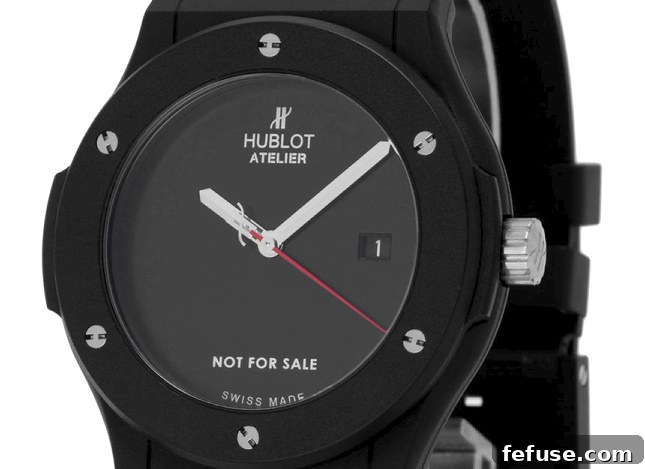
The core concept was straightforward: while a customer’s high-end timepiece was being meticulously cared for by Hublot’s expert watchmakers, they would receive a loaner. This temporary replacement, known affectionately as the “Atelier” watch, was designed to bridge the gap and maintain the brand’s commitment to continuous luxury. What Hublot did not anticipate was the profound attachment customers would develop to these black composite, quartz-movement watches, each boldly marked “NOT FOR SALE” on its face. Far from being seen as mere stand-ins, these Atelier watches began to capture the hearts and minds of their temporary owners.
The Unexpected Rise of the Hublot Atelier Watch
The “Atelier” watch, French for “workshop,” was never intended for commercial sale. It was a utilitarian piece, crafted from a black composite material and powered by a reliable quartz movement, designed solely for internal use and as a loaner. Its distinct marking, “NOT FOR SALE,” was a clear declaration of its purpose and status. Yet, it was precisely this demarcation that inadvertently fueled its desirability. In a market saturated with readily available luxury items, the Atelier watch represented something truly exclusive – a piece that money simply couldn’t buy.
This inherent exclusivity, coupled with its direct association with the prestigious Hublot brand, imbued the Atelier watch with an unexpected mystique. Customers, instead of returning them promptly after their original watches were serviced, often found themselves so captivated by these unique loaners that they chose to hold onto them. The consequence? Many customers forfeited their original timepieces, effectively opting to keep the “NOT FOR SALE” Atelier watch as a permanent fixture in their collection. This behavior, while flattering to Hublot, presented a logistical challenge for the brand.
A Collector’s Item Born of Scarcity and Exclusivity
Ricardo Guadalupe, the chief executive of Hublot, part of the LVMH luxury conglomerate, articulated this unusual predicament to the Financial Times. He acknowledged the significant “interest in these Atelier watches, as they are not for sale.” This sentiment perfectly encapsulates the allure. The very fact that these watches were not accessible through conventional retail channels made them intensely desirable. They transformed from a simple service amenity into a bona fide collector’s item, sought after by enthusiasts and connoisseurs who appreciate rarity and unique brand stories.
The concept of “forbidden fruit” is a powerful psychological driver. When something is declared off-limits, its appeal often skyrockets. The “NOT FOR SALE” inscription acted as a badge of honor, signifying an insider status or a special connection to the brand that mere purchase could not confer. Owning an Atelier watch became a statement, a testament to one’s engagement with Hublot’s service ecosystem, and a subtle nod to being part of an exclusive club. This phenomenon highlights a fascinating aspect of consumer psychology in the luxury market: true exclusivity often trumps price tag.
Dwindling Stocks and a Shifting Strategy
The overwhelming success and retention rate of these courtesy watches naturally led to a depletion of Hublot’s stock. Launched approximately a decade ago, the program, while initially robust, could not sustain the unexpected demand. As Mr. Guadalupe confirmed, due to dwindling stocks, the issuance of these loan watches has become far more restrictive. They are now provided only “sporadically in some exceptional cases,” a stark contrast to their original, more readily available status. This strategic pivot underscores the practical challenges faced by a brand when an ancillary service offering inadvertently becomes a primary point of desire.
This change reflects Hublot’s need to re-evaluate how it manages such exclusive perks. While the intention was to enhance customer satisfaction during service periods, the outcome created an unintended new product demand and a logistical hurdle. It forced the brand to find a balance between offering a premium service and preserving the integrity and availability of its core service assets. The decision to limit their distribution was a pragmatic one, aiming to regain control over their inventory and perhaps encourage customers to retrieve their main timepieces rather than keep the loaner.
The FIFA World Cup Edition: A Glimpse into Adaptability
Interestingly, the appeal of the Atelier watch was recognized and strategically leveraged by Hublot on at least one notable occasion. For guests attending the prestigious FIFA World Cup in Brazil in 2014, Hublot created a reproduction of the Atelier watch. Crucially, this special edition was released without the iconic “NOT FOR SALE” marking. This subtle yet significant alteration speaks volumes. By removing that specific inscription, Hublot was able to offer a version of the beloved design to a wider audience without undermining the unique exclusivity of the original service loaners.
The FIFA World Cup edition demonstrated Hublot’s awareness of the Atelier’s aesthetic appeal and its potential as a promotional item, even if not explicitly a “collector’s item” in the same vein as the original. It allowed the brand to capitalize on the design’s popularity while maintaining the distinct status of the true “courtesy watch.” This strategic move provided a tangible memento of the event, reinforcing Hublot’s presence in high-profile sports sponsorships, without conflating it with the rarity of the service watches.
Broader Implications for Luxury Brand Management
The Hublot Atelier watch saga offers valuable insights for other luxury brands. It exemplifies the delicate balance involved in offering exclusive perks and managing customer expectations. What begins as a thoughtful gesture can, under unforeseen circumstances, evolve into a complex challenge. Brands must anticipate how such offerings might be perceived and valued, especially when they possess inherent qualities of rarity or exclusivity.
- The Power of Exclusivity: The “NOT FOR SALE” tag inadvertently created a highly coveted item, proving that scarcity and inaccessibility can drive desire more powerfully than marketing campaigns.
- Customer Behavior: It highlights how deeply customers can connect with objects, even temporary ones, and the surprising decisions they might make when presented with a truly unique opportunity.
- Brand Storytelling: The Atelier watch has become part of Hublot’s unique brand narrative, a testament to its innovation not just in design, but in customer engagement and the unexpected outcomes that can arise from it.
- Operational Challenges: The depletion of stock necessitated a re-evaluation of the courtesy watch program, illustrating the need for robust inventory management and contingency planning for auxiliary services.
This phenomenon extends beyond watches. Imagine a luxury car brand loaning a uniquely branded vehicle during service that customers then refuse to return, or a high-end fashion house providing a bespoke accessory during alterations that becomes a must-have. The Hublot story serves as a fascinating case study in how unexpected “side products” can inadvertently gain immense value and reshape brand perception.
Conclusion: A Testament to Uniqueness and Desire
The Hublot Atelier courtesy watch stands as a remarkable testament to the unpredictable nature of desire and collectibility within the luxury market. What began as a practical solution to enhance customer service during watch repairs transformed into an icon of accidental exclusivity. Its black composite facade, quartz heart, and the bold declaration of “NOT FOR SALE” on its dial propelled it into a realm of unexpected prestige, turning a temporary loaner into a permanent fixture for many and a highly sought-after item for collectors.
Hublot’s experience with the Atelier watch perfectly illustrates that in the world of luxury, true value is not always dictated by price or initial intent, but often by rarity, a unique story, and the powerful allure of the unobtainable. It underscores the profound psychological impact that exclusivity can have on consumer behavior, making a simple service amenity one of the most intriguing and coveted items in the Hublot universe.