
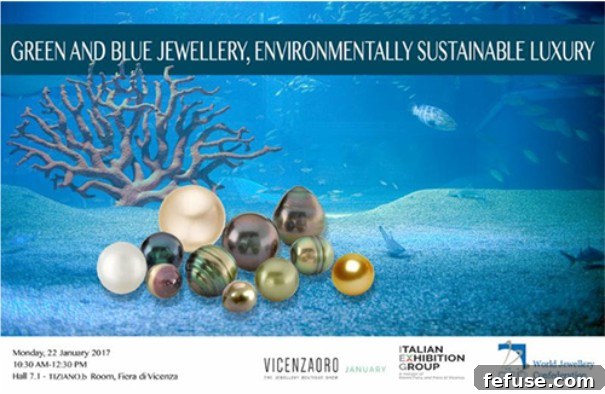
CIBJO, the World Jewellery Confederation, and the Italian Exhibition Group (IEG) are set to host a pivotal seminar titled “Green and Blue Jewellery, Environmentally Sustainable Luxury.” Scheduled for January 22, 2018, during the prestigious VICENZAORO January 2018 jewellery trade show in Vicenza, Italy, this event promises to delve deep into the critical intersection of luxury and responsibility. The seminar’s central theme is the paramount importance of environmental, social, and economic responsibility within the global jewellery sector, with a specific and timely focus on the unique challenges and opportunities presented by pearls and coral.
This initiative underscores a growing global awareness that the pursuit of beauty and value must be harmoniously integrated with ethical considerations and sustainable practices. As consumers become increasingly discerning, demanding transparency and accountability from the brands they patronize, the luxury jewellery industry is at a significant inflection point. The seminar aims to not only address these evolving demands but also to showcase how certain segments of the industry are already leading the way in establishing truly sustainable business models.
The Essence of Green and Blue Jewellery: A Holistic Approach
The discussions at the seminar will revolve around sectors of the jewellery industry where both the product itself and the underlying business operations can achieve environmental, social, and economic sustainability. This holistic approach recognizes that true sustainability extends beyond mere ecological impact, encompassing the well-being of communities and the long-term viability of economic activities. Such sectors frequently involve organic materials that originate from marine environments, presenting unique opportunities and challenges for responsible sourcing and production.
A prime example of this synergy is found in materials like cultured pearls, where sustainability is actively enabled and enhanced through innovative aquafarming techniques. These methods allow for the controlled cultivation of marine organisms in a manner that can minimize environmental disruption while maximizing economic output. Precious coral, though presenting a different set of sustainability considerations due to its natural harvesting methods, also falls under this umbrella, with ongoing efforts to ensure its long-term viability.
Pearls: A Model of Sustainable Luxury Through Aquafarming
Cultured pearls stand as a shining example of how luxury goods can be produced sustainably, offering a regenerative model that benefits both the environment and local communities. A well-managed and responsibly operated pearl farm has the potential to continue production indefinitely. This regenerative capacity positions pearl farming as a unique asset that, when managed with care and foresight, can serve as a perpetual resource for sustainable economic growth and social empowerment.
The process of pearl aquafarming involves cultivating oysters or mussels in controlled marine environments, where they produce pearls over time. Far from depleting natural resources, many pearl farming operations actively contribute to the health of marine ecosystems. Oysters, being filter feeders, play a vital role in purifying water, enhancing marine biodiversity, and providing habitats for other marine life. Moreover, responsible pearl farming practices often lead to the protection of surrounding coastal areas and the establishment of marine protected zones, further bolstering ecological balance.
Economically, pearl farming provides stable employment and income for coastal communities, often in remote regions where alternative economic opportunities are scarce. This includes employment in farming, harvesting, processing, and trade, fostering skill development and contributing to local economies. Socially, these operations can empower indigenous communities, preserve traditional knowledge, and improve living standards, creating a positive ripple effect that extends far beyond the immediate business.
The long-term economic viability of pearl farming is intrinsically linked to the health of the marine ecosystem. This interdependence encourages farmers to become custodians of their environment, implementing practices that ensure ecological balance and resource regeneration. The global demand for cultured pearls, from Akoya to South Sea and Tahitian varieties, continues to grow, making responsible aquafarming a key driver for the future of sustainable luxury.
Precious Coral: Navigating Sustainability Challenges
In contrast to cultured pearls, precious coral is typically harvested from deep-water natural reefs, presenting a distinct set of sustainability challenges. Unlike the regenerative aquafarming model of pearls, coral harvesting requires careful management to prevent overexploitation and ensure the long-term health of these delicate marine ecosystems. The primary approach to sustainability in this sector is to maintain harvesting levels well below the natural growth and regeneration capabilities of the coral reefs themselves.
Precious corals, such as Red Coral and Pink Coral, are slow-growing organisms, making them particularly vulnerable to unsustainable harvesting practices. Consequently, stringent regulations and international agreements, such as those under the Convention on International Trade in Endangered Species of Wild Fauna and Flora (CITES), play a crucial role in controlling trade and ensuring that only legally and sustainably sourced coral enters the market. These regulations often specify quotas, harvesting methods, and designated collection areas to protect vulnerable populations.
Beyond regulatory frameworks, active research and innovative initiatives are being undertaken to investigate new means of actively restoring precious coral reefs, particularly within protected zones. These efforts include coral gardening, where fragments of coral are grown in nurseries and then transplanted back onto damaged reefs, and developing new methods for promoting natural regeneration. Such conservation efforts are vital not only for the future supply of precious coral for jewellery but, more importantly, for the preservation of biodiversity and the health of the marine environment.
The commitment to sourcing precious coral responsibly requires robust traceability systems and transparent supply chains, allowing consumers to be confident that their purchases do not contribute to environmental degradation. Education and awareness campaigns are also essential in informing both industry stakeholders and consumers about the delicate balance required to ensure the continued existence of this magnificent natural material.
Industry Leaders Addressing the Future of Sustainable Luxury
The seminar on “Green and Blue Jewellery” will feature a distinguished panel of blue-ribbon speakers, each bringing invaluable expertise and insight to the discussions. These industry luminaries represent the forefront of sustainable practices and innovation within the jewellery sector, particularly concerning pearls and coral.
- Laurent Cartier, SSEF, Basel, Switzerland: As the co-founder of the Sustainable Pearls Project, Laurent Cartier is a leading authority on the environmental and social aspects of pearl production. His work at SSEF (Swiss Gemmological Institute) provides critical scientific backing for understanding and promoting responsible sourcing practices in the pearl industry.
- Justin Hunter, J. Hunter Pearls, Fiji: As President of the Fiji Pearl Association and a key initiator of Fiji’s new pearl industry development project, Justin Hunter embodies the practical application of sustainable aquafarming. His pioneering efforts in Fiji showcase how pearl cultivation can drive economic development while upholding the highest environmental standards.
- Shigeru Akamatsu, Mikimoto Pearls, Japan: Representing Mikimoto Pearls, a name synonymous with cultured pearls, and serving as Vice President of the CIBJO Pearl Commission, Shigeru Akamatsu brings a legacy of quality and a commitment to responsible practices from one of the industry’s most respected institutions.
- Jacques Christophe Branellec, Jewelmer Joaillerie, Philippines: As a prominent figure from Jewelmer Joaillerie, a leader in South Sea pearl production, and also a Vice President of the CIBJO Pearl Commission, Jacques Christophe Branellec offers perspectives on large-scale sustainable pearl farming and its impact on local communities in the Philippines.
- Rui Galopim de Carvalho, Portugal Gemas Academy, Portugal: The founder of the Portugal Gemas Academy and Vice President of the CIBJO Coral Commission, Rui Galopim de Carvalho provides crucial expertise on the responsible sourcing, identification, and trade of precious coral, advocating for rigorous standards and conservation efforts.
The diverse expertise of these speakers ensures a comprehensive and multi-faceted discussion, covering scientific advancements, practical implementation, industry standards, and global policy considerations.
CIBJO and Italian Exhibition Group: A Unified Vision for Responsibility
This seminar represents the latest in a series of impactful educational events jointly organized by CIBJO and the Italian Exhibition Group. It forms an integral part of their collaborative program, which has received the significant endorsement of the United Nations Economic and Social Council (ECOSOC). This powerful partnership is dedicated to fostering Corporate Social Responsibility (CSR) and sustainability across the entire international jewellery sector.
The CIBJO-IEG joint program, backed by ECOSOC, is a testament to the growing recognition that the luxury industry has a vital role to play in achieving broader global development goals. Corporate Social Responsibility in the jewellery sector encompasses a wide array of practices, from ensuring ethical sourcing of materials and fair labor conditions throughout the supply chain to minimizing environmental footprints and contributing positively to the communities where operations are based. By promoting these principles, CIBJO and IEG aim to elevate industry standards and encourage a culture of responsibility that resonates from mine to market.
The Imperative of Responsibility: Insights from Industry Leaders
Gaetano Cavalieri, President of CIBJO, powerfully articulated the dual imperative of sustainable practices. He stated, “As the experience of the pearl and precious coral industries shows, we should not only strive to be environmentally and socially responsible corporate citizens from the moral and ethical perspective, but such an approach is also critical if we want to optimise our economic viability over the long term.” This statement underscores a fundamental truth: sustainability is not merely a philanthropic endeavor but a strategic necessity for enduring economic success. Cavalieri further emphasized the deep connection between ecological health and business prosperity, adding, “Our potential for producing top-quality products is largely dependent on the health of the marine ecosystem, as it is on the commitment by local communities to our industry and our joint business goals.” This highlights the interconnectedness of environmental stewardship, community engagement, and commercial longevity.
Echoing this sentiment, Corrado Facco, Managing Director of the Italian Exhibition Group and Vice President of CIBJO, stressed the unwavering commitment required. “What the seminar will underline is there should be no compromises made when it comes to jewellery and environmental and social responsibility,” he asserted. Facco’s vision for the industry is one where ethical considerations are as integral to a product’s appeal as its aesthetic and intrinsic value. He elaborated, “Our goal should be that when consumers purchase an item of jewellery, they are inspired to do so not only because it is valuable, beautiful and emotionally significant, but also because it contributes to improving the wellbeing of ordinary people in developing countries, as well as to the protection of the natural environment.” This perspective elevates the act of purchasing luxury jewellery into a conscious decision that actively contributes to positive global change, resonating deeply with the values of the modern consumer.
A Sustainable Future for Luxury: Beyond the Seminar
The “Green and Blue Jewellery” seminar is more than just an event; it is a significant step in a continuous journey towards a more responsible and transparent luxury jewellery industry. The discussions and insights shared will contribute to shaping best practices, influencing policy, and inspiring innovation across the sector. As consumer awareness of ethical and environmental issues continues to grow, the demand for sustainably sourced and produced luxury items will only intensify.
For the jewellery industry, embracing sustainability is no longer an option but a strategic imperative. It offers an opportunity to build trust, enhance brand reputation, and attract a new generation of conscious consumers. By prioritizing the health of our planet and the well-being of its people, the industry can ensure its long-term viability, creating products that are not only symbols of beauty and enduring value but also beacons of hope and positive change. The path forward for luxury jewellery is undoubtedly green and blue, reflecting a deep commitment to the earth’s precious resources and the communities that depend on them.