
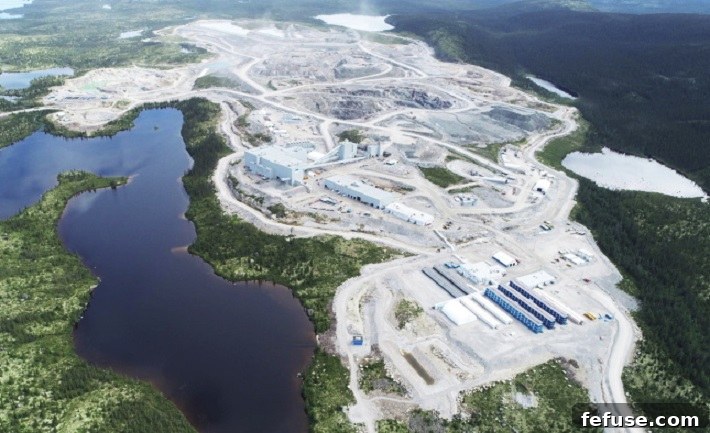
In a significant development for the global diamond industry and Canada’s mining sector, Stornoway Diamonds, a prominent Canadian diamond miner, has been compelled to seek bankruptcy protection. This difficult decision, announced last month, has set in motion a critical search for a new buyer to acquire the company and its valuable assets. At the heart of this urgent situation lies the Renard mine, Quebec’s pioneering and sole diamond operation, which has regrettably suspended all activities. The halt in operations has led to the layoff of a substantial portion of its 500-strong workforce, underscoring the severe impact of market downturns and operational challenges on even well-established enterprises within the natural diamond sector. The fate of Renard, a key contributor to Canada’s limited number of diamond mines, now hangs in the balance, representing both a significant loss and a potential high-value investment opportunity for the right strategic partner.
Stornoway Diamonds had an ambitious vision when it embarked on the journey to establish the Renard mine. Co-founded by industry veteran Eira Thomas, known for her leadership at Lucara Diamond Corp., Stornoway brought to life a project that promised to unlock significant diamond reserves in an entirely new Canadian province. Renard was not merely another mine; it was heralded as a symbol of Quebec’s foray into hard-rock diamond mining, a testament to geological potential and engineering prowess in challenging northern environments. Upon commencing commercial production in January 2017, the mine represented years of exploration, development, and substantial capital investment. It was anticipated to contribute significantly to Canada’s position as a major producer of high-quality, ethically sourced diamonds, creating hundreds of jobs and fostering economic development in remote regions.
However, the path from development to sustainable profitability proved arduous for Stornoway. Early operational challenges quickly emerged, notably issues concerning the integrity of diamonds during the processing phase. Reports indicated problems with diamonds being broken, which naturally led to a reduction in the proportion of higher-value, intact stones recovered. Such processing inefficiencies can severely impact a mine’s revenue stream and overall profitability, requiring substantial investment in refining recovery processes and technology. These initial hurdles, though not uncommon in large-scale mining operations, placed considerable strain on the company’s financial resources and operational targets, making it difficult to fully capitalize on the Renard mine’s inherent geological potential in its nascent stages.
Beyond internal operational difficulties, Stornoway’s struggles were exacerbated by broader external economic factors and the inherent volatility of the global diamond market. Even before the onset of the unprecedented global health crisis, the natural diamond industry was grappling with fluctuating demand, evolving consumer preferences, and the increasing prominence of lab-grown diamonds as an alternative. These dynamics created a challenging pricing environment for rough diamonds, directly impacting the margins of producers like Stornoway. The company had to navigate periods of price stagnation and even decline, which made it difficult to generate the robust cash flows necessary to service its debts and invest in critical operational improvements. The capital-intensive nature of mining means that sustained periods of lower-than-expected commodity prices can quickly erode profitability and liquidity.
The situation took a dramatic turn for the worse with the arrival of the COVID-19 pandemic. The global health crisis brought with it widespread lockdowns, travel restrictions, and a severe disruption of international supply chains. For Stornoway, operating in a remote location, the challenges were immense. In March 2020, the company was forced to halt operations at the Renard mine entirely, prioritizing the health and safety of its workforce and adhering to public health mandates. This closure, initially conceived as temporary, stretched into an extended period as the pandemic ravaged global economies. The subsequent collapse in diamond prices, driven by a precipitous drop in consumer spending on luxury goods and a general atmosphere of economic uncertainty, further compounded Stornoway’s woes, making a viable restart seem increasingly distant and financially unfeasible for a prolonged period.
Even as the world slowly began to emerge from the immediate grip of the pandemic, the natural diamond market faced a complex and uneven recovery. While certain segments saw renewed demand, the overall pricing environment remained challenging for many producers. Stornoway, having endured an extended closure and significant financial strain, found itself in a precarious position attempting to re-establish full operational capacity amidst ongoing market uncertainties. The cumulative effect of past operational issues, the heavy debt burden incurred during development and periods of non-production, and the lingering softness in rough diamond prices created an untenable financial situation. Despite dedicated efforts to stabilize the business, these persistent headwinds ultimately proved too strong for the company to overcome independently, leading to the difficult decision to seek creditor protection.
Adding to the complex web of factors contributing to Stornoway’s demise was the recent voluntary moratorium on rough diamond imports imposed by India. India, a global hub for diamond cutting and polishing, implemented this two-month ban as a measure to stabilize prices and clear excess inventory within its manufacturing sector. While Stornoway cited this ban as a contributing reason for its bankruptcy filing, the immediate impact as reflected in figures from the Gems and Jewellery Export Promotion Council (GJEPC) showed a modest drop of just 1.4 per cent from September to October, coinciding with the moratorium’s commencement on October 15. However, the perception of reduced demand from the world’s largest cutting center, coupled with existing market anxieties, undoubtedly played a role in further depressing rough diamond prices and creating an environment of heightened uncertainty for producers reliant on consistent demand from key markets. The psychological effect of such a significant market signal can often outweigh the initial statistical impact.
In response to this critical situation, Deloitte Corporate Finance Inc. has been appointed to orchestrate the Sale and Investment Solicitation Process (SISP) for Stornoway Diamonds. Announced today, November 22, the SISP is a structured process designed to attract potential buyers and investors for the company’s entire business, including all its property, assets, and undertaking. This comprehensive approach aims to maximize value for stakeholders by facilitating a competitive bidding environment. The SISP framework ensures transparency and fairness, allowing interested parties to thoroughly evaluate the assets and submit proposals, ultimately seeking to secure the best possible outcome for the distressed company and its creditors. Deloitte’s expertise in navigating complex financial restructurings and asset sales will be crucial in this intricate process.
The opportunity presented by the Stornoway SISP is compelling for strategic investors looking to acquire a significant asset within the Canadian diamond mining landscape. The Renard Mine, despite its recent operational suspension, remains a fully developed and permitted diamond mine, equipped with substantial infrastructure and a defined resource base. It represents a rare chance to gain entry into, or expand presence within, one of the world’s most stable and ethically recognized diamond-producing nations. The sale encompasses not just the physical mine and its equipment, but also Stornoway’s intellectual property, operational permits, and potentially its established supply chain relationships. For a well-capitalized entity, the Renard mine offers the underlying geological potential and existing infrastructure that could, with renewed investment and optimized management, resume its role as a significant producer of high-quality diamonds.
Prospective buyers and interested parties are now operating under a tight and critical deadline. As outlined by the SISP, the phase 1 bid deadline for submitting a non-binding letter of intent (LOI) is fast approaching, set for January 19, 2024. This initial submission is a crucial step for potential investors to formally express their interest and gain access to more detailed due diligence materials. The urgency of this timeline underscores the need for swift action and decisive engagement from entities considering an acquisition. A robust response to this initial phase will be vital in ensuring a competitive and successful sale process, ultimately determining the future trajectory of the Renard mine and its potential to contribute once again to the Canadian diamond supply.
The significance of the Renard mine extends far beyond Stornoway’s corporate fortunes. As proudly stated, it is not only Quebec’s inaugural and sole diamond mine but also one of merely five such operations across the vast expanse of Canada. This elite status highlights its strategic importance to the national mining industry. Canada has earned a global reputation for producing conflict-free, ethically sourced diamonds, a factor that increasingly appeals to discerning consumers worldwide. The Renard mine, located in the remote northern regions of Quebec, has been a vital source of employment and economic opportunity for local communities, including Indigenous populations, fostering partnerships and contributing to regional development. Its successful revival under new ownership would therefore be a significant boon for both the provincial and national economies, reaffirming Canada’s commitment to responsible resource development.
The human impact of Stornoway’s struggles is particularly poignant. The layoff of the majority of its 500-strong workforce represents a considerable blow to these individuals and their families, as well as to the communities that rely on the mine for economic stability. These are skilled professionals, from geologists and engineers to equipment operators and support staff, whose livelihoods are directly tied to the mine’s operations. The prospect of Renard restarting under new stewardship offers a glimmer of hope for many of these displaced workers. A successful acquisition would not only save a valuable asset but also potentially restore hundreds of high-paying jobs, injecting renewed vitality into the local economies that have been profoundly affected by the mine’s closure and subsequent bankruptcy proceedings.
Identifying the ideal buyer for Stornoway and the Renard mine will be paramount to its future success. A prospective investor would ideally be a well-capitalized entity with a proven track record in hard-rock mining, particularly in challenging northern climates. This could include larger established mining conglomerates seeking to diversify their portfolio, specialized private equity firms focused on distressed assets with significant upside potential, or even a consortium of investors. Beyond financial strength, the new owner would need operational expertise to address past processing inefficiencies, a strategic vision for market positioning, and a commitment to community engagement and environmental stewardship. The complexities of restarting a suspended mine, re-engaging a workforce, and navigating the volatile diamond market demand a buyer with robust capabilities and long-term commitment.
For any new owner, the Renard mine presents a unique blend of challenges and opportunities. On one hand, there will be the immediate task of re-evaluating the mine’s operational parameters, potentially upgrading processing facilities to improve recovery rates, and carefully managing the restart process. On the other hand, the mine comes with existing infrastructure, permits, and a geological understanding developed over years, significantly reducing the initial capital outlay and timeline compared to a greenfield project. The global diamond market, while volatile, continues to show resilience in certain segments, particularly for high-quality natural stones. A new owner would have the opportunity to strategically position Renard’s output, capitalize on Canada’s reputation for ethical diamonds, and potentially implement innovative sales and marketing strategies to navigate the evolving landscape of natural versus lab-grown diamonds, ensuring long-term viability and profitability.
The broader context of the natural diamond industry’s future remains a critical consideration for potential investors. While the market has faced headwinds, including the rise of lab-grown diamonds, natural diamonds continue to hold a unique allure as symbols of rarity, authenticity, and enduring value. The challenge for producers like Renard is to effectively differentiate their product and communicate its intrinsic value to consumers. A new owner would need to be adept at navigating this evolving market, potentially leveraging new technologies for traceability and provenance, and collaborating with industry bodies to reinforce the value proposition of natural diamonds. The investment in Renard is not just an investment in a mine, but an investment in the belief in the enduring appeal and market stability of responsibly sourced natural diamonds in a competitive global marketplace.
In conclusion, the ongoing Sale and Investment Solicitation Process for Stornoway Diamonds represents a pivotal moment for the Renard mine and indeed for the Canadian diamond mining industry. While the company’s journey has been marked by significant challenges leading to bankruptcy protection, the underlying value and strategic importance of the Renard asset remain undeniable. The successful identification of a new, well-resourced owner committed to long-term sustainable operations could not only breathe new life into Quebec’s only diamond mine but also restore vital employment opportunities and reaffirm Canada’s position as a reliable supplier of ethical diamonds to the world. As the January 19, 2024, deadline for non-binding letters of intent approaches, all eyes will be on the potential investors who recognize the inherent value and future potential encapsulated within this unique Canadian diamond story.