
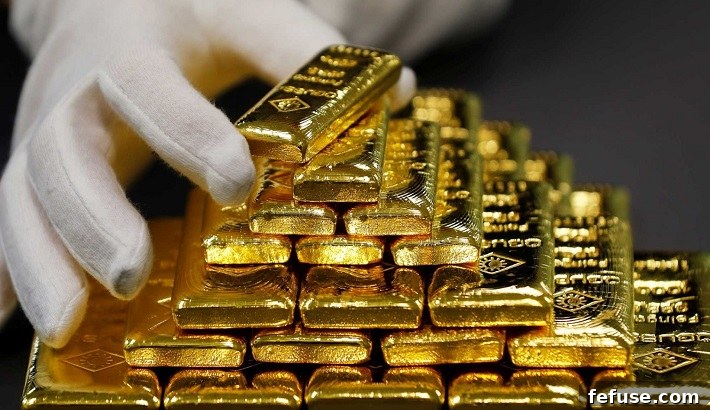
Gold Prices Navigate Volatile Waters Ahead of Crucial Fed Meeting
Gold, the perennial safe-haven asset, found itself under pressure earlier this week, experiencing a notable dip in prices. This softening came as global equity markets demonstrated renewed vigor, and the U.S. dollar maintained a steady footing against a basket of major currencies. The overarching sentiment driving market movements was the keen anticipation surrounding an upcoming policy meeting of the U.S. Federal Reserve, with investors meticulously sifting through every piece of economic data and geopolitical news for clues about future monetary policy direction.
The precious metal’s traditional inverse relationship with both the dollar and risk assets like equities played out prominently. As confidence in broader markets seemed to improve, drawing capital towards riskier investments, gold’s appeal as a store of value temporarily diminished. This dynamic underscores the complex interplay of forces that dictate the ebb and flow of gold prices on the global stage, often making it a bellwether for underlying economic health and investor sentiment.
Market Fundamentals: A Snapshot of Gold’s Performance
On Monday, spot gold prices registered a decrease of approximately 0.2 percent, settling at around $1,299.15 per ounce during early GMT trading hours. This marginal decline was mirrored in the futures market, with U.S. gold futures also slipping by 0.3 percent to $1,299.10 an ounce. While these movements might seem modest, they reflect the cautious optimism pervasive in the markets and highlight the sensitive nature of gold in the face of shifting financial landscapes.
Beyond gold, other precious metals also experienced fluctuations. Spot palladium, for instance, saw a more significant dip of 0.8 percent, trading at $1,547 an ounce. This decline followed a remarkable performance in the preceding session, where palladium had reached an all-time record high of $1,567.50. Such volatility in the platinum group metals often signals broader trends in industrial demand and supply chain dynamics, distinct yet sometimes correlated with gold’s movements, given their shared status as precious commodities.
The U.S. dollar, a crucial factor in gold pricing due to their inverse relationship, held steady at 96.593 against a compilation of major currencies. This stability came after a slight 0.2 percent dip in the previous trading session, suggesting a period of consolidation as currency traders also awaited further clarity from the Fed. A stronger dollar makes gold more expensive for holders of other currencies, potentially dampening demand, while a weaker dollar can have the opposite effect.
The Federal Reserve’s Pivotal Role: Anticipating a Dovish Shift
The primary catalyst for market speculation and investor positioning this week was undoubtedly the impending policy meeting of the U.S. Federal Reserve. Asian share markets, for example, edged higher on Monday, while global demand for bonds remained robust. This dual movement was largely fueled by pervasive speculation that the U.S. central bank would adopt a decidedly “dovish” tone during its policy announcement.
The term “dovish” in central banking parlance refers to a policy stance characterized by an inclination towards lower interest rates or a more accommodating monetary policy to stimulate economic growth, even at the risk of higher inflation. Conversely, a “hawkish” stance prioritizes controlling inflation, often through higher interest rates. The market’s anticipation centered around the expectation that Fed policymakers would revise down their interest rate forecasts, commonly known as “dot plots.” These dot plots are crucial as they graphically represent individual Fed officials’ projections for the federal funds rate over the next few years, offering valuable insight into the committee’s collective thinking.
Current sentiment strongly suggested that these revised dot plots would indicate little to no further tightening of monetary policy – meaning no additional interest rate hikes – for the remainder of the current year. Such a shift from previous hawkish pronouncements would signal a significant recalibration of the Fed’s strategy, moving away from aggressive rate increases towards a more patient, wait-and-see approach. For gold, a dovish Fed typically translates into a more supportive environment. Lower interest rates reduce the opportunity cost of holding non-yielding assets like gold, making it a more attractive investment compared to interest-bearing alternatives such as bonds.
Global Economic Health and Its Influence
The underlying rationale for the anticipated dovish stance from the Fed stems from growing concerns about the outlook for the world economy and global trade. A range of forecasters has also pointed to an expected sharp slowdown in U.S. economic growth, adding weight to the arguments for a more accommodative monetary policy. Markets are thus on “hair-trigger” alert, poised to react sharply to any signals emanating from the Fed that could confirm these slowdown fears or provide reassurance.
Recent economic data from the United States provided further evidence of this deceleration. U.S. manufacturing output experienced a decline for the second consecutive month in February, indicating a cooling in the industrial sector. Concurrently, factory activity in New York state plummeted to nearly a two-year low this month. These indicators collectively paint a picture of significant economic growth slowdown during the early part of the first quarter, reinforcing the necessity for central bank vigilance and potentially justifying a pause in monetary tightening.
Beyond American shores, global economic dynamics also play a critical role. The Chinese government, recognizing the need to bolster its own economy, has indicated its readiness to deploy additional monetary policy measures to support growth this year. Premier Li Keqiang explicitly stated on Friday that Beijing would even “cut its own flesh” – a metaphor for making significant sacrifices – to help finance large-scale tax cuts. This commitment from the world’s second-largest economy highlights the widespread concerns about global growth and the proactive steps nations are taking to mitigate potential downturns. Such efforts, if successful, could stabilize commodity demand, including for gold, but also reflect a difficult economic period globally.
Geopolitical Landscape and Safe-Haven Appeal
Adding layers of complexity to the economic picture are ongoing geopolitical developments that invariably influence investor behavior and, by extension, gold prices. Political uncertainty often drives investors towards safe-haven assets, and gold typically benefits during such periods of heightened risk.
In Europe, British Prime Minister Theresa May’s government was engaged in a frantic effort on Sunday to secure parliamentary support for her Brexit deal. With the third attempt looming, the government was reportedly using a combination of threats and promises to sway wavering lawmakers, desperately trying to avoid any move to unseat her. The ongoing saga of Brexit, with its potential to disrupt European and global trade, continues to be a significant source of uncertainty. A disorderly Brexit could trigger market volatility and currency instability, factors that historically enhance gold’s appeal as a hedge against risk.
Across the Atlantic, President Donald Trump exercised the first veto of his presidency on Friday. This action blocked a measure passed by both Democrats and Republicans in Congress that aimed to terminate his emergency declaration regarding funding for a wall on the U.S. border with Mexico. While seemingly a domestic political issue, such executive actions and legislative clashes can contribute to broader political instability, which occasionally prompts investors to seek refuge in safe-haven assets like gold, even if the direct economic impact is not immediately clear.
On the labor front, South Africa’s mining sector faced its own challenges. The country’s labor court rejected a request by the Association of Mineworkers and Construction Union (AMCU) to hold an industry-wide strike covering both the platinum and gold sectors. Major mining companies, including AngloGold Ashanti, Anglo American Platinum, and Lonmin, confirmed this decision on Friday. While this averted immediate supply disruptions, labor relations in a key gold-producing nation remain a factor for the global supply outlook, and any future unrest could impact prices.
Supply, Demand, and Market Sentiment: Physical vs. Futures
While macroeconomic factors and geopolitical events often dominate headlines, the underlying dynamics of physical demand and speculative positioning in futures markets are equally crucial for understanding gold’s trajectory. This week offered a mixed picture, highlighting localized strength alongside broader market adjustments.
In India, a key consumer market, physical gold demand showed signs of improvement this week. A correction in local prices proved attractive to buyers, particularly with the ongoing wedding season, a traditionally strong period for gold purchases in the country. The cultural significance of gold during Indian weddings means that even slight price dips can trigger significant buying interest, providing a floor for global prices. Simultaneously, premiums in China, the world’s leading gold consumer, also experienced an increase, indicative of steady buying activity in that crucial market. Sustained demand from these two Asian powerhouses provides consistent support for gold, counteracting some of the downward pressures from other market segments.
However, the speculative side of the market reflected a different trend. Hedge funds and money managers, active participants in the COMEX gold futures market, trimmed their net long position by a notable 6,097 contracts. This reduced their overall net long holdings to 41,774 contracts in the week ending March 12, according to data released by the U.S. Commodity Futures Trading Commission (CFTC) on Friday. A “net long position” signifies that the number of contracts betting on price increases (longs) outweighs those betting on price decreases (shorts). A reduction in this position suggests that institutional investors are becoming less bullish on gold’s immediate prospects, possibly due to the perceived increase in risk appetite or expectations of a less volatile environment.
Further evidence of shifting investor sentiment came from the SPDR Gold Trust, the world’s largest gold-backed exchange-traded fund (ETF). Its holdings, which represent physical gold held on behalf of investors, experienced a decline of approximately 0.2 percent on Friday. A decrease in ETF holdings often signals a liquidation of positions by institutional and retail investors, indicating a reduced appetite for physical gold exposure through investment vehicles. This movement, alongside the COMEX data, suggests a cautious approach by larger investors, even as physical demand from consumer markets remains robust.
Looking Ahead: The Future of Gold Prices
The immediate future for gold prices remains intricately tied to the outcomes of the Federal Reserve’s policy meeting and subsequent pronouncements. Should the Fed indeed adopt a distinctly dovish stance and signal a pause in rate hikes, gold could find renewed upward momentum as the opportunity cost of holding the metal decreases and real interest rates potentially fall. Such a scenario would also likely put downward pressure on the dollar, further bolstering gold’s appeal.
Beyond monetary policy, the health of the global economy, particularly the trajectory of U.S. and Chinese growth, will continue to be a dominant factor. Any further deterioration in economic indicators or escalating trade tensions could reignite safe-haven demand for gold. Conversely, signs of robust economic recovery and a resolution to geopolitical flashpoints like Brexit could divert capital back towards riskier assets, potentially capping gold’s gains.
Ultimately, gold’s performance in the coming weeks and months will be a delicate balance between investor perceptions of risk, the real value of currencies, and the broader economic landscape. While short-term fluctuations are inevitable, its role as a fundamental hedge against uncertainty and a store of value ensures its enduring relevance in diverse investment portfolios.