
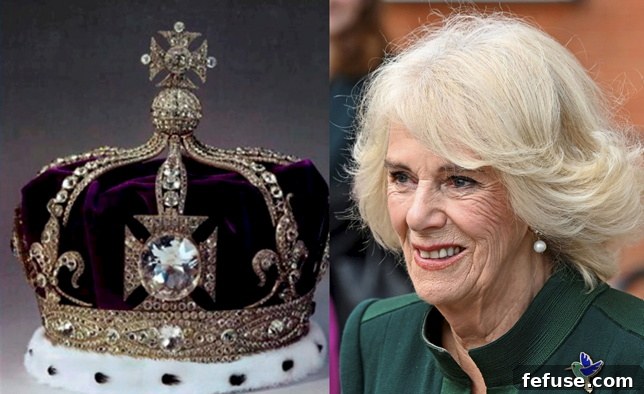
Queen Camilla to Wear Modified Queen Mary’s Crown at Historic Coronation, Avoiding Koh-i-Noor Controversy
Buckingham Palace has formally announced that Queen Consort Camilla will not wear the highly controversial 105-carat Koh-i-Noor diamond during the upcoming coronation of her husband, King Charles III, scheduled for May 6th. Instead, a thoughtful and strategically significant decision has been made: Camilla will wear a meticulously modified version of Queen Mary’s crown, originally crafted by Garrard for the 1911 coronation. This historic crown will be reset with the magnificent Cullinan III, IV, and V diamonds, ensuring a display of breathtaking grandeur while deftly navigating a complex geopolitical issue.
This announcement, while unlikely to fully resolve the long-standing international dispute over the ownership of the Koh-i-Noor diamond – a gem fervently claimed by India, Pakistan, Iran, and Afghanistan – will undoubtedly prevent an immediate and inevitable escalation of tensions that would have overshadowed the solemnity and joy of the coronation ceremony. The choice reflects a modern monarchy’s commitment to diplomacy, sustainability, and a nuanced understanding of its global image.
A Coronation for a New Era: King Charles III and Queen Camilla
The coronation of King Charles III marks a pivotal moment in British history, signifying the formal ascent of a new monarch to the throne and the beginning of a new chapter for the United Kingdom and the Commonwealth realms. For the first time in 70 years, the nation will witness this ancient ceremony, rich in tradition, symbolism, and constitutional significance. Central to this grand spectacle is the role of the Queen Consort, Camilla, whose presence and chosen regalia carry immense symbolic weight.
As Queen Consort, Camilla’s coronation will mirror, in part, the anointing and crowning of the King, though without taking an oath. Her crown is more than just a beautiful piece of jewelry; it is a powerful emblem of her support, her stature within the monarchy, and her commitment to duty. The careful consideration given to her choice of crown underscores the deep historical and cultural resonance of every detail within the coronation ceremony, an event meticulously planned to honour centuries of tradition while reflecting contemporary values.
Queen Mary’s Crown: A Symbol of Continuity and Modernity
The decision to use Queen Mary’s crown for Queen Camilla is a remarkable departure from recent tradition, where new crowns were typically commissioned for Consorts. This choice, as articulated by Buckingham Palace, is driven by clear principles of “sustainability and efficiency.” This marks the first instance in modern history that an existing crown will be repurposed for a consort’s coronation, aligning the monarchy with contemporary concerns about environmental impact and resourcefulness. It suggests a conscious effort to demonstrate fiscal prudence and a forward-thinking approach to royal engagements.
The Enduring Legacy of Queen Mary’s Crown
Queen Mary’s Crown boasts a rich and fascinating history, designed specifically for Queen Mary of Teck – the grandmother of Queen Elizabeth II – for her coronation alongside King George V in 1911. Crafted by the esteemed royal jewelers Garrard, it is a magnificent testament to Edwardian-era opulence and craftsmanship. This elegant crown features a silver frame, lined with gold, and initially incorporated a breathtaking array of 2,200 diamonds, including the historic Koh-i-Noor at its front cross pattee, along with the Cullinan III and IV diamonds.
Over the decades, Queen Mary’s crown has seen several transformations. Notably, after King George V’s death, Queen Mary removed the large diamonds and often wore the crown as a circlet for less formal occasions. Its adaptability and the historical significance of its components make it an ideal choice for a Queen Consort who is stepping into her role in an evolving monarchy. The re-use of such a historically significant item speaks volumes about continuity, respect for heritage, and a practical approach to royal expenditure.
The Dazzling Cullinan Diamonds: Resplendent Additions
For Queen Camilla’s coronation, Queen Mary’s crown will be spectacularly reset with the Cullinan III, IV, and V diamonds. These are extraordinary gems, cut from the colossal Cullinan Diamond, the largest gem-quality rough diamond ever found, weighing an astonishing 3,106 carats (about 1.37 pounds). Discovered in 1905 in the Premier No. 2 mine in Cullinan, South Africa, this monumental diamond was presented to King Edward VII in 1907 and subsequently cut into nine major stones and 96 smaller brilliants by the renowned Asscher Company of Amsterdam.
The Cullinan III, a pear-shaped diamond weighing 94.4 carats, and the Cullinan IV, a cushion-cut diamond of 63.6 carats, are often worn together as a brooch and are affectionately known as “Granny’s Chips” due to their association with Queen Mary and later Queen Elizabeth II. The Cullinan V, a heart-shaped diamond weighing 18.8 carats, is also a prominent part of the Crown Jewels. The decision to incorporate these particular diamonds into Queen Mary’s crown for Camilla’s coronation not only ensures a dazzling display of British royal heritage but also continues a tradition of showcasing some of the world’s most historically significant and precious gems.
The Koh-i-Noor Diamond: A Legacy of Empire and Dispute
The avoidance of the Koh-i-Noor diamond is arguably the most talked-about aspect of the crown choice. This particular gem carries a profound and often painful history, intricately linked to colonial conquest and imperial power. Its inclusion would have undoubtedly reignited strong sentiments and calls for its repatriation, particularly from India, where it remains a highly emotive symbol.
A Diamond Shrouded in History and Dispute
The Koh-i-Noor, meaning “Mountain of Light” in Persian, is a magnificent 14th-century Type IIa D-color Golconda diamond. It was originally cut from a much larger 186-carat gem. Its origins trace back to the Golconda mines in the southern part of India, renowned for producing some of the world’s most famous diamonds, including the Hope Diamond and the Daria-i-Noor.
The diamond’s history is a tumultuous narrative of empires and conquests. It passed through the hands of various Indian rulers, including the Kakatiya dynasty, the Delhi Sultanate, the Mughal emperors, and later, the Persian and Afghan empires. Each transfer of ownership was often the result of fierce battles, treaties, or acts of coercion, lending to its controversial “cursed” reputation among some of its historical owners.
Its journey to Britain occurred in 1847, following the Anglo-Sikh War. At the conclusion of the conflict, the then 10-year-old Maharaja Duleep Singh of the Sikh Empire was compelled to “present” the diamond to Queen Victoria as part of the Treaty of Lahore. This act, under colonial pressure, forms the basis of the current claims for its return, as many view it not as a gift, but as a spoil of war. Upon its arrival in Britain, Prince Albert, Queen Victoria’s consort, deemed its cut dull and lifeless by European standards. Consequently, it was re-cut into a significantly smaller, brilliant oval diamond, weighing 105.6 carats, losing much of its original Indian character but gaining a more dazzling fire according to Victorian tastes. It has been a prominent part of the British Crown Jewels ever since, most notably set in the crowns of Queen Alexandra, Queen Mary, and later, the Queen Mother.
International Claims and Diplomatic Sensitivity
The Koh-i-Noor diamond has become a potent symbol of colonial-era appropriation, particularly for nations like India, Pakistan, Iran, and Afghanistan, all of whom lay claim to its ownership. In India, it is often seen as a national treasure unlawfully taken, and repeated calls for its return have been made by various governments and cultural groups. The emotional resonance of the diamond in these countries is immense, intertwined with national identity and historical grievances.
Wearing the Koh-i-Noor at the coronation would have undoubtedly triggered a fresh wave of outrage and diplomatic headaches, creating an unfortunate distraction from what is intended to be a celebratory and unifying event. By opting for a different crown, Buckingham Palace has demonstrated a keen awareness of these sensitivities, prioritizing international relations and public perception over a strict adherence to historical precedent regarding royal regalia. This strategic move aligns with King Charles III’s known interest in promoting diversity and fostering harmonious international relationships, reflecting a more empathetic and globally conscious monarchy.
Modern Monarchy: Blending Tradition with Contemporary Values
The decision surrounding Queen Camilla’s coronation crown is indicative of a broader trend within the British monarchy under King Charles III – an effort to balance centuries-old tradition with the demands and values of the 21st century. This approach is multifaceted, touching upon areas from environmental responsibility to cultural sensitivity.
Sustainability and Efficiency in Royal Ceremonies
Buckingham Palace explicitly stated that the choice of Queen Mary’s crown was made “in the interests of sustainability and efficiency.” This commitment is a significant signal from the new reign. In an era acutely aware of environmental impact and resource consumption, commissioning an entirely new crown would have sent a message out of step with global priorities. By reusing and modifying an existing, magnificent piece from the Crown Jewels, the monarchy demonstrates a practical and responsible approach. This reflects a broader shift towards a more streamlined, less overtly extravagant image, which may resonate more effectively with a public increasingly scrutinizing institutional spending and environmental footprints.
The Symbolism of Choice: A Monarchy Adapting
The selection of Queen Mary’s crown, coupled with the omission of the Koh-i-Noor, carries profound symbolism. It suggests a monarchy that is willing to adapt, to listen to global conversations about historical injustices, and to project an image of responsibility. For King Charles III, whose reign is expected to be characterized by a focus on environmental causes and interfaith dialogue, such choices are not merely logistical; they are foundational to the narrative of his kingship.
Queen Camilla, through this choice, also embraces a path of continuity and quiet strength. By wearing a crown with deep historical ties to previous Queens Consort, she aligns herself with a lineage of duty and service, while simultaneously sidestepping a controversy that could have overshadowed her significant moment. It allows the focus to remain on the sacred ceremony and the future of the monarchy rather than past colonial legacies.
Preparing for the Grand Occasion
In anticipation of the coronation, Queen Mary’s crown has been removed from its public display at the Tower of London, where it forms part of the magnificent Crown Jewels exhibition. This removal facilitates the necessary modifications, which include the careful extraction of the Koh-i-Noor diamond and the precise resetting of the Cullinan III, IV, and V diamonds. Such intricate work is undertaken by the Crown Jeweller, a highly skilled craftsperson responsible for the maintenance and care of the precious royal regalia.
Queen Elizabeth II’s Endorsement
Adding another layer of significance to this choice is the reported endorsement from Queen Elizabeth II herself. Shortly before her passing, the late monarch is understood to have indicated her wish for Camilla to wear the crown. This personal blessing from the revered Queen Elizabeth II lends an air of legitimacy and continuity to the decision, reinforcing Camilla’s role and ensuring that the choice is seen not just as a practical or diplomatic one, but also as one rooted in the continuity of the royal family’s wishes. This connection to the deeply respected Queen Elizabeth II provides a powerful narrative, further solidifying Camilla’s position as Queen Consort and her impending coronation as a moment of both historical progression and heartfelt remembrance.
Conclusion: A Crown That Speaks Volumes
As the world eagerly anticipates the coronation of King Charles III and Queen Camilla, the choice of Queen Mary’s crown stands as a profound statement. It is a decision that masterfully balances adherence to grand royal tradition with a pragmatic and sensitive response to contemporary global realities. By embracing sustainability, respecting international sensitivities, and upholding continuity within the royal lineage, the British monarchy demonstrates its capacity to evolve while honouring its rich heritage. Queen Camilla’s crown will not only be a dazzling centrepiece of the coronation but also a powerful symbol of a modern monarchy navigating a complex world, representing a reign that seeks to be both deeply traditional and consciously forward-looking.