
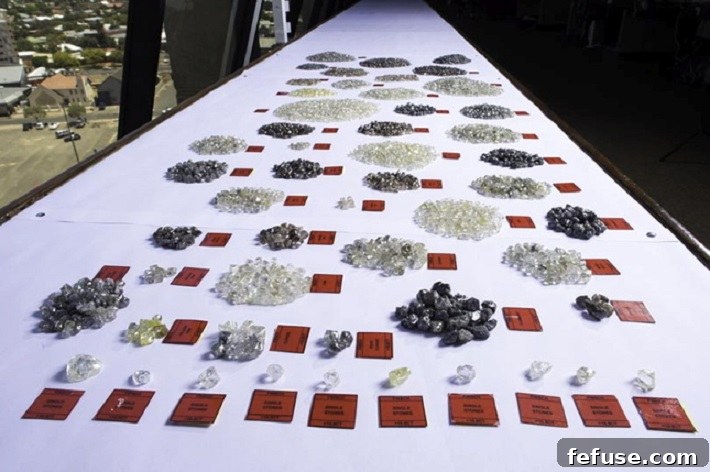
Petra Diamonds Navigates Challenging Diamond Market with Strategic Sales Deferral
In a clear reflection of current pressures within the global diamond industry, Petra Diamonds, a leading independent diamond mining company, has announced the postponement of its anticipated June tender. This strategic move, which involves a significant parcel of 380,000 carats, serves as a further indication of a discernible slowdown gripping the midstream segment of the diamond supply chain. The decision underscores a period of heightened caution among miners and signals a proactive approach to safeguard asset value amidst fluctuating market conditions.
Understanding the Midstream Slowdown: Key Market Dynamics
The “midstream” of the diamond pipeline encompasses the crucial stages of cutting, polishing, and trading rough diamonds into finished gems. This segment acts as a vital link between the mining operations (upstream) and the retail market (downstream). A slowdown here typically implies an accumulation of inventory, reduced demand for rough diamonds from cutters and polishers, and a general tightening of credit lines. Petra Diamonds’ experience at its May tender offered an early warning sign, with the UK-based miner reporting a substantial 42 per cent drop in sales compared to its March event. Furthermore, the company was compelled to withdraw almost 76,000 predominantly high-value carats from sale due to the prevailing weak demand, highlighting the severity of the market conditions.
Several factors contribute to such a slowdown. Macroeconomic uncertainties, including rising inflation, higher interest rates, and geopolitical tensions, often dampen consumer confidence, subsequently impacting demand for luxury goods like diamonds. Inventory levels in the midstream can swell when polished diamond sales slacken, leading to a bottleneck that reduces the appetite for new rough diamond purchases. Additionally, cyclical factors such as extended holiday periods in key manufacturing hubs, like the Indian holidays mentioned by Petra’s CEO, Richard Duffy, can temporarily halt production and further exacerbate inventory build-up, creating a ripple effect across the entire value chain.
Petra’s Strategic Pivot: Responding to Evolving Market Realities
Initially, Petra Diamonds had expressed optimism regarding a market recovery, with CEO Richard Duffy stating two weeks prior that “Demand is expected to improve and the withdrawn parcels will be offered for sale at Petra’s Antwerp facilities during May and June 2023.” However, the subsequent decision to defer both the goods from the June tender and the previously withdrawn May diamonds until August suggests that the market recovery has not materialized as quickly or as robustly as anticipated. This shift in strategy indicates Petra’s agile response to real-time market signals, prioritizing long-term value over immediate sales at potentially unfavorable prices.
In a more recent statement, Mr. Duffy elaborated on the updated rationale: “In light of what we expect to be a temporary slowdown in the market for rough diamonds as a result of elevated inventory in the mid-stream, we have taken the decision to postpone the majority of our Tender 6 rough diamond sales.” This reiterates the core issue of midstream inventory and frames the postponement as a tactical, temporary measure. The company plans to offer the deferred goods, alongside the previously withdrawn high-value carats, during August, aligning with what it hopes will be a more receptive market environment.
The Strength of Flexibility: A Resilient Business Model
A key aspect emphasized by Mr. Duffy is Petra’s capacity for flexibility. He noted, “Our ability to be flexible in the timing of our tenders is attributable to our strengthened balance sheet and the resilience of our business.” This statement is crucial, as it indicates that Petra is not operating from a position of distress but rather from one of financial stability, allowing it to make strategic decisions that might not be available to less robust competitors. The company believes this deferral will only impact sales revenues for “a relatively short period” and is ultimately “in the best interests of the business and shareholders,” by preserving the value of its rough diamond inventory and optimizing sale prices.
Operational Landscape: Mines and Production Outlook
The 380,000 carats slated for the June tender were primarily sourced from Petra’s key South African operations. Approximately 230,000 carats were expected from the iconic Cullinan Mine, renowned for its production of large, high-value diamonds, including some of the world’s most famous gems. The remaining 150,000 carats were anticipated from the Finsch Mine, another significant producer within Petra’s portfolio, known for its consistent output of quality rough diamonds. These mines are the backbone of Petra’s production and their output’s successful sale is vital for the company’s financial health.
Navigating Challenges: Williamson and Koffiefontein
Beyond its core South African assets, Petra Diamonds also operates in Tanzania and is in the process of closing operations in another South African mine. The Williamson deposit in Tanzania remains out of action following a breach of a tailings dam, which has significantly impacted the company’s overall production profile and required substantial remediation efforts. This incident highlights the inherent operational risks within the mining sector and the financial and reputational implications of such events. Furthermore, the loss-making Koffiefontein mine in South Africa is in the process of being closed for good, a strategic decision to divest from non-performing assets and streamline operations, focusing resources on more profitable ventures.
Financial Implications and Petra’s Resilience
The deferral of Petra’s June sales means that the associated revenues will now be recognized in the Financial Year 2024, inevitably impacting the company’s reported revenues and financial results for the current period. While this shift will certainly be noticeable in upcoming reports, Petra Diamonds has expressed strong confidence in its ability to manage this temporary setback. The company explicitly stated that the delay is manageable without the need to draw on its $52 million revolving credit facility. This detail is critical, as it underscores Petra’s robust liquidity position and its capacity to absorb short-term revenue fluctuations without resorting to additional debt, further reinforcing the message of a strengthened balance sheet and operational resilience. This prudent financial management is key to navigating the cyclical nature of the diamond industry.
Broader Industry Outlook: Navigating Uncertainty in the Luxury Market
Petra’s decision is not an isolated incident but rather indicative of broader trends within the global diamond industry. The rough diamond market is inherently volatile, influenced by a complex interplay of supply-side factors (mine production, new discoveries) and demand-side drivers (global economic health, consumer sentiment, luxury spending patterns). While demand for diamonds has shown remarkable resilience in recent years, particularly in key markets like the US and China, periods of economic contraction or uncertainty invariably lead to reduced discretionary spending on luxury items. The current midstream slowdown highlights the sensitivity of the entire pipeline to these macroeconomic shifts.
Industry analysts are closely monitoring these developments, looking for signs of stabilization or recovery. The outlook for the remainder of the year will largely depend on several key indicators: the resolution of inventory overhangs in the midstream, a rebound in polished diamond sales, and an improvement in overall global economic sentiment. Companies like Petra Diamonds, with their strategic flexibility and robust financial standing, are better positioned to weather these storms and capitalize on eventual market recoveries. The long-term fundamentals of the diamond market, driven by increasing wealth globally and the enduring appeal of diamonds as symbols of love and commitment, remain strong, but the short to medium term demands careful navigation and strategic foresight.
Conclusion: A Strategic Pause for Long-Term Value Creation
Petra Diamonds’ decision to postpone its June tender and defer sales to August represents a considered and strategic response to the prevailing weakness in the rough diamond market’s midstream. Far from being a sign of weakness, it reflects a strong commitment to value preservation and prudent asset management, underpinned by a robust balance sheet and operational resilience. By waiting for more favorable market conditions, Petra aims to maximize the realized value for its high-quality rough diamonds from Cullinan and Finsch, ultimately benefiting its business and shareholders. As the diamond industry continues to navigate a complex global economic landscape, such adaptive strategies will be crucial for sustainable success and long-term value creation.