
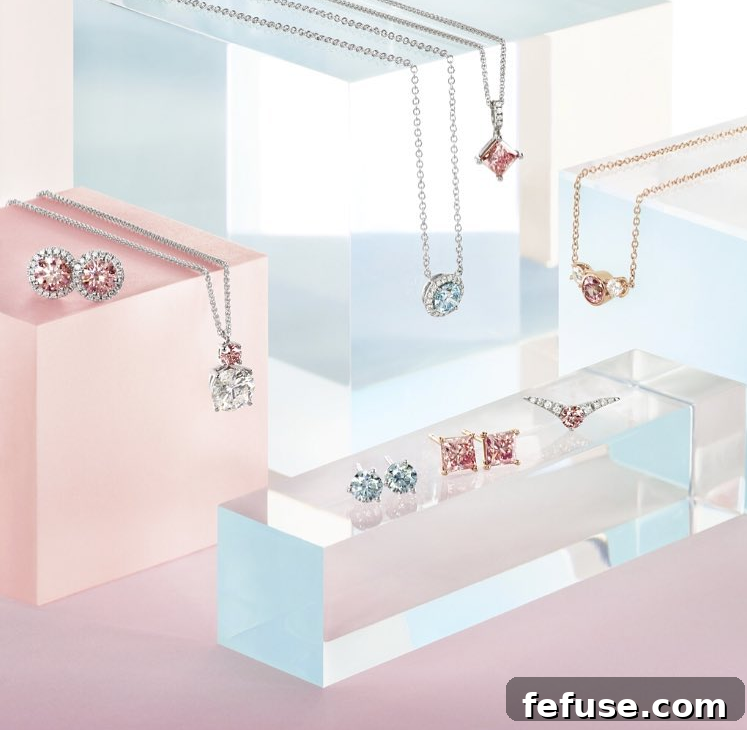
The global diamond industry is witnessing a seismic shift with the much-anticipated entry of De Beers, historically the titan of natural diamonds, into the burgeoning lab-grown diamond market. Its new brand, Lightbox, set to launch this month, has already ignited a firestorm of controversy among competitors who are openly questioning whether its proposed pricing strategy is deliberately set too low, potentially signaling a disruptive — or even predatory — market maneuver.
De Beers’ Strategic Entry with Lightbox: Reshaping the Diamond Landscape
While a precise launch date remains under wraps, the industry anticipates De Beers’ official foray into man-made gems within weeks. Lightbox promises to deliver high-quality fashion jewellery featuring lab-grown diamonds, aiming to make these captivating stones accessible to a broader consumer base through significantly lower price points than what is currently prevalent in the synthetic diamond sector. This move by De Beers, a company deeply rooted in the mystique and scarcity of natural diamonds, marks a pivotal moment, challenging established norms and forcing rivals to reconsider their own positions and strategies.
Unpacking Lightbox’s Aggressive Pricing Model
The cornerstone of Lightbox’s strategy lies in its remarkably aggressive pricing. De Beers has stated that Lightbox lab-grown diamonds will retail starting from US$200 (approximately £151) for a quarter-carat stone, escalating to US$800 (approximately £604) for a full one-carat stone. This pricing structure is groundbreaking for several reasons. Firstly, it starkly contrasts with the pricing of natural diamonds, creating a clear demarcation. Secondly, it also significantly undercuts the existing market for lab-grown diamonds, which, while more affordable than their natural counterparts, still command premium prices, often representing a substantial percentage of natural diamond prices.
De Beers articulates its strategy as a move to “eliminate customer confusion over lab-grown diamonds and their natural counterparts.” By positioning lab-grown diamonds as a distinct, more affordable category primarily for fashion jewellery, the company ostensibly aims to clarify the market, rather than blur the lines. This distinction, they argue, will preserve the unique value proposition and luxury status of natural diamonds, while allowing lab-grown alternatives to flourish in a separate, high-volume segment focused on everyday accessibility and transient trends. However, this seemingly benevolent objective has been met with considerable skepticism and outright alarm from within the lab-grown diamond industry.
Industry Backlash: Allegations of Predatory Pricing and Market Manipulation
Almost immediately following the announcement, several lab-grown diamond producers began to “cry foul,” expressing serious concerns about the implications of Lightbox’s pricing. The core of their argument revolves around accusations of price dumping and predatory pricing—tactics that, if proven, could constitute anti-competitive behavior. Bloomberg reported that segments of the lab-grown industry had filed a complaint with the U.S. Federal Trade Commission (FTC), urging the regulatory body to investigate De Beers’ practices.
The Voice of Discontent: Tom Chatham’s Perspective
A prominent voice in this chorus of concern is Tom Chatham, CEO of Chatham Created Gems, a company with a long history in the synthetic gem market. As quoted by Bloomberg, Chatham articulated the industry’s incredulity: “De Beers aren’t stupid. They know how to grow diamonds, but this equipment is not cheap. They are selling below cost.” This statement cuts to the heart of the matter. If De Beers is indeed selling lab-grown diamonds at prices below their production cost, it suggests a deliberate strategy to stifle competition, drive smaller players out of the market, and ultimately gain a dominant, possibly monopolistic, position once competitors have been eliminated or forced to consolidate.
Following the initial Bloomberg report, the US jewellery industry publication JCK reached out to Tom Chatham for further clarification. Chatham confirmed that he had indeed submitted comments to the FTC regarding De Beers’ pricing strategy, though he would not characterize it as a “formal complaint” in the absence of legal counsel involvement. Nevertheless, his submission underscored profound concerns about the potential market ramifications.
Chatham elaborated on his stance to JCK, drawing on decades of experience: “As a grower of gem crystals for over 53 years, growing diamonds since 1993, I [am] very familiar with the costs. I felt it was impossible for Lightbox to sell 1 ct. eye-clean, white stones at stated prices and that De Beers had a 100-year-plus history of buying markets and shoving competitors aside.” This statement from an industry veteran carries significant weight. Chatham’s assertion of “impossibility” regarding Lightbox’s stated prices, combined with his reference to De Beers’ historical market tactics, paints a picture of a company potentially leveraging its immense financial power and historical dominance to manipulate a nascent market.
Understanding Predatory Pricing and its Implications
Predatory pricing is a deliberate strategy by a dominant firm to set prices so low as to drive competitors out of the market or prevent new entrants. Once competition is eliminated, the predator can then raise prices to supra-competitive levels, recouping its losses and ultimately harming consumer welfare in the long run. Given De Beers’ past market behaviors and its formidable resources, these accusations, even if not yet formally proven, are taken very seriously within the industry and by regulatory bodies like the FTC. The potential for such practices to stifle innovation and consolidate market power in a rapidly evolving sector is a major concern.
De Beers’ Perspective: Profitability, Not Dominance?
Despite the uproar, De Beers CEO Bruce Cleaver has maintained that he expects the company’s lab-made gems venture to be profitable. However, he also made a seemingly contradictory statement, confirming that Lightbox is “not going to be a big business for the company.” This assertion has left many scratching their heads. Why would a company of De Beers’ stature invest significant capital and brand reputation into a market it believes will not be “big business,” especially when facing accusations of predatory pricing?
One interpretation is that De Beers’ primary motivation isn’t to dominate the lab-grown market outright, but rather to control its narrative and trajectory. By setting a low price ceiling, De Beers might be attempting to “commoditize” lab-grown diamonds, effectively differentiating them from natural diamonds and solidifying the perception of natural diamonds as the ultimate symbol of rarity and enduring value. In this scenario, Lightbox serves as a strategic defensive play to protect the core natural diamond business by clearly delineating the two product categories and ensuring that lab-grown diamonds do not erode the perceived value or pricing power of natural diamonds.
Broader Market Implications and the Future of Diamonds
The entry of Lightbox is set to have far-reaching consequences across the entire diamond supply chain. Existing lab-grown diamond producers, many of whom have invested heavily in technology and marketing to establish their brands, are now faced with immense pressure to either match Lightbox’s prices or find new ways to differentiate their offerings. This could lead to a wave of price reductions, consolidation within the industry, or a strategic pivot towards niche markets or specialized lab-grown diamond applications.
For consumers, the implications are generally positive in terms of accessibility. The availability of high-quality, eye-clean diamonds at such an affordable price point could democratize diamond ownership, making them accessible for fashion jewellery, gifts, and personal adornment without the significant investment traditionally associated with natural diamonds. However, the potential for market confusion, despite De Beers’ stated aim, still exists, particularly if the distinctions between natural, lab-grown, and simulants are not clearly and consistently communicated across the industry.
For the natural diamond market, Lightbox’s strategy could be a double-edged sword. On one hand, by clearly separating lab-grown diamonds into an affordable “fashion” category, De Beers might succeed in reinforcing the unique luxury and investment value of natural diamonds. On the other hand, the sheer affordability of lab-grown alternatives might subtly devalue the perception of all diamonds for some consumers, making the premium price of natural diamonds harder to justify for those primarily seeking aesthetic appeal rather than intrinsic value or rarity.
A Transforming Industry at a Crossroads
The launch of De Beers’ Lightbox brand signifies more than just a new product line; it marks a critical juncture in the evolution of the global diamond industry. It pits traditional power against modern technology, scarcity against accessibility, and established market structures against disruptive innovation. The accusations of predatory pricing, whether formally upheld or not, underscore the intense competition and strategic maneuvering at play. As regulatory bodies continue to monitor the situation, and competitors adapt their own strategies, the coming months will reveal the true impact of Lightbox and how it ultimately reshapes consumer perceptions, market dynamics, and the very definition of a “diamond” in the 21st century. The diamond world is undoubtedly sparkling with new possibilities, but also navigating uncharted and contentious waters.
News Source : professionaljeweller.com