
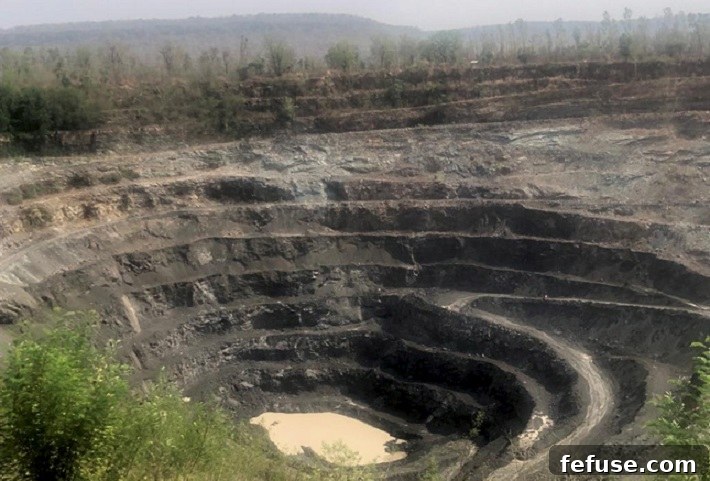
The gears of progress are once again turning at India’s sole mechanized diamond mine, the Majhgawan project. Located in the heart of the central state of Madhya Pradesh, this vital operation, now managed by the National Mineral Development Corporation (NMDC), signifies a renewed commitment to domestic diamond production and economic growth. This resumption of work after significant pauses is a crucial development for India’s mineral sector, highlighting both the immense potential and the inherent challenges of large-scale mining operations in environmentally sensitive regions.
Before the sparkling gems can be extracted, an extensive and meticulous process of overburden removal must be completed. This critical initial phase, involving the clearing of vast quantities of soil and stone that lie above the diamond-bearing Kimberlite pipe, is projected to take approximately one year. This lengthy preparatory stage underscores the scale and complexity of mechanized diamond mining, demanding significant capital investment, advanced machinery, and meticulous planning. NMDC, India’s largest iron ore merchant miner, harbors ambitious goals for the Majhgawan mine, aiming to achieve an annual production target of 40,000 carats once full extraction commences. This target, if realized, would significantly bolster India’s domestic diamond supply, albeit a small fraction of its vast processing needs.
The Panna Diamond Mining Project, situated merely 15 kilometers from the historic town of Panna, boasts a rich and storied history. Commercial production first began in 1971, with the mine operating under the stewardship of the global mining giant Rio Tinto until 2017. Over its long operational life, the mine has faced numerous challenges and experienced several production halts, reflecting the dynamic interplay between economic imperatives, regulatory frameworks, and environmental concerns. Its designation as India’s only mechanized diamond mine highlights its unique technological capacity and its importance in contrast to the more numerous artisanal mining operations scattered across the country.
One of the most significant impediments to continuous operation has been the intricate balance required with environmental conservation. In December 2020, the mine’s environmental clearances notably lapsed, primarily due to valid concerns raised by the proximity of the revered Panna Tiger Reserve. This critical juncture brought into sharp focus the imperative of sustainable mining practices and the need for robust environmental impact assessments and mitigation strategies. The Panna Tiger Reserve is a vital ecological hotspot, home to a flourishing population of Bengal tigers and diverse biodiversity, making any industrial activity in its vicinity subject to rigorous scrutiny and stringent regulations. The temporary cessation of operations underscored the absolute necessity for NMDC to demonstrate unwavering commitment to ecological preservation and to secure renewed clearances through comprehensive environmental management plans.
The recent history of production at Majhgawan illustrates the direct impact of these operational stoppages. For the fiscal year 2021 (FY2021), the mine recorded a production of 13,681 carats. However, the subsequent fiscal year, FY22, saw no production activity, although 25,219 carats were successfully sold from existing stockpiles, generating approximately $7.5 million in revenue. This period of non-production extended into FY23 and persisted through the first eleven months of FY24, representing a substantial loss of potential revenue and a disruption to the domestic diamond supply chain. The reliance on stockpiled diamonds for sales during these periods highlights the financial and operational challenges posed by extended halts and the critical importance of achieving stable, continuous production for the project’s long-term viability and profitability.
India’s diamond landscape is multifaceted. While Majhgawan stands alone as the country’s sole mechanized diamond mine, there are over 1,000 licensed artisanal mines operating across various regions. This contrast underscores the dichotomy within the Indian diamond extraction sector. Mechanized mining, as demonstrated by Majhgawan, involves large-scale operations, significant capital investment, advanced technology, and a higher degree of industrial efficiency and safety protocols. It allows for the processing of vast quantities of ore to extract diamonds, typically from primary Kimberlite sources. Artisanal mining, on the other hand, is characterized by smaller scale operations, often relying on manual labor and rudimentary tools, primarily focusing on alluvial deposits or small-scale primary sources. These artisanal operations, while providing livelihoods for thousands, often face challenges related to worker safety, environmental regulation, and consistency of production. The Majhgawan project, therefore, represents a crucial technological benchmark and a significant contributor to the nation’s strategic mineral resources.
The journey from the Earth’s depths to a polished gem is complex and arduous. For a mechanized mine like Majhgawan, the process of overburden removal, followed by ore extraction, crushing, screening, and ultimately diamond recovery through advanced sorting technologies, is a highly engineered endeavor. The scale of operation requires powerful excavators, trucks, and sophisticated processing plants capable of handling thousands of tons of material daily. This contrasts sharply with the labor-intensive methods of artisanal miners, who might sift through riverbeds or excavate shallow pits. The ambition to produce 40,000 carats annually places Majhgawan as a key player in India’s aspiration to enhance its self-reliance in rough diamond sourcing, even though the country remains heavily dependent on imports to feed its colossal diamond cutting and polishing industry, which processes approximately 90% of the world’s rough diamonds.
Re-establishing consistent operations at Majhgawan is not just about diamond production; it’s also about regional economic development and national pride. The mine provides direct employment opportunities for a significant workforce, ranging from geologists and engineers to plant operators and administrative staff. Moreover, its operations stimulate a myriad of indirect economic activities, supporting local businesses, supply chains, and infrastructure development in Madhya Pradesh. A stable and productive mine contributes to the state’s revenue through royalties and taxes, which can then be reinvested into public services and community development projects. The long-term success of the Majhgawan project under NMDC’s stewardship is therefore intrinsically linked to the economic well-being of the surrounding communities and the broader region.
Looking ahead, the Majhgawan Diamond Mine represents more than just a source of precious stones; it is a testbed for sustainable mining practices in India. The renewed environmental clearances will undoubtedly come with stringent conditions, requiring NMDC to implement robust environmental management systems, including water conservation, dust control, waste management, and biodiversity protection measures. The focus will be on minimizing the ecological footprint and ensuring co-existence with the Panna Tiger Reserve. This ongoing dialogue and adaptation between industrial activity and environmental stewardship are critical for the future of resource extraction in sensitive areas globally. The successful operation of Majhgawan, demonstrating both economic viability and environmental responsibility, could serve as a model for future mineral development projects in India, ensuring that the pursuit of natural resources does not come at an irrecoverable cost to the nation’s invaluable natural heritage.
In conclusion, the resumption of operations at India’s only mechanized diamond mine marks a pivotal moment. With NMDC at the helm, the Majhgawan project is poised to overcome past hurdles, embark on a path toward its 40,000-carat annual production target, and contribute significantly to India’s domestic diamond supply. The extensive period of overburden removal symbolizes the investment and commitment required. Furthermore, the challenges encountered with environmental clearances underscore the paramount importance of integrated planning, sustainable practices, and continuous engagement with conservation efforts. As Majhgawan moves forward, it will not only contribute precious diamonds to the market but also shape the narrative around responsible and mechanized mining in a nation striving to balance industrial growth with ecological preservation, setting a precedent for future resource endeavors across India.