

Gold’s Resurgent Bull Market: Poised for a Major Breakout Above $1350
In recent months, gold has largely stayed out of the spotlight, overshadowed by the impressive rally in the stock market. However, behind this quiet facade, gold has been consolidating its gains at high levels, meticulously building a foundation for its next significant move. This period of consolidation positions gold for a crucial challenge to its major bull-market resistance level of $1350. A decisive breach of this threshold would undoubtedly capture the attention of global investors, dramatically improving market sentiment and attracting substantial capital inflows. With gold-futures speculators not yet heavily long, there remains ample buying power to propel prices higher.
The Dominant Influence of Gold Futures Speculators
Last August, gold experienced a significant downturn, hitting a 19.3-month low near $1174. This decline was primarily driven by unprecedented levels of short selling in gold futures. Speculators trading these derivatives wield a disproportionately powerful influence over short-term gold price movements, particularly when investor demand is subdued. The aggressive trading of gold futures can dramatically sway gold’s price, often distorting the broader psychological landscape surrounding the gold market.
The core reason for this immense influence lies in the extreme leverage inherent in gold futures contracts. For instance, the maintenance margin required to trade a single 100-troy-ounce gold-futures contract might be as low as $3400. This is the minimum cash required in a trader’s account. Yet, with gold recently trading around $1300, each contract controls gold valued at $130,000. This allows gold-futures speculators to operate with staggering leverage, often exceeding 38 times their capital. Such leverage means that even a small amount of capital can exert a massive impact on market prices.
Operating with such high leverage is inherently risky. A mere 2.6% adverse price movement against a fully leveraged position could result in a 100% loss of capital. This extreme risk profile contrasts sharply with other markets; for example, stock markets have had a legal leverage limit of 2x since 1974. Leverage of 10x, 20x, or even 30x+ is exceptionally aggressive and has historically led to significant volatility in the gold market, greatly amplifying the effect of gold-futures speculators on prices.
Due to this amplification, every dollar invested in gold futures with 30x leverage has 30 times the impact on gold prices compared to a dollar invested directly in physical gold. Consequently, even though gold-futures speculators command considerably less overall capital than long-term investors, their amplified buying and selling power makes their market actions far more potent. When general gold investment demand is weak, as it has been recently amidst robust stock market performance and widespread complacency, gold-futures speculators become the primary drivers of gold price action.
Their collective trading activities also significantly shape gold market psychology. The American gold-futures price has become the global benchmark for gold. Investors often begin to feel bullish and initiate purchases only after gold-futures speculators have already pushed prices higher. Conversely, aggressive gold-futures selling can foster bearish sentiment among investors, prompting them to liquidate their gold holdings. In essence, gold-futures trading acts as the “tail that wags the dog” of gold investment.
Decoding Speculator Behavior: The Commitments of Traders Reports
Given their profound impact, anyone with an interest in gold must closely monitor the collective actions of gold-futures speculators. The US Commodity Futures Trading Commission (CFTC) provides crucial insights into their positioning through its weekly Commitments of Traders (CoT) reports. Released late on Friday afternoons, these reports detail the aggregate number of gold-futures long and short contracts held by various groups of traders as of the preceding Tuesday’s close. These reports offer a transparent look into the market’s underlying dynamics.
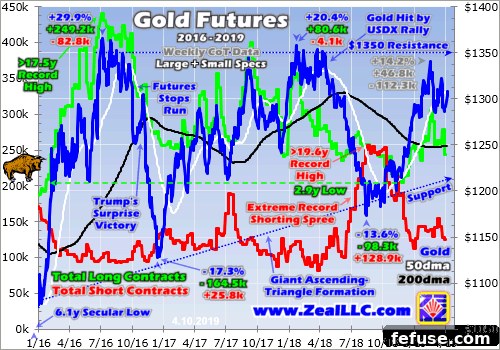
Despite gold’s healthy upward trend since its mid-August lows, CoT data reveals that these traders still possess substantial buying power, suggesting the potential for significantly higher gold prices. The daily gold price (depicted in blue) overlaid with speculators’ weekly total gold-futures long (green) and short (red) contracts clearly illustrates this. A large portion of gold’s gains to date in this upleg has been fueled by short-covering buying. Crucially, the larger volume of long buying, typically a hallmark of more mature uplegs, is still largely anticipated.
The Genesis of the Current Gold Upleg: Short Covering
In mid-August, when the current gold upleg began, speculators’ total gold-futures shorts surged to an astonishing 256.7k contracts. This figure represented the highest level recorded in over 19.6 years, dating back to early 1999, and was almost certainly an all-time record. This unprecedented wave of extreme shorting hammered gold, driving it down from approximately $1300 to $1175 within a span of roughly two months. Such a sharp, futures-driven decline inevitably devastated market psychology, leading many to question gold’s future.
These gold-futures traders were effectively “borrowing” gold they did not own and selling it into the market, with the expectation of repurchasing it later at lower prices to profitably cover their debts. Executing this strategy with extreme 30x+ leverage amplified the price impact of their capital significantly. This record shorting spree was not fundamentally driven; rather, it was a self-reinforcing momentum play. Nevertheless, the resulting price plunge spooked many investors into selling their holdings in sympathy, further exacerbating the downturn.
Consider the contrast: in mid-June, with gold trading just above $1300, total speculator shorts stood at only 100.3k contracts. Over the subsequent ten CoT weeks, this figure skyrocketed by 156% to the record 256.7k. The resulting “gold carnage” compelled American stock investors to sell shares in the leading GLD SPDR Gold Shares ETF at an even faster rate than gold itself was being sold. This forced a reduction in GLD’s gold-bullion holdings by 60.1 metric tons, or 7.2%, within that short period.
Gold reached its bottom precisely the week gold-futures short sellers had seemingly exhausted their capital limits. Since then, gold has steadily climbed higher, enjoying a robust 14.2% upleg over the following 6.2 months into mid-February. Gold briefly peaked near $1341 then, and has since been consolidating at these elevated levels. This upleg has been primarily propelled by gold-futures buying, a perfectly normal pattern in the initial phases of a gold rally.
The Three Stages of Gold Uplegs: Fueling Sustainable Growth
Major gold uplegs typically unfold in three distinct stages, each driven by different groups of traders. The inception and initial momentum of an upleg are always provided by gold-futures short covering. Speculators are motivated to buy long contracts to cover their short positions and lock in profits. This short covering quickly becomes a self-feeding cycle; rapid gold price gains compel other short-side traders to quickly buy to cover, avoiding potentially catastrophic leveraged losses.
However, this “stage-one” short-covering buying typically expends itself after a couple of months. But before it fades, it pushes gold prices high enough and for long enough to entice long-side gold-futures speculators back into the market. These long-side traders command significantly more capital than their short-side counterparts, as evidenced by the green “long” line on the chart usually being considerably higher than the red “short” line. Speculator gold-futures long buying constitutes the second crucial stage of an upleg.
Stage two unfolds more gradually than short covering, often lasting six months or even longer. Long-side traders possess greater capital to deploy, and their buying is entirely voluntary. They must have genuine conviction that gold prices are set to rise further to commit to such risky, hyper-leveraged upside bets. In contrast, short covering is frequently mandatory and often involuntary, as these effective “debts” must be legally repaid. The buying pressure from stage one directly ignites stage two.
The Unfolding Stage Two: Remaining Long Buying Potential
Gold possesses significant bull-market breakout potential in the coming months precisely because this current upleg has not yet seen extensive gold-futures long buying. While stage two is underway, the majority of this buying is likely still to come. The “total spec gold-futures longs” line clearly supports this; at its peak in mid-February near gold’s recent high, total speculator longs reached 305.0k contracts. Since then, they have retreated sharply to 243.8k as of last Tuesday, indicating considerable room for growth.
Both of these levels are remarkably low when compared to historical precedents within this current bull market. This young secular gold bull emerged from deep 6.1-year secular lows in mid-December 2015. Its maiden upleg was swift and substantial, with gold soaring 29.9% in just 6.7 months during the first half of 2016. As that rally peaked in early July 2016, total speculator longs hit an all-time record high of 440.4k contracts, demonstrating the willingness of gold-futures traders to pile in and fuel significant upside momentum.
During that same CoT week, total speculator shorts stood at 100.2k contracts. That upleg was partly driven by gold-futures speculators adding a massive 249.2k longs while simultaneously covering 82.8k shorts. Gold reached $1365 in early July, a level that remains the highest point of this bull market to date. In subsequent years, the $1350 level repeatedly repelled gold, establishing itself as a significant overhead resistance as gold consistently failed to break above it.
Speculators soon began to unwind their excessive long positions, contributing to gold’s 17.3% decline by mid-December 2016. This heavy gold-futures selling was intensified by the surging stock markets following Trump’s unexpected election victory. This gold bull’s second upleg then emerged, first driven by gold-futures short covering, which quickly triggered gold-futures long buying – mirroring the pattern of the first upleg.
Gold surged another 20.4% higher to $1358 by late January 2018, only to falter once again near that critical $1350 resistance. Gold-futures speculators played a somewhat lesser role in this upleg as genuine investor interest began to return. Gold investment buying represents the third stage of gold uplegs, a phase that can lead to far greater price movements than the futures-driven stages. Futures buying essentially acts as a two-stage ignition mechanism designed to attract broader investor participation.
During that second upleg, total gold-futures longs climbed only 80.6k contracts, while shorts merely slipped 4.1k. However, these precise upleg dates can be slightly misleading, as the green “long” line generally trended higher while the red “short” line trended lower throughout the period. When that upleg peaked, total speculator longs and shorts were running at 356.4k and 121.9k contracts respectively. The former figure was still significantly higher than today’s levels, serving as a highly bullish indicator for current potential.
The first two uplegs of this gold bull faltered when total speculator longs were considerably higher than today’s 243.8k, averaging around 398.4k contracts. Historically in this bull market, second-stage speculator long buying has typically exhausted itself and curtailed uplegs when positions reached approximately 350k to 450k contracts. Therefore, the sub-250k levels observed last Tuesday are still far too low to indicate a mature gold upleg. Speculators have ample room to complete the majority of their stage-two long buying, suggesting significant upside remains.
It is highly probable that this gold upleg will see at least another 100k contracts of long buying, and potentially up to 200k if gold regains significant favor among traders. This translates into the gold-futures equivalent of an additional 311 to 622 metric tons of gold demand. Such substantial buying pressure will almost certainly catapult gold prices much higher, replicating the dynamics observed during this bull’s previous uplegs. Given gold’s current position, this creates a major bull-market breakout potential, making a concerted assault on the $1350 resistance level highly likely.
The Significance of $1350: A Gateway to New Bull Market Highs
Throughout the entire lifespan of this gold bull market, gold has never traded higher with speculator long positions below 250k contracts than it is today near $1300. Typically, with this level of positioning, the yellow metal would be hovering around $1250. This indicates that we are currently witnessing gold’s highest basing formation in its bull market relative to speculator long positions. The $1350 resistance is not a distant target, representing just another 3.8% increase from $1300. There is a strong probability that the remaining stage-two buying will successfully drive gold to this critical level.
While not an exact science, in previous gold uplegs within this bull market, an increase of 50k contracts in gold-futures long buying has often propelled gold prices $50 higher. Considering we anticipate at least another 100k contracts, and potentially up to 200k in a best-case scenario, gold is arguably better positioned now than ever before in this bull market to surge towards and decisively break through its multi-year $1350 resistance. A conclusive breakout above $1350 would fundamentally alter the psychology and dynamics of the gold market, signaling a new era of growth.
Gold-futures speculators, due to their extreme leverage, are inherently focused on short-term momentum. Their primary objective is to ride the immediate trend, regardless of gold’s long-term fundamentals. Investors, however, operate with a vastly different mindset. Lacking leverage, they maintain a long-term perspective. For investors, nothing generates more excitement and drives greater capital inflows into gold than the achievement of new bull-market highs. Consistently higher highs validate gold’s upward trajectory, signaling further future gains and instilling confidence.
Investors have not witnessed a new gold-bull high since early July 2016, a period that feels like an eternity in the fast-paced financial markets. As months and years passed with gold consistently failing to surpass $1350, many investors gradually lost interest. While gold’s bull-market lower support zone has incrementally risen, the persistent horizontal upper resistance at $1350 significantly tainted market psychology. Gold came to be perceived as merely consolidating, rather than actively progressing within a robust bull market.
However, the potential for 100k to 200k contracts of speculator gold-futures long buying, commencing from current levels near $1300, holds the genuine potential to propel gold convincingly above $1350. A decisive breakout is defined as a move of 1% or more beyond that level, or approximately $1364. Once gold surpasses $1365, it will begin to register new bull-to-date highs. This achievement will thrust gold back into major financial news headlines, reigniting broad investor interest and stimulating significant capital inflows. The resulting bullish sentiment is likely to become a powerful, self-sustaining force.
The prospect of major “stage-three” investment gold buying becomes considerably more likely the higher gold climbs above $1350. It’s a curious irony that while sound investment principles advocate buying low when assets are out of favor, the vast majority of investors instead prefer to chase winners, flocking into positions as their prices ascend. There is little doubt that new bull-market gold highs will generate substantial excitement and draw significant attention to this precious metal.
Amplifying Factors: Seasonality and Stock Market Dynamics
Gold’s bull-market breakout potential in the coming months is further amplified by a couple of other significant factors. Firstly, gold is currently in a seasonally strong period of the year, typically enjoying its seasonal spring rally. This provides a solid sentimental tailwind, which should help to motivate gold-futures speculators to continue rebuilding their relatively low gold-futures long positions. Their buying activity, once initiated, tends to become self-reinforcing, gaining momentum as gold prices rise and sustain their upward trend.
More importantly, gold investment levels remain exceptionally low, largely due to the extraordinary stock market rally witnessed since late December. With US stock markets skyrocketing from severe correction lows (which almost signaled a bear market) to nearly reclaiming September’s all-time highs, market complacency and euphoria are at epic levels. Stock investors currently exhibit virtually no fear of a significant market selloff, which, as is typical, has greatly suppressed demand for gold investment.
However, these elevated stock markets are dangerously overvalued and overbought, heading into a Q1’19 earnings season that is widely expected to be the weakest in years. When the stock markets inevitably experience a downturn again, investors will quickly recall the wisdom of prudently diversifying their stock-heavy portfolios with gold. Gold possesses the rare and desirable quality of tending to rally when stock markets weaken, serving as a crucial hedge. The next material stock market selloff is highly likely to provide a significant boost to gold prices.
For instance, back in December, when the flagship US S&P 500 stock index plunged 9.2%, gold surged 4.9% higher in response. Any significant stock-market selloff, regardless of its underlying cause, will swiftly rekindle gold investment demand. If investors begin buying even before gold-futures speculators have completed their stage-two long buying, a decisive breakout back above $1350 is all but certain. The upside breakout potential for this gold bull is indeed very real and compelling.
The Gold Miners: Supercharging Returns in a Rising Gold Market
The greatest beneficiaries of higher gold prices, and the rekindling of interest in gold’s bull market, will be the stocks of gold mining companies. The major gold miners, as represented by the GDX VanEck Vectors Gold Miners ETF, typically amplify gold’s own price movements by a factor of 2x to 3x. Therefore, a 10% rally in gold prices can often translate into gains of 20% to 30% for GDX. However, when gold truly shifts back into favor among investors and sentiment turns decisively bullish, the upside potential for gold stocks can be far greater. We have already witnessed this dynamic play out during the early phases of this bull market.
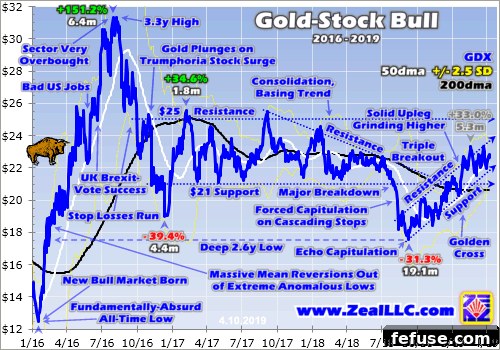
This updated GDX gold-stock-bull chart, from a previous analysis, vividly illustrates the bullish situation for gold stocks. To recap: the last time gold powered to new bull-market highs, igniting investor excitement, was during this bull’s first upleg, largely in the first half of 2016. In that period, GDX skyrocketed an astonishing 151.2% higher, essentially over the same span as gold’s 29.9% upleg. This represented an outstanding 5.1x upside leverage to gold from the major gold miners.
Even smaller mid-tier and junior gold miners, represented by the GDXJ VanEck Vectors Junior Gold Miners ETF, performed even better. With their often superior fundamental characteristics and smaller market capitalizations, mid-tier miners typically offer greater upside potential than the larger majors. Even if gold merely re-challenges the $1350 resistance level, gold stocks are poised to surge dramatically higher as traders and investors alike flock back into the sector, eager to capitalize on the renewed momentum.
While the current lack of widespread interest in gold and its mining stocks is understandable given recent market trends, it is ultimately unfortunate for those seeking substantial gains. The most significant returns are typically secured by buying relatively low, before widespread excitement propels an asset or stock sector into the mainstream. Once gold and gold stocks begin to surge again as the $1350 threshold is approached and potentially breached, both speculators and investors will be forced to buy in at much higher prices. Aggressively deploying capital before new bull market highs are established should yield truly impressive gains.
Capitalizing on Gold’s Next Move: An Opportunity for Astute Investors
At Zeal, our core mission revolves around diligently studying the gold-stock universe to identify companies with superior fundamentals and exceptional upside potential. Our popular weekly and monthly newsletters are consistently stocked with recommendations for these top-tier gold and silver miners. Many of these positions were added in recent months as gold stocks began their recovery from deep lows, and we’re already seeing unrealized gains running as high as 76% this week, demonstrating the power of early entry.
To effectively multiply your capital in the financial markets, staying informed is paramount. Our newsletters offer an accessible and affordable pathway to market intelligence, drawing on extensive experience, knowledge, wisdom, and ongoing research to demystify market movements, explain their underlying causes, and provide specific stock trading recommendations. As of Q1, we have recommended and realized 1089 newsletter stock trades since 2001, achieving average annualized realized gains of +15.8%—nearly double the long-term stock-market average. Subscribe today for just $12 per issue and empower your investment decisions!
Conclusion: Gold’s Unprecedented Upside Potential
The bottom line is that this gold bull market now possesses the highest major-upside-breakout potential in its entire lifespan. The latest gold upleg, fueled initially by gold-futures buying, is far from mature, as speculators’ long positioning remains relatively low. For the first time in this bull market, gold is already consolidating at high levels around $1300, even before the majority of the likely gold-futures long buying has run its course. This unique alignment of factors makes a concerted assault on the critical $1350 resistance level highly probable.
Should gold succeed in breaking decisively above this multi-year resistance and begin forging new bull-market highs, market psychology will undergo a profound transformation. Investors will take notice and re-engage, initiating fresh buying that will further drive gold prices higher and fuel mounting bullish sentiment. The stocks of gold mining companies will be the primary beneficiaries of these new bull-market gold highs. Their shares soared dramatically the last time investors became truly excited about this gold bull, demonstrating their capacity to rapidly multiply wealth for those positioned to benefit.
NewsSource: mining