
Enhancing India’s Global Edge: GJEPC’s Urgent Appeal for GST Reforms in Gem & Jewellery Exports
The Indian gems and jewellery sector is not merely an industry; it is a vibrant tapestry woven into the fabric of the nation’s economic prowess. Recognized worldwide for its unparalleled craftsmanship, ethical sourcing practices, and the sheer volume of its output, this sector plays an indispensable role in India’s export earnings, foreign exchange generation, and, crucially, in providing widespread employment across various skill levels. To ensure its sustained growth and reinforce India’s position as a global leader, the Gem & Jewellery Export Promotion Council (GJEPC) has embarked on an intensive advocacy campaign, engaging with key government stakeholders to propose vital amendments to the Goods and Services Tax (GST) framework.
The Strategic Importance of GST Harmonization for Exports
Since its inception, GST has aimed to streamline India’s indirect tax system, fostering greater transparency and efficiency. However, for an export-oriented industry as intricate and globally connected as gems and jewellery, specific GST provisions can inadvertently create hurdles, impacting competitiveness and operational fluidity. GJEPC’s mission is to meticulously identify these pain points and articulate pragmatic solutions that not only align with the ‘Make in India’ vision but also bolster the industry’s capacity to thrive on the international stage. The Council’s primary focus is to cultivate a tax environment that actively supports export growth, encourages foreign investment, and dismantles any regulatory obstacles that could impede the sector’s vibrant progress.
A Coordinated Advocacy Across State and Central Governments
GJEPC’s advocacy strategy is characterized by its comprehensive and multi-tiered approach, ensuring that the industry’s concerns resonate across all echelons of policy-making. Members and senior officials of the Council have been relentlessly engaging with representatives from various state governments, delving into regional specifics and presenting a consolidated industry perspective. These engagements are complemented by high-level discussions with pivotal central government officials, underscoring the macro-economic implications of the existing GST structure on India’s critical export performance.
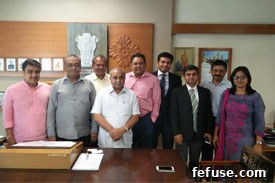
A significant milestone in these efforts occurred on June 8th, when a high-profile GJEPC delegation from the Gujarat region met with Shri Nitin Patel, the esteemed Deputy Chief Minister of Gujarat. During this crucial interaction, the Council presented a detailed exposition of its recommendations, emphasizing the pressing need for a judicious review of the current GST rates and associated procedures. Gujarat, being the epicenter of India’s diamond cutting and polishing industry and a significant hub for jewellery manufacturing, represents a vital artery of the sector, making the state government’s understanding and support absolutely fundamental.
Preceding this, GJEPC committee members in Jaipur, a globally renowned center for coloured gemstones and intricate jewellery craftsmanship, held an equally impactful meeting with the Finance Minister of Rajasthan. This engagement served as a crucial platform to convey the Council’s perspective on GST rates from a localized viewpoint, illustrating how particular provisions might uniquely affect the distinct segments of the industry prevalent in Rajasthan. Such localized dialogues are indispensable for crafting policy recommendations that are nuanced and responsive to the diverse operational landscapes across India’s expansive gems and jewellery sector.
These interactions are integral components of a broader, sustained endeavor to educate senior central government officials on the potential adverse impacts of specific GST rates on India’s precious gems and jewellery exports. The Council consistently highlights how seemingly minor percentage points in taxation can accrue into substantial cost burdens, incrementally eroding the industry’s hard-won global competitiveness. The overarching message articulated by GJEPC is unequivocally clear: precisely targeted amendments are not just beneficial but essential to safeguard and powerfully propel India’s preeminent position as a leading exporter in the dynamic global gems and jewellery market.
Pivotal Reforms Advocated by GJEPC for Sustainable Export Growth
GJEPC has meticulously identified several critical areas within the existing GST framework that demand immediate governmental attention. Addressing these issues promises to significantly enhance the ease of doing business, stimulate investment, and provide a much-needed impetus to the entire export ecosystem. The Council’s proposals extend beyond mere tax reductions; they are strategic interventions aimed at fostering an equitable, efficient, and globally competitive tax regime for the sector.
-
Abolition of 0.25% Integrated Goods and Services Tax (IGST) on Rough Diamonds
The current imposition of a 0.25% IGST on rough diamonds, while seemingly negligible, presents a notable challenge for the industry. Rough diamonds are the fundamental raw material that fuels India’s world-leading diamond cutting and polishing industry, a sector renowned for processing over 90% of the world’s diamonds. Taxing this essential input, even at a minimal rate, results in unnecessary working capital blockages and adds an layer of administrative complexity. This burden is particularly acute for manufacturers operating on razor-thin margins. GJEPC advocates for the complete abolition of this tax, arguing that rough diamonds, as an intermediate good, should be exempt from such levies to ensure seamless processing and to bolster India’s cost efficiency against international competitors that typically do not impose similar taxes on critical raw materials. This measure would free up significant capital, allowing businesses to invest more in technology and expansion.
-
Rationalizing the 18% GST on Labour Charges for Diamond Manufacturing via Job Workers
The existing 18% GST levied on labour charges for manufacturing diamonds through job workers is another critical area of concern. The job work model is a cornerstone of the Indian diamond industry, enabling highly specialized tasks and supporting an expansive ecosystem of skilled artisans and small enterprises. An 18% tax on these fundamental labour services drastically inflates production costs, inevitably rendering Indian-processed diamonds less competitive in the global marketplace. GJEPC’s primary recommendation is the outright abolition of this tax. As an alternative, the Council suggests significantly reducing it to a level consistent with the GST on rough diamonds (e.g., 0.25%), primarily to maintain an audit trail without imposing a substantial financial burden. This adjustment would alleviate considerable financial pressure on thousands of small and medium enterprises (SMEs) engaged in job work, thereby fostering their growth, ensuring fair remuneration for skilled labour, and preserving India’s unique artisanal heritage.
-
Achieving Parity in GST Treatment for Coloured Gemstones with Diamonds
India holds a prominent global position in the trade and processing of coloured gemstones, including coveted emeralds, rubies, and sapphires, with Jaipur serving as a globally recognized processing and trading hub. Currently, coloured gemstones often encounter disparate GST rates and a labyrinth of procedural complexities when compared to diamonds. GJEPC strongly advocates for the identical treatment of coloured gemstones as diamonds across all facets of GST taxation and procedures, encompassing rates, valuation, and compliance. Achieving this parity would systematically eliminate market distortions, significantly simplify compliance for businesses operating in both categories, and ensure that the vibrant coloured gemstone sector receives the same beneficial treatment as the diamond sector. This standardization is crucial for enhancing its export potential, attracting further investment, and solidifying its global standing.
-
Ensuring Nil-Rated GST for Diamond Dollar Account (DDA) Transactions
Diamond Dollar Accounts (DDAs) are specialized foreign currency accounts, meticulously regulated and permitted by the Reserve Bank of India. They are specifically designed to facilitate seamless international trade for diamond businesses, empowering them to conduct transactions efficiently in US dollars. These accounts are indispensable for mitigating foreign exchange risks, simplifying cross-border dealings, and maintaining the liquidity essential for international operations. GJEPC proposes that all transactions conducted through DDAs should be designated as ‘nil-rated’ under GST. Applying GST to DDA transactions introduces an unnecessary layer of complexity and potential taxation on what are fundamentally financial mechanisms engineered to facilitate trade, not to generate taxable income in a conventional sense. Granting them nil-rated status would ensure smoother international transactions, substantially reduce administrative overheads, and unequivocally reinforce India’s reputation as a reliable and efficient global trading partner.
-
GST on Labour Charges for Jewellery Manufacturing: Towards Nil or Final Product Rate
Analogous to diamond manufacturing, the labour component in jewellery manufacturing constitutes a substantial portion of the final product’s value. India’s jewellery sector is globally celebrated for its intricate designs and exquisite handcrafted pieces, which are inherently labour-intensive. GJEPC advocates for either a ‘nil’ GST rate on labour charges specifically for jewellery manufacturing or, at a minimum, a rate equivalent to that of the final product, which is jewellery (currently 3%). Imposing a high GST on labour charges directly inflates the cost of production, particularly for handcrafted jewellery. Reducing or eliminating this tax would directly benefit the vast artisan community, significantly boost the competitiveness of Indian jewellery in coveted export markets, and support the preservation and growth of the traditional skills for which India is globally celebrated.
-
Streamlined GST Procedures for Jewellery Exports with Duty-Free Procurement
Indian jewellery exporters extensively utilize the crucial mechanism of procuring gold and silver duty-free through designated nominated agencies (such as MMTC, STC, or various banks) against the provision of bonds or bank guarantees. This system is absolutely vital for maintaining competitiveness in a volatile global market where metal prices fluctuate significantly. GJEPC emphatically states that GST procedures for jewellery exports must be fully commensurate and harmonized with this established duty-free gold/silver procurement system. This entails ensuring that the GST framework does not introduce any unwarranted blockage of working capital or impose additional administrative burdens that could effectively negate the economic benefits of duty-free raw material acquisition. Seamless integration and precise procedural alignment are paramount to maintaining the critical liquidity required by exporters and ensuring that India’s jewellery products can compete effectively on price and quality in fiercely competitive international markets.
A Strategic Imperative: Reducing GST on Cut & Polished Diamonds to 1%
Beyond addressing specific input taxes and procedural complexities, GJEPC is also vigorously advocating for a strategic reduction in the GST rate applied to cut and polished diamonds. The Council proposes a significant reduction from the current 3% GST rate to a more globally competitive 1%. This proposed reduction is a calculated strategic move aimed squarely at achieving parity with major competing diamond centers worldwide, such as Belgium. Countries like Belgium, formidable players in the international diamond trade, benefit from more advantageous tax regimes, frequently resulting in lower effective tax rates on polished diamonds. A 1% GST rate in India would not only substantially enhance the price competitiveness of Indian-processed diamonds but would also decisively solidify India’s position as the world’s foremost diamond manufacturing and trading hub by attracting increased international trade, fostering greater investment, and optimizing supply chain efficiency. This pivotal move is crucial for safeguarding India’s substantial market share and ensuring its long-term dominance in the dynamic global diamond industry.
Catalyzing Growth and Securing Global Leadership
The cumulative impact of these proposed GST reforms extends far beyond mere fiscal adjustments; they are foundational pillars designed to sustain and significantly accelerate the growth trajectory of India’s gems and jewellery export sector. By proactively addressing these critical issues, the government has an unprecedented opportunity to unlock substantial potential for increased exports, which directly translates into higher foreign exchange earnings, the creation of enhanced employment opportunities across the entire value chain, and greater, more robust contributions to the national GDP. These meticulously crafted measures align perfectly with overarching national objectives of boosting domestic manufacturing, fostering advanced skill development, and projecting India as a reliable, competitive, and indispensable global trading partner.
GJEPC’s continuous and dedicated engagement underscores its unwavering commitment to the holistic welfare of the industry and its ambitious vision for India to not only remain but also consolidate its position as a global leader in gems and jewellery. The Council firmly believes that a collaborative and symbiotic approach, where invaluable industry insights rigorously inform policy-making, is the quintessential key to effectively overcoming contemporary challenges and strategically capitalizing on emerging global opportunities. The proposed GST reforms are not merely about providing immediate tax relief; they are strategically designed to lay a robust, enduring foundation for future growth, fostering innovation, and ensuring India’s sustained global leadership in a sector that exquisitely marries rich tradition with cutting-edge modern enterprise.