
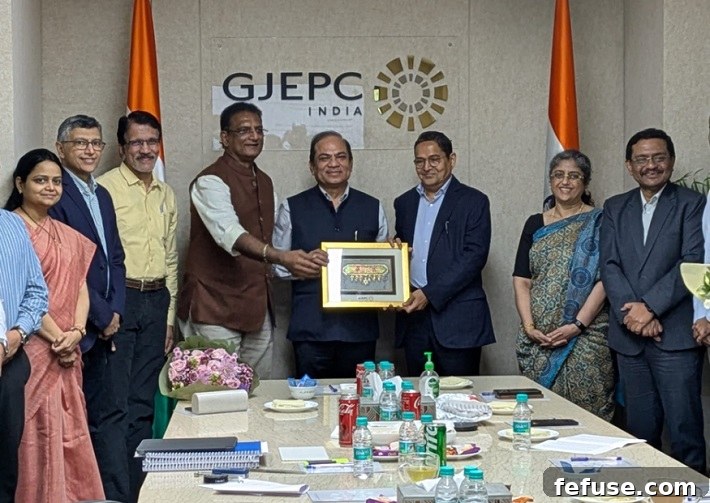
GJEPC and CBIC Leaders Converge: Paving the Way for Enhanced Trade Facilitation in India’s Gem & Jewellery Sector
In a significant move aimed at bolstering the operational framework and enhancing the global competitiveness of India’s illustrious gem and jewellery industry, a pivotal meeting was held on December 7th, at the Gem and Jewellery Export Promotion Council (GJEPC) office in Mumbai. The leadership of GJEPC extended a warm and official welcome to a high-powered delegation from the Central Board of Indirect Taxes & Customs (CBIC), marking a crucial dialogue between the industry’s apex body and key regulatory authorities. This high-level interaction brought together Shri Sanjay Kumar Agarwal, the esteemed Chairman of CBIC, alongside Smt Prachi Saroop, Chief Commissioner of Customs, and Shri Harish Dharnia, Commissioner of Customs, Mumbai. The primary objective of this strategic confluence was to foster open dialogue, address pressing challenges, and collectively chart a course towards creating a more seamless and supportive environment for the gem and jewellery sector, a cornerstone of India’s export economy.
The meeting underscored the vital importance of collaborative governance, recognizing that sustained growth and innovation within the industry are inextricably linked to a responsive and efficient regulatory ecosystem. GJEPC, as the custodian and promoter of Indian gem and jewellery exports, initiated this dialogue to articulate the industry’s specific needs and propose practical solutions that could significantly streamline trade processes, reduce bureaucratic hurdles, and ultimately contribute to India’s ambition of becoming a global leader in this specialized domain. Such high-profile engagements are fundamental for an export-oriented industry, enabling direct communication with policymakers and ensuring that regulatory frameworks are agile, adaptive, and supportive of market dynamics.
Key Representatives Steering the Dialogue
The GJEPC delegation, representing the diverse interests and expertise within the industry, was spearheaded by its prominent leaders. These included Shri Vipul Shah, the Chairman, and Shri Kirit Bhansali, the Vice Chairman, whose strategic vision guides the Council’s initiatives and advocacy efforts. They were joined by Shri Ajesh Mehta, Convener of the Diamond Panel, bringing invaluable insights into the intricacies of the diamond trade, from sourcing to global distribution. Shri Shaunak Parikh, Convener of Banking, Insurance & Taxation, addressed the critical financial and compliance aspects that underpin international trade. Shri Milan Chokshi, Convener of PM&BD (Promotion, Marketing & Business Development), focused on market access, brand building, and expansion strategies for Indian jewellery globally. Overseeing the Council’s operational and strategic execution was Shri Sabyasachi Ray, the Executive Director. The collective expertise of these leaders ensured that the industry’s multifaceted concerns were presented comprehensively, drawing upon deep practical understanding and foresight into future market trends.
Prioritizing Ease of Doing Business: A Path to Global Competitiveness
At the heart of the discussions was GJEPC’s unwavering commitment to enhancing the “ease of doing business” for its members and the broader industry. The Council’s leadership meticulously highlighted several critical issues that currently pose operational challenges and bottlenecks for exporters. The core thrust of their appeal to the CBIC officials was to implement practical, industry-centric solutions that would not only alleviate existing difficulties but also proactively foster an environment conducive to accelerated growth, innovation, and enhanced global competitiveness. Simplifying customs procedures, ensuring regulatory clarity, and facilitating smoother logistics are paramount for an industry that thrives on precision, trust, and timely delivery of high-value goods across international borders. These measures are not merely about convenience; they are about strengthening India’s position as a preferred global trading partner and securing economic prosperity for the millions involved in this sector.
Addressing Core Industry Challenges: A Detailed Outlook
The agenda for the meeting covered a range of specific, actionable points, each crucial for the smooth functioning and future growth of the gem and jewellery sector. These deliberations aimed at forging a collaborative pathway for regulatory enhancements that align with global trade best practices, ultimately benefiting the entire value chain from artisans to exporters.
1. Facilitating Hand-Carriage of Gems and Jewellery Through All Ports
One of the foremost requests from GJEPC was the facilitation of hand-carriage for gems and jewellery through all designated ports. The existing limitations often restrict business travelers, manufacturers, and traders from personally carrying high-value samples or urgent consignments. For an industry where trust, personal inspection, and immediate transactions are often critical, especially in international trade shows or buyer meetings, the ability to hand-carry goods is indispensable. It offers unparalleled security, direct oversight, and significantly speeds up delivery times, which is paramount for time-sensitive deals and maintaining a competitive edge in fast-moving global markets. Expanding this facility to all operational ports, including major international airports, would not only enhance operational efficiency and reduce reliance on third-party logistics for critical consignments but also bolster confidence among international buyers and facilitate quicker market access for Indian exporters. This strategic move would further position India as a more agile, responsive, and secure trade partner for high-value goods, aligning its practices with those of other leading global gem and jewellery trading centers.
2. Extending Tolerance Limits on Cut and Polished Diamonds Sent on Consignment
The subject of extending tolerance limits for cut and polished diamonds (CPD) dispatched on a consignment basis received significant attention. In the intricate world of diamond manufacturing and trading, subtle variations in weight or characteristics can naturally occur due to inherent properties of diamonds or during the meticulous cutting and polishing processes. For instance, minute weight loss during final inspection or due to slight polishing imperfections is an accepted reality in the trade. Current tolerance limits, if too stringent, can lead to unnecessary disputes, valuation challenges, and compliance burdens for exporters when the returned consignment differs slightly from the original export declaration. By extending these tolerance limits, the CBIC would acknowledge the practical realities of the diamond trade, reducing instances of discrepancies and simplifying the reconciliation process for consignments. This move would foster greater trust between customs authorities and the industry, minimize administrative overheads for both parties, and encourage more seamless international trade flows, ultimately benefiting India’s status as a leading diamond manufacturing and trading hub by making its processes more adaptable and understanding of industry-specific nuances.
3. Establishing a Standard Operating Procedure (SOP) for Re-import of Jewellery for Repair and Subsequent Re-export
India’s gem and jewellery industry is renowned globally not just for its manufacturing prowess but also for its exceptional craftsmanship and after-sales service capabilities. Often, jewellery exported from India may need to be re-imported for repairs, resizing, quality enhancements, or design modifications before being re-exported to the same or a different international client. The absence of a clear, standardized operating procedure (SOP) for such re-imports and subsequent re-exports creates significant bureaucratic hurdles, delays, and uncertainties regarding duty implications and required documentation. This ambiguity can deter international customers from utilizing India’s excellent repair and enhancement services. A well-defined SOP would streamline this crucial process, ensuring clarity on valuation, appropriate duty exemptions, and the necessary paperwork, thereby eliminating potential bottlenecks. This would not only support critical after-sales services and enhance customer satisfaction for international clients but also reinforce India’s position as a comprehensive service provider in the global jewellery value chain, attracting more international business for repairs, refurbishments, and value-addition. Such a measure would underscore India’s commitment to facilitating the entire lifecycle of jewellery trade.
4. RMS Facility for G & J Products for Exports
The implementation of a robust Risk Management System (RMS) facility specifically tailored for gem and jewellery products for exports was another key point of discussion. An effective RMS allows customs authorities to identify and focus their inspection efforts on high-risk consignments while facilitating faster clearance for low-risk, compliant exporters. For high-value, sensitive goods like gems and jewellery, where security and speed are paramount, a robust RMS can significantly reduce physical inspections, paperwork, and processing times for legitimate traders, thereby cutting down operational costs and enhancing efficiency. This modernization of customs procedures aligns with global best practices in trade facilitation, promoting a smarter, data-driven approach to customs clearance. By adopting an advanced RMS tailored for the unique characteristics of the gem and jewellery sector, India can dramatically improve its logistical efficiency, reduce dwell times at ports and airports, and enhance the predictability of export processes, making Indian exports more attractive and competitive on the international stage. This also allows for better resource allocation for customs officials, enabling them to focus on genuine risks.
5. Addressing Difficulties Faced with Exports of Lab-Grown Cut and Polished Diamonds (CPD)
The burgeoning sector of Lab-Grown Diamonds (LGDs) represents a significant growth opportunity for India, with the country rapidly emerging as a key player in LGD manufacturing. However, the industry has encountered specific difficulties in the export of Lab-Grown Cut and Polished Diamonds. These challenges often stem from issues related to distinct classification from natural diamonds, valuation ambiguities, clarity on regulatory frameworks, and sometimes, varying international perceptions and import regulations in different markets. Without clear and consistent guidelines, exporters face hurdles in declarations, customs assessments, and ensuring compliance across diverse jurisdictions. GJEPC emphasized the urgent need for clear guidelines, streamlined customs procedures, and robust support mechanisms to facilitate the smooth export of LGDs, ensuring they are treated distinctly from natural diamonds while enjoying similar trade facilitations where appropriate. As India aims to become a global hub for LGD manufacturing and trading, addressing these export hurdles is paramount. Clarity in policy and operational ease would enable the industry to fully capitalize on this rapidly expanding market segment, fostering innovation, creating new employment opportunities, and significantly diversifying India’s diamond export portfolio, cementing its leadership in both natural and lab-grown diamond categories.
A Collaborative Vision for the Future
The fruitful discussions concluded with a strong reaffirmation of the need for continuous and collaborative efforts between the industry and the customs department. Shri Agarwal and his distinguished team from CBIC assured the GJEPC leadership of their unwavering commitment to meticulously reviewing and actively addressing the outlined issues. They pledged to work in close consultation with the industry to develop viable, practical, and effective solutions that resonate with the dynamic needs of the gem and jewellery sector. This assurance signals a positive trajectory towards a more supportive, efficient, and growth-oriented business environment for India’s exporters, laying the groundwork for future policy reforms.
Such high-level dialogues are instrumental in bridging the gap between policy formulation and on-ground implementation. By proactively engaging with regulatory bodies, GJEPC continues to advocate for policies that not only protect the interests of its members but also propel the entire industry towards greater global prominence. The mutual understanding and commitment demonstrated during this meeting are critical steps in fostering a regulatory climate that empowers India’s gem and jewellery industry to overcome challenges, seize new opportunities, and reinforce its undisputed position as a world leader in craftsmanship, innovation, and ethical trade practices. This collaboration is a testament to the Indian government’s dedication to supporting its export sectors and enhancing the nation’s overall economic resilience.
The positive outcomes anticipated from these deliberations are expected to translate into tangible benefits for thousands of businesses and millions of livelihoods across the country, further cementing the gem and jewellery sector’s crucial contribution to India’s economic prosperity and export growth, ensuring a vibrant and competitive future.