
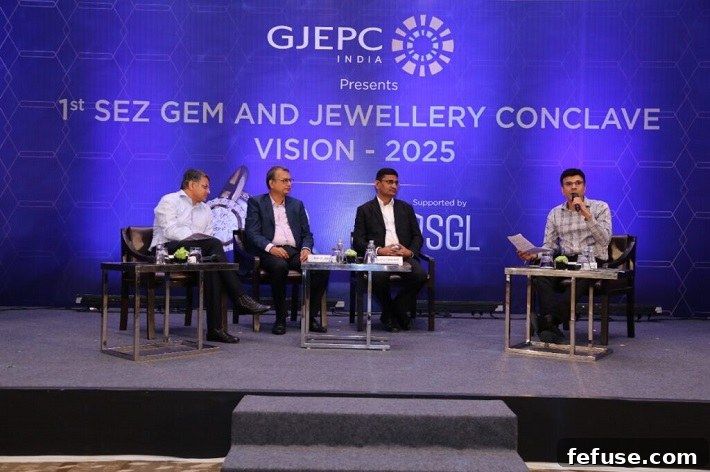
- India’s Special Economic Zones (SEZs) aim to propel Gem & Jewellery exports from the current USD 7 billion to an ambitious USD 15 billion within the next three years.
The Indian gem and jewellery sector, a cornerstone of the nation’s economy and a significant contributor to its export revenues, is poised for transformative growth. Recognizing this immense potential, the Gem & Jewellery Export Promotion Council (GJEPC), India’s premier trade body for the industry, orchestrated its inaugural SEZ Gems & Jewellery Conclave – Vision 2025. Held on August 23rd, 2022, this landmark event brought together industry leaders, policymakers, and experts with a singular, resolute aim: to significantly boost exports originating from India’s Special Economic Zones (SEZs) across the country.
The conclave served as a crucial platform for strategic dialogue, designed to identify innovative pathways for enhancing global competitiveness and leveraging the unique advantages offered by SEZs. The ambitious target set, to nearly double SEZ-based gem and jewellery exports from approximately USD 7 billion to USD 15 billion within a three-year timeframe, underscores the industry’s dynamism and its unwavering commitment to global market leadership.
Inaugural Visions: Setting the Stage for Growth and Innovation
The prestigious event was formally inaugurated by a distinguished panel of dignitaries, signifying the high-level commitment to the sector’s growth. The esteemed lineup included Shri Shyam Jagannathan (I.A.S.), Zonal Development Commissioner, SEEPZ, Mumbai; Shri Colin Shah, Chairman, GJEPC; Shri Kiran Mohan Mohadikar, Deputy Development Commissioner, Noida SEZ; Shri M K Anjanaiah, Deputy Development Commissioner, Falta EPZ & Mani Kanchan SEZ; Shri Ashok Singh, Specified Officer, Surat SEZ; Shri Suvankar Sen, Convener, SEZ Sub-Committee, GJEPC; and Shri Sabyasachi Ray, Executive Director, GJEPC. Their collective presence underscored the collaborative spirit essential for achieving the ambitious export targets.
Championing the Sector: Insights from Key Leaders
Shyam Jagannathan, I.A.S., Zonal Development Commissioner, SEEPZ, Mumbai, lauded the gem and jewellery industry as a true champion sector, highlighting its robust potential to reach an astounding USD 100 billion within the next two years. His address emphasized the pivotal role of supportive legislative frameworks, specifically pointing to the upcoming Development of Enterprise and Service Hubs (DESH) Act. Currently undergoing crucial consultation phases with the parliamentary committee, the DESH Act is expected to be a critical game-changer for the entire SEZ ecosystem.
Jagannathan elaborated on the profound impact of the DESH Act, stating that it would effectively address longstanding issues related to Domestic Tariff Areas (DTAs). Furthermore, it aims to significantly enhance global competitiveness by actively reducing cost inputs in manufacturing, thereby making Indian products more attractive on the international stage. The Act is also designed to foster a greater ease of doing business, achieved through closer collaboration and synchronization with state government entities. Expressing gratitude to the GJEPC for the timely organization of the conclave, he affirmed that the invaluable insights gleaned from this platform would undoubtedly contribute to a transformative shift for the industry.
Echoing this sentiment, Colin Shah, Chairman, GJEPC, articulated the conclave’s immense value. He stated, “The SEZ Conclave offered an unparalleled opportunity to assess our industry’s current standing across vital parameters such as technology adoption, skill development, and overall capability.” He expressed confidence that the profound takeaways from the insightful panel discussions and presentations would undeniably accelerate the sector’s growth trajectory. Shah reiterated the current contribution of SEZs to India’s total gem and jewellery exports—approximately 18%, or USD 7 billion. He emphatically declared the industry’s ambitious target: “Our goal is to elevate this contribution to USD 15 billion within the next three years, cementing India’s position as a global leader.”
Suvankar Sen, Convener, SEZ Sub-Committee, GJEPC, reflected on the historical significance of the event, coinciding with India’s 75th year of independence. He extended his gratitude to all stakeholders within the gem and jewellery fraternity who collaborated to bring about this first-ever SEZ – Gem & Jewellery Conclave. Sen conveyed his optimism, expressing hope that the conclave would provide the necessary strategic frameworks to position India as the preferred global destination for gem and jewellery, thereby making a substantial contribution to the nation’s economy.
Strategic Dialogues: Panels Charting the Future
The conclave’s agenda was packed with a series of engaging and thought-provoking sessions throughout the day, each delving into critical aspects of industry growth and development.
Panel 1: Exports Enhancement Strategy – Targeting USD 15 Billion in 3 Years
The inaugural panel discussion, titled “Exports Enhancement Strategy – USD 15 billion in next 3 years,” featured a distinguished group of experts: Mr. C.P.S. Chauhan, IRS, Joint Development Commissioner, SEEPZ; Mr. Rohit Gupta, Managing Director, Agra Products Pvt. Ltd. (ACPL); Mr. Tejas Shah, CEO, Unique Designs Inc.; and Mr. Ashish Shah, Managing Director, Gold Star Jewellery Pvt. Ltd. The session was adeptly moderated by Mr. Bobby Kothari, Director, Jewelex India. Prior to leading the discussion, Bobby Kothari provided an exclusive preview of the eagerly anticipated Mega Common Facility Centre, soon to be operational in SEEPZ, promising enhanced infrastructure and shared resources for manufacturers.
The panel engaged in a comprehensive discourse on the strategic roadmap required to escalate SEZ export targets from the current USD 7 billion to an aspirational USD 15 billion. Discussions highlighted that the Indian gem and jewellery segment possesses a substantial untapped potential, estimated to be around USD 30 billion. A key consensus emerged: India must strategically transition up the value chain. Instead of primarily focusing on high-volume production, the emphasis needs to shift towards the intricate cutting and polishing of high-value diamonds, thereby maximizing per-unit profitability and prestige.
Further strategies included robust investment in cutting-edge technology to significantly enhance product quality and a relentless pursuit of innovation in terms of design and creative output. The panelists also advocated for the proactive repositioning of ‘Brand SEEPZ’ and all other SEZs. This would involve aggressive participation in prominent international ‘India Pavilions’ and actively encouraging direct e-commerce channels, which are vital for expanding global reach and direct consumer engagement. Another sunrise segment identified as a clear winner was Lab-Grown Diamonds (LGDs). LGDs offer several advantages, being relatively eco-friendly, more accessible on the wallet, and promising excellent profit margins, representing a significant growth avenue for the industry. Collaborative efforts and synergy in manufacturing processes among different SEZs were also identified as powerful enablers for accelerating export growth.
Panel 2: Technology, Skilling & Branding – Manufacturing for the Future & Promoting Make in India SEZs
The second pivotal panel, “Technology, Skilling & Branding – Manufacturing for Future & Promote Make in India SEZs,” brought together prominent industry luminaries: Mr. Ankit Mehta, Founder & Director, Walking Tree; Professor Asim Tewari, Department of Mechanical Engg. IIT Bombay; Mr. Adil Kotwal, CEO, Creations Jewellery Mfg. Pvt. Ltd.; and Dr. Parag K. Vyas, Director & Founder, Grau Bar Design Studios. The insightful session was moderated by Mr. Neville Tata, Executive Director, Renaissance Global Ltd.
This discussion critically centered on the intricate correlation and symbiotic relationship between technology, branding, and skilling. It was widely acknowledged that advanced technology, particularly the transformative power of Artificial Intelligence (AI), is poised to elevate the jewellery industry to unprecedented levels of efficiency and precision. However, the panel emphasized that technology alone is insufficient. The continuous skilling and upskilling of artisans are paramount, as these skilled craftspeople remain the indispensable backbone of the industry. The future of jewellery manufacturing, it was predicted, would likely witness a hybrid model, seamlessly integrating traditional craftsmanship with state-of-the-art technological advancements.
The panelists also underscored the profound link between quality and brand building. The ability to consistently deliver high-quality products directly correlates with the capacity to command premium pricing, which, in turn, facilitates the genesis of a strong brand. It was stressed that there are no shortcuts to establishing a reputable brand; it demands significant investment in meticulous research, out-of-the-box thinking, and a relentless commitment to developing high-design, innovative products. Without truly innovative design, even the most advanced technology, while enhancing production, would fail to add significant value to the final branded offering.
Inspirational Special Speaker Sessions
The conclave also featured several special speaker sessions, providing diverse perspectives and cross-industry insights.
The first Special Speaker Session featured Mr. Srinath Ravichandran, Co-founder & CEO, Agnikul Cosmos. Drawing compelling parallels between SEZs established for the aerospace sector and those for jewellery manufacturing, Mr. Ravichandran articulated a powerful message: for industries to truly grow and achieve global prominence, there must be a strategic evolution from merely ‘Make In India’ to aspiring to be recognized for ‘Design In India.’ This shift emphasizes indigenous innovation, creativity, and intellectual property development as critical drivers for future success.
Another illuminating Special Speaker Session hosted Ms. Rucha Nanavati, Chief Information Officer, Mahindra Group. Leveraging her extensive experience in the dynamic retail and automotive sectors, Ms. Nanavati offered invaluable insights into adopting the latest available technologies. She highlighted the practical application of high-powered cameras, augmented by Artificial Intelligence, for conducting rigorous quality checks—a methodology highly transferable to the gem and jewellery industry. She strongly advocated that gem and jewellery manufacturers could gain a significant competitive edge by integrating cutting-edge technologies such as Augmented Reality (AR), Virtual Reality (VR), the Internet of Things (IoT), and 5G connectivity into their core production processes. These advancements promise enhanced precision, efficiency, and immersive customer experiences.
Open House: Decoding SEZ Rules and the New DESH Act
A crucial “Open House” discussion focused on “SEZ rules and the New DESH Act,” addressing regulatory frameworks vital for the industry’s future. This session featured an eminent panel comprising Mr. Shyam Jagannathan IAS, Zonal Development Commissioner, SEEPZ, Mumbai; Mr. Kiran Mohan Mohadikar, Deputy Development Commissioner, Noida SEZ; Mr. M.K. Anjanaiah, Deputy Development Commissioner, Falta EPZ & Mani Kanchan SEZ; and Mr. Ashok Singh, Specified Officer, Surat SEZ. The Open House was expertly moderated by Mr. Sabyasachi Ray, Executive Director, GJEPC.
The discussion thoroughly delved into the significant changes currently being contemplated within the much-anticipated DESH Act. Panelists elaborated on the various provisions specifically designed to enhance the ease of doing business, which are slated for inclusion in the forthcoming bill. This session provided a critical forum for industry stakeholders to understand the implications of these regulatory shifts and offer their feedback, ensuring the new framework is robust, equitable, and conducive to accelerated growth for businesses operating within SEZs.
Learning from Industry Transformations: The Tata Motors Case Study
In a compelling special speaker session, Mr. Vivek Srivatsa, Head Marketing, Sales and Service Strategy, Tata Passenger Electric Mobility Ltd., presented a remarkable case study on the redemption and astonishing turnaround of the Tata Motors brand. He meticulously outlined the company’s successful implementation of a dual-phase strategy, offering profound lessons applicable to various industries, including the gem and jewellery sector.
The first phase of Tata Motors’ revitalization involved establishing a distinctive new design language, significantly enhancing the focus on product quality, advancing manufacturing processes through technological upgrades, and meticulously improving the overall customer experience. The subsequent phase centered on the adoption of the ‘New Forever’ philosophy, which involved elevating key product pillars to new heights, integrating the latest technological innovations, and implementing a fresh, modern retail identity. This comprehensive strategy resulted in a remarkable resurgence for the company, demonstrating the power of visionary leadership and a holistic approach to brand transformation. For the gem and jewellery sector, this example underscored the critical importance of continuous innovation, unwavering commitment to quality, strategic branding, and an acute understanding of evolving consumer expectations to achieve sustainable growth and market dominance.
Conclusion: A Resounding Commitment to India’s Gem & Jewellery Future
The GJEPC SEZ Gems & Jewellery Conclave – Vision 2025 concluded with a resounding affirmation of the Indian gem and jewellery sector’s collective commitment to unprecedented growth. The strategic discussions, expert insights, and collaborative spirit demonstrated throughout the event laid a robust foundation for achieving the ambitious USD 15 billion export target from SEZs within the next three years. By embracing the transformative potential of the DESH Act, investing heavily in advanced technology, prioritizing the skilling and upskilling of its invaluable artisan workforce, and strategically building strong global brands, India is not merely aiming to increase its exports. It is charting a definitive course to consolidate its position as an undisputed leader in the global gem and jewellery market, driven by innovation, quality, and a clear vision for the future.