
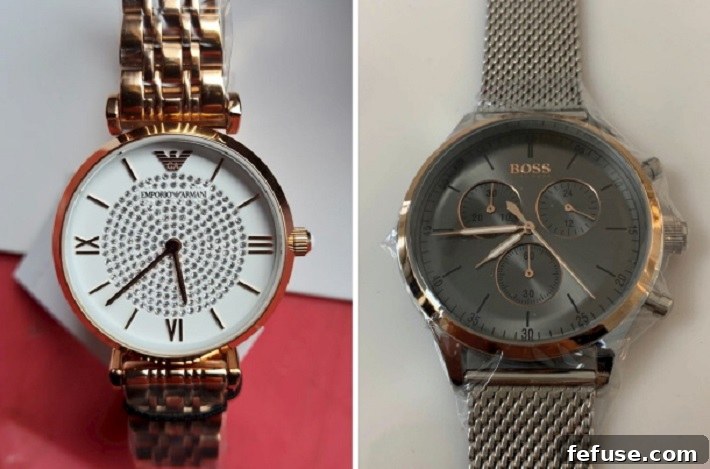
UK Court Mandates Destruction of 2,361 Counterfeit Watches, Emphasizing Global Battle Against Fake Goods Online
In a significant ruling that underscores the ongoing global battle against intellectual property crime, a court in the United Kingdom has issued a definitive order for the destruction of 2,361 counterfeit watches. These illicit timepieces, originally imported from China, were actively marketed and offered for sale across various online platforms, posing a direct threat to legitimate brands and misleading unsuspecting consumers.
The individual at the heart of this particular case was 41-year-old Jeremy Smith, who utilized the widely popular e-commerce giant eBay, alongside two dedicated websites, to advertise and sell the vast collection of watches. Smith staunchly maintained that the watches were genuine articles, despite glaring inconsistencies that painted a clear picture of their counterfeit nature. Evidence presented in court highlighted numerous critical flaws, including the use of incorrect fonts on the watch faces and packaging, improperly placed logos that deviated from authentic branding standards, and other significant discrepancies in the information printed on packaging tags and accompanying documentation. These subtle yet definitive indicators are often the tell-tale signs for experts distinguishing between genuine products and their illegal imitations.
A thorough investigation was launched by the City of London Police, delving deep into the origins and marketing of these watches. Crucially, the investigation concluded that there was insufficient evidence to suggest that Smith had prior knowledge of the watches being fake. Consequently, no criminal charges were brought against him, separating this civil forfeiture and destruction order from a criminal prosecution. This distinction highlights the complex legal landscape surrounding intellectual property offenses, where intent can be a difficult element to prove, even when the products themselves are unequivocally counterfeit.
Collaboration Between Industry and Law Enforcement: A Crucial Partnership
The court hearing witnessed powerful testimony from representatives of six distinct legitimate luxury watch brands. These industry experts provided compelling and irrefutable evidence, meticulously demonstrating that the watches seized by the Police Intellectual Property Crime Unit (PIPCU) were indeed fraudulent reproductions. Their detailed analysis, contrasting the seized items with genuine products, proved instrumental in the court’s decision, illustrating the critical role that brand owners play in policing their own intellectual property.
The entire case was initially brought to the attention of PIPCU through a referral from a legal representative acting on behalf of two prominent designer brands. This legal team had diligently identified an eBay account and two suspicious websites actively engaged in the sale of suspected counterfeit watches. A key indicator that raised immediate red flags was the pricing strategy: these watches were being sold for considerably less than the legitimate retail value of their genuine counterparts. Such “too good to be true” pricing is a classic hallmark of counterfeit goods and often serves as a primary alert for both consumers and brand protection specialists.
The Far-Reaching Consequences of Counterfeit Goods Trade
Detective Constable Daryl Fryatt, a leading figure within PIPCU, issued a stern warning regarding the broader implications of this illegal trade. “Selling counterfeit goods is illegal,” he stated unequivocally. “Some consumers get conned, some end up with a poor-quality product, and critically, the money that runs through the counterfeit goods trade funds organised crime.” His statement encapsulates the multifaceted harm caused by counterfeiting, extending far beyond a simple transaction for a fake item.
The repercussions for consumers are significant. Many buyers are directly defrauded, believing they are purchasing an authentic product, only to receive a sub-standard imitation. This not only results in financial loss but also fosters a deep sense of dissatisfaction and distrust in online marketplaces. Beyond deception, counterfeit products often pose safety risks. Unlike genuine items that adhere to stringent quality control and safety standards, fake goods are frequently manufactured with inferior materials, lacking proper testing, and may even contain hazardous components. This is particularly concerning for products like electronics, cosmetics, or even children’s toys, where the risks can escalate from mere disappointment to serious injury or health problems.
Even more alarming is the stark reality that the vast profits generated from the sale of counterfeit merchandise are not isolated transactions. They form a crucial revenue stream for large-scale organized criminal networks. These funds are often channeled into a myriad of illicit activities, including drug trafficking, human smuggling, cybercrime, and even terrorism. This direct link transforms the seemingly innocuous purchase of a fake watch or handbag into an unwitting contribution to global criminality, highlighting the profound societal impact of intellectual property infringement.
The Power of Collaboration: A Unified Approach to IP Crime
Detective Constable Fryatt further emphasized the indispensable role played by legitimate brands in these enforcement actions. “The evidence provided by the legitimate brands involved in this hearing was instrumental in helping us achieve this result,” he noted. This underscores the symbiotic relationship required between law enforcement agencies and the private sector. Brands possess invaluable expertise regarding their own products, including proprietary authentication methods and detailed knowledge of their intellectual property. Their active participation and willingness to share information are vital for successful investigations and prosecutions.
He concluded by affirming, “which is proof of what law enforcement and industry can achieve when we work together to tackle the counterfeit goods trade.” This statement serves as a powerful testament to the efficacy of collaborative efforts. In an increasingly interconnected world, where counterfeiters operate across borders with sophisticated methods, a unified approach is not just beneficial but absolutely essential. By pooling resources, sharing intelligence, and coordinating strategies, both public and private entities can mount a more robust and effective defense against intellectual property infringers.
Navigating the Digital Landscape: Challenges and Safeguards
The prevalence of online marketplaces, while offering unparalleled convenience and global reach, simultaneously presents a fertile ground for the proliferation of counterfeit goods. Platforms like eBay, Amazon, and various social media channels, despite their best efforts and implemented anti-counterfeiting measures, are constantly battling against sellers who exploit their systems. The sheer volume of transactions and sellers makes comprehensive real-time monitoring an immense challenge, allowing illicit goods to slip through the cracks. Consumers bear a significant responsibility in being vigilant when making online purchases. Red flags often include prices that are dramatically lower than the official retail price, sellers with limited or new feedback, generic product descriptions, poor-quality images, and suspicious payment methods. Opting for authorized retailers, official brand websites, and reputable stores remains the safest bet to guarantee authenticity and quality.
Protecting Innovation: The Broader Economic and Ethical Imperatives
Beyond the immediate financial losses to consumers and the funding of organized crime, the counterfeit trade inflicts substantial damage on the global economy and stifles innovation. Legitimate businesses invest heavily in research, development, marketing, and quality control to create their products. Counterfeiters, by contrast, parasitize these investments, producing inferior copies without any of the associated costs. This undercuts legitimate businesses, leading to lost sales, reduced profits, and ultimately, job losses. It also disincentivizes innovation, as companies become less willing to invest in new products if their intellectual property can be easily stolen and replicated.
Intellectual property rights are the bedrock of modern economies, protecting inventions, designs, brands, and creative works. When these rights are violated, the entire ecosystem of creativity and entrepreneurship suffers. Governments around the world, recognizing this profound impact, are continually strengthening their intellectual property laws and enforcement mechanisms. This includes international cooperation through bodies like Interpol and Europol, as well as enhanced customs controls to intercept counterfeit shipments at borders.
A Continuous Battle: The Future of Anti-Counterfeiting Efforts
The fight against counterfeit goods is an ongoing and evolving battle. As technology advances, counterfeiters adopt increasingly sophisticated methods to produce and distribute their fake products, often exploiting new digital platforms and supply chain loopholes. This necessitates a continuous adaptation of anti-counterfeiting strategies by brands, law enforcement, and policymakers. Future efforts will likely focus on even deeper collaboration, leveraging advanced data analytics and artificial intelligence to identify trends and disrupt supply networks, and empowering consumers with better tools and information to make informed purchasing decisions.
This UK court ruling, resulting in the destruction of thousands of fake watches, serves as a powerful reminder of the tangible consequences for those involved in the counterfeit trade. It also highlights the unwavering commitment of legitimate brands and law enforcement agencies to protect intellectual property, safeguard consumers, and ultimately, undermine the criminal enterprises that profit from deception.