
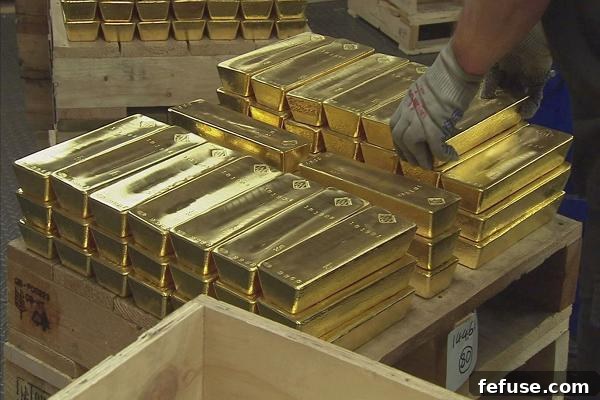
The Resurgence of Gold: Why Central Banks Are Shifting Strategies in a Volatile World
For centuries, gold has held an unparalleled allure, serving as a symbol of wealth, power, and stability. In recent years, this ancient precious metal has experienced a significant resurgence, not merely among individual investors but notably within the vaults of the world’s central banks. A growing number of nations, including economic powerhouses like China and Russia, alongside various Asian and West Asian central banks, have dramatically accelerated their gold accumulation strategies. This renewed interest in gold hoarding isn’t just a fleeting trend; it reflects profound underlying shifts in global economic policy and geopolitical landscapes.
The motivations behind this strategic pivot are multifaceted, extending far beyond traditional inflationary hedges or speculative price appreciation. Instead, central banks are primarily driven by a pressing need for diversification away from an over-reliance on a single, dominant reserve currency – the US dollar. As we delve deeper into this phenomenon, we uncover a fascinating narrative of economic prudence, geopolitical maneuvering, and a quest for greater financial sovereignty in an increasingly interconnected yet unpredictable world.
China’s Golden Ambition: Diversification and De-dollarization
Among the most prominent players in this renewed gold rush are Chinese investors and the Chinese central bank. Until 2015, private ownership of gold in China was significantly restricted, limiting individual participation in the global gold market. However, a landmark policy shift in 2015 privatized gold ownership, unleashing a massive wave of demand from the world’s most populous nation. This move not only empowered private citizens but also signaled a broader strategic embrace of gold by the Chinese state.
While official figures from the Chinese central bank, the People’s Bank of China (PBOC), indicate substantial gold holdings – currently standing at 1,842 tonnes, valued at approximately $84.45 billion and steadily rising – these figures represent only a fraction of China’s overall foreign exchange reserves. According to industry analyses, China was the top gold jewellery buyer in 2017, underscoring a deep cultural and economic affinity for the metal that permeates both public and private sectors.
However, the PBOC’s relentless gold acquisition is not driven by a bullish outlook on gold prices or an anticipation of rampant inflation, as might be the case for traditional gold investors. Instead, China’s primary motivation is a strategic diversification away from the US dollar, a currency on which it has become heavily reliant due to its colossal foreign exchange reserves. China boasts a staggering $3.091 trillion in foreign exchange reserves, a significant portion of which is held in US dollar-denominated assets, including an estimated $1.09 trillion worth of US Treasury bonds, alongside trillions more in cash and bank deposits.
This immense exposure to the US dollar presents a considerable strategic vulnerability. Any significant depreciation of the dollar, or more critically, the imposition of financial sanctions similar to those seen in other geopolitical contexts, could severely impact China’s economic stability and international trade capabilities. Gold, with its universal acceptance and independence from any single fiat currency or financial system, offers a robust alternative asset that mitigates these risks, bolstering China’s financial independence and resilience.
Gold as a Shield: The Geopolitical Imperative for Russia and Beyond
The strategic use of gold as a hedge against geopolitical risks and financial sanctions is not unique to China. Countries like Iran and Russia have pioneered this approach, demonstrating gold’s invaluable role when traditional dollar-based financial pathways are curtailed. When Tehran faced severe trade sanctions and was effectively barred from US dollar transactions and clearing systems, it resorted to an age-old gold barter system to facilitate international trade, circumventing the very mechanisms designed to isolate it.
Following a similar playbook, the Russian government significantly accelerated its gold accumulation tactic after the annexation of Crimea in 2014, which triggered a cascade of international trade sanctions. These sanctions highlighted the vulnerability of relying heavily on a financial system dominated by the dollar and subject to the unilateral decisions of the United States and its allies. By stockpiling gold, Russia aimed to build a robust, sanction-proof financial buffer, allowing it to maintain economic stability and engage in international trade outside the purview of the dollar-centric financial architecture. In September of one recent year, Russia added 34 tonnes of gold to its reserves, bringing its total to 1,779 tonnes and positioning it as the sixth largest holder globally, just behind China.
This strategic imperative extends to other nations as well. To bolster their national currencies and fortify their reserves against global economic turbulence, numerous countries have started accumulating gold. Germany, for instance, embarked on a highly publicized repatriation of its gold reserves, bringing back significant portions that had been stored in French and US vaults. This move was not merely logistical; it was a powerful statement of sovereignty and a response to increasing domestic demand from German investors seeking to protect their wealth amidst loose monetary policies and successive financial crises across Europe. In 2016 alone, a substantial €6.8 billion was invested into German gold investment products, reflecting a widespread belief in gold’s enduring value.
Beyond the major players, developed economies such as South Korea, Taiwan, Singapore, and The Netherlands have also quietly but steadily increased their gold holdings, underscoring a global recognition of gold’s role as a reliable reserve asset. Typically, developed countries maintain a significant portion of their total reserves, often around 60 percent, in gold. In contrast, emerging economies like India hold approximately 6.1 percent of their reserves in gold, while China’s current gold holding represents only about 2 percent of its total foreign exchange reserves.
The Immense Potential Impact on Gold Prices
The scale of China’s potential gold acquisition, should it aim to reach a reserve ratio comparable to developed nations, is staggering. For China to raise its gold holdings to even 17 percent of its total reserves, a relatively modest target compared to the 60 percent held by many developed countries, it would need to acquire an additional $540 billion worth of gold. This figure alone represents a monumental demand that could reshape the global gold market.
Should China decide to purchase even a fraction of this amount from the open market, the repercussions for gold prices would be significant. Such an influx of demand would likely trigger a sharp upward trajectory in gold prices, potentially pushing them into the range of $1800-$1900 per ounce, or even higher, depending on the speed and volume of acquisition. This demonstrates the immense leverage that central bank buying, particularly from an economic giant like China, holds over the global gold market.
Beyond mere diversification, gold accumulation also serves to buttress national currencies and facilitate alternative trade mechanisms. Russia, Indonesia, and Turkey are actively accumulating gold to prop up their currencies, enhancing confidence and stability in their respective financial systems. China has taken this a step further with its innovative initiative regarding oil trade. As reported by Nikkei, China has announced that any oil exporter willing to accept yuan for oil payments can convert that yuan into physical gold on the Shanghai Gold Exchange. Furthermore, they can hedge the hard currency value of gold on the Shanghai Futures Exchange, effectively creating a “petroyuan-gold” system that offers an attractive alternative to the petrodollar.
This mechanism clearly illustrates China’s strategic need for substantial physical gold reserves. It underscores that central banks are not merely buying gold because they believe its price is undervalued in the short term, but rather to fundamentally rebalance their reserve portfolios, reduce their dependence on the US dollar, and establish a more robust and independent financial framework for their international trade and economic stability.
Long-Term Implications for Gold Investors
While the primary driver for central bank gold accumulation is strategic diversification rather than speculative price appreciation, the undeniable impact of such large-scale buying cannot be ignored by individual investors. The sustained demand from central banks, particularly from major economies with vast reserves, is a significant factor in the supply-demand dynamics of the global gold market. With a limited global supply of physical gold, persistent institutional buying will inevitably tighten the market over the long term.
This long-term tightening of supply, coupled with increasing demand from a diverse array of central banks and private investors, is a strong indicator for potential appreciation in gold prices. However, it is crucial for investors to understand the distinction between short-term market movements and long-term trends. Short-term gold prices are often susceptible to manipulation, particularly through activities like shorting in futures markets, which can create temporary volatility and price swings that do not necessarily reflect the underlying fundamental demand. Therefore, while central bank buying lays a solid foundation for long-term price growth, immediate price action may still be subject to market whims and speculative pressures.
In conclusion, the current wave of central bank gold hoarding is a powerful testament to gold’s enduring role as a fundamental asset in a world grappling with economic uncertainties and geopolitical shifts. It signals a conscious effort by nations to de-risk their financial systems from an over-concentration in a single currency, build resilience against potential sanctions, and establish greater financial autonomy. For individual investors, this trend offers a valuable insight into the evolving global economic landscape and highlights gold’s continued relevance as a strategic component in a diversified investment portfolio.
(Disclaimer: The views expressed in this article are for informational purposes only and should not be construed as investment advice. Investors are strongly encouraged to consult with their financial advisers before making any investment decisions.)