
Washington Jade: Unveiling Rare Cat’s-Eye Nephrite from the Pacific Northwest
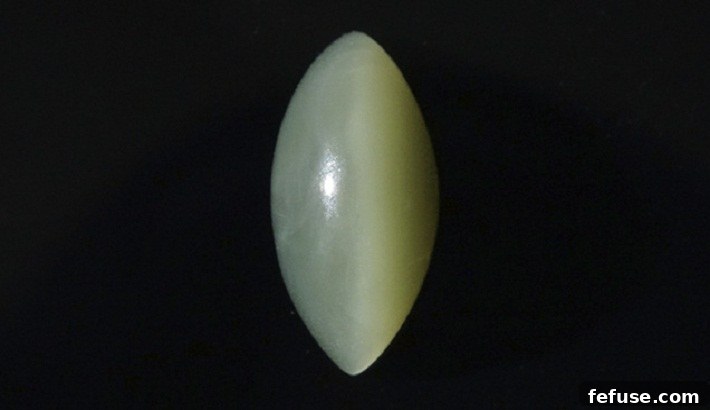
A new star emerged on the gemstone stage at the prestigious AGTA show in Tucson: Washington Jade. Hailing from Edmonds, Washington, this innovative company marked its highly anticipated debut by showcasing exquisite nephrite jade sourced directly from Washington State. Their carefully curated collection captivated attendees, featuring a diverse array of cabochons—some exhibiting mesmerizing chatoyancy, others displaying classic jade beauty—alongside intricate carvings and captivating rough collector’s stones. However, it was the stunning cat’s-eye nephrite that truly stole the spotlight, securing its position as the undisputed crowd favorite, a fact confirmed by Nathaniel Cook of Washington Jade.
The reception for this unique material was overwhelmingly positive. Rod Cook, Nathaniel’s father and co-founder of Washington Jade, shared an intriguing observation: many seasoned industry professionals at the show drew comparisons between the chatoyancy of Washington’s nephrite and the legendary Siberian nephrite, a material that has long dominated the discerning mid-to-high-end Chinese nephrite market. This comparison alone speaks volumes about the quality and visual appeal of Washington Jade’s offerings, hinting at its potential to carve out a significant niche in the global jade landscape.
The Elusive Beauty of Cat’s-Eye Nephrite: A Rarity Redefined
What makes cat’s-eye nephrite so exceptional? Its rarity is paramount. This distinctive form of nephrite is known to be found in only a handful of locations worldwide: primarily Washington State and Russia. While a deposit in Taiwan once yielded this coveted material, it has largely been depleted, making new, viable sources incredibly valuable. The phenomenon of chatoyancy, often referred to as the “cat’s-eye effect,” occurs when parallel fibrous inclusions within the jade reflect light in a single, luminous band, creating a dynamic optical illusion that appears to glide across the stone’s surface as it’s moved. This captivating play of light is what gives cat’s-eye nephrite its unique allure and elevates its desirability among collectors and designers alike.
While nephrite itself has been discovered in the rugged landscapes of northwest Washington since the early 1900s, formal, large-scale production remained elusive for decades. A notable operation west of Darrington, near Everett, did exist for a period but ultimately ceased in the 1970s. It was during this earlier era, specifically in 1974, that chatoyant nephrite from the region was first officially documented, though its commercial potential remained largely untapped. For many years following, the Washington nephrite market largely consisted of an artisanal “gray market,” where individuals illegally collected jade from streams and state-owned lands. This unsustainable and unregulated practice meant that the true potential of Washington’s jade deposits was yet to be realized, awaiting a responsible and legitimate endeavor.
This long-standing situation began to change dramatically in 2012 when Washington Jade stepped onto the scene. With a commitment to ethical sourcing and sustainable practices, the company embarked on the rigorous process of staking claims, transitioning the local jade industry from an informal “gray market” to a legitimate, regulated enterprise. Today, the majority of Washington Jade’s exceptional production originates from a rich deposit located northwest of Darrington, a region now recognized for its high-quality and, particularly, its sought-after cat’s-eye nephrite.
Pioneering Sustainable Jade Mining with Innovative Techniques
Washington Jade distinguishes itself not only through the exceptional quality of its material but also through its groundbreaking approach to mining. Eschewing the more invasive and environmentally impactful traditional mining methods, the company has embraced innovative, small-footprint techniques designed to minimize ecological disruption. This commitment to sustainability is central to their philosophy and sets a new standard for responsible gemstone extraction.
Their methodology is remarkably sophisticated, blending cutting-edge technology with deep geological understanding. To precisely identify a jade seam, Washington Jade employs advanced pattern recognition, meticulously analyzing geological models of the area. This data-driven approach is further augmented by the keen observation of biological indicators, such as specific tree species and distinctive lichen growth, which often signal underlying geological formations. Once a potential seam is identified, magnetic and conductivity surveys are deployed to pinpoint the highest-grade portions, ensuring that efforts are concentrated on the most valuable deposits.
This comprehensive, multi-faceted approach allows Washington Jade to develop highly accurate 3D models of the subsurface. By understanding the three-dimensional structure and composition of the jade deposits, they can strategically focus their mining operations solely on the high-grade materials. This contrasts sharply with traditional mining practices, which often involve extensive core drilling, followed by the deployment of heavy equipment to excavate vast areas, removing all jade regardless of grade, only to sort it later. Washington Jade’s method is inherently more efficient and environmentally conscious: they extract only the high-value materials, leaving the surrounding geology and lower-grade jade undisturbed in the ground.
Rod Cook emphasizes their unwavering commitment to environmental stewardship. After the targeted jade is extracted, the team meticulously backfills the excavated areas and carefully replaces the native vegetation. This meticulous process ensures that their mining operations leave an exceptionally small environmental footprint, preserving the natural beauty and ecological integrity of the Washington wilderness. It’s a testament to their belief that premium gemstones can be sourced responsibly and ethically.
Navigating the Global Jade Market: Trends and Opportunities
In the global nephrite market, British Columbia has long held the dominant position as the leading supplier. However, the burgeoning deposits in Washington State, which are part of the very same expansive geological formation stretching across the Pacific Northwest, represent a significant untapped potential that is now finally beginning to be developed. The domestic jade market within the United States is considerably smaller compared to the colossal Asian market, particularly in China, where jade boasts a profound cultural significance stretching back thousands of years. In Chinese culture, jade is more than just a gemstone; it embodies virtues such as purity, wisdom, justice, and courage, and is deeply interwoven into art, mythology, and spiritual beliefs.
Nathaniel Cook offered insights into the broader nephrite market, noting that it has recently experienced a period of tightening. Prices, after two decades of steady and robust growth, have seen a recent downturn. Despite this general trend, attendees at the AGTA show were visibly surprised by what they perceived as an exceptionally attractive price point for Washington Jade’s unique cat’s-eye material. This suggests that even in a softening market, truly distinctive and rare items like the Washington cat’s-eye nephrite retain their appeal and can command strong interest, potentially due to their unique qualities and limited availability.
Emerging Trends in Jewelry Design and Millennial Preferences
Rod Cook highlighted a significant and exciting trend within the jewelry industry: a remarkable explosion in the number of artisanal jewelers who are increasingly incorporating nephrite into their designs. This growing movement represents a fertile ground for Washington Jade’s products, particularly the coveted cat’s-eye nephrite, which resonates well with this creative segment of the market. While market acceptance for this specific material is still in its nascent stages, the initial response from designers has been highly enthusiastic.
Cook assured that Washington Jade’s current production capacity is robust enough to comfortably meet the burgeoning domestic demand. Furthermore, he emphasized the company’s capability to significantly scale up its output, should the need arise—for instance, to supply a larger jeweler with hundreds of retail outlets. This flexibility positions Washington Jade as a reliable partner for both emerging independent designers and established brands alike.
Looking ahead, Rod Cook also identified an evolving preference among consumers, noting a discernible trend towards jewelry with “less bling.” This suggests a shift away from overly elaborate or ostentatious designs towards pieces that exude understated elegance and natural beauty. He specifically observed that younger demographics, particularly millennials, appear to favor carved material over faceted gemstones. This preference aligns perfectly with the inherent qualities of jade, a stone historically celebrated for its sculptural potential and the artistic expression it allows through carving. Washington Jade, with its emphasis on unique cabochons and carved pieces, is perfectly positioned to capitalize on these emerging market trends and cater to a new generation of jewelry enthusiasts seeking authenticity and natural charm.
The Astonishing Discovery: Washington Jade’s “Jade Cave”
Beyond their regular mining operations, the Cooks made an astonishing discovery that further underscores the immense potential of Washington State’s jade deposits: a remarkable “jade cave.” This natural wonder, captured in stunning detail (as depicted in Figure 2 of the original report), was found nestled within a dramatic 200-foot canyon, meticulously carved out by a flowing stream. This incredible find serves not only as a testament to the geological richness of the region but also as an invaluable resource for Washington Jade, profoundly informing and refining their geological models by offering a rare glimpse into how similar structures appear deep within the earth.
The formation of this unique jade cave is a fascinating tale of natural forces at work. Geologists believe it originated when a substantial piece of the main chatoyant jade seam fractured, broke loose, and slowly slid down the steep hillside. It eventually came to rest, falling into the stream along one side, effectively creating a natural tunnel or cavern underneath. During the annual spring melt, the increased volume of water rushing through this newly formed passage initiated a powerful hydraulic plume. This forceful current relentlessly washed away the overlying earth and debris on one side of the tunnel, dramatically revealing a magnificent 2-foot-wide seam of vibrant chatoyant jade, majestically traveling upwards into the adjacent mountainside.
The sheer scale of this discovery is breathtaking. Rod Cook conservatively estimates that the immediate vicinity of this jade cave alone harbors an astounding 30 to 100 tons of high-quality chatoyant jade. Furthermore, Washington Jade’s extensive exploration has confirmed additional outcrops of the main nephrite lode, which contains this very same chatoyant seam, extending an impressive 1,500 feet across two of their 23 claims. Based on these significant discoveries and ongoing geological assessments, Rod Cook’s initial estimates suggest that the primary lode itself is a colossal formation, ranging from 150 to 300 feet in width and, astonishingly, “goes for miles.” This grand scale indicates that Washington State could become a major, long-term supplier of some of the world’s most unique and valuable nephrite jade, establishing a new chapter in the history of gemstone sourcing and sustainable mining practices.
New Source: gia.edu