
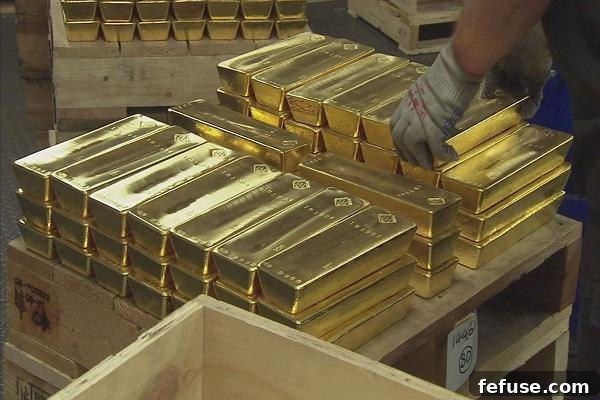
The Resurgent Lure of Gold: Why Central Banks Are Shifting Strategies
In a significant geopolitical and economic trend, central banks worldwide are increasingly accumulating gold reserves. This resurgence in gold hoarding is not merely a nostalgic return to an old tradition but a calculated strategic move driven by profound fundamental reasons. From the bustling financial hubs of East Asia to the historic capitals of Europe and beyond, nations are re-evaluating their reserve assets, positioning gold as a cornerstone of their economic sovereignty and stability in an increasingly uncertain global landscape.
This article delves into the core motivations behind this gold accumulation, focusing on key players like China and Russia, and exploring the broader implications for the global financial system and the future of the U.S. dollar.
China’s Strategic Gold Accumulation: Diversification and De-Dollarization
China stands out as a pivotal player in the renewed gold rush. Historically, private ownership of gold in China was heavily restricted. However, a landmark shift occurred around 2015 when the Chinese government began to liberalize private gold ownership, signaling a broader strategic intent. This move not only opened avenues for its vast population to invest in gold but also mirrored an intensifying push by the state to bolster its own gold holdings.
The official figures for the Chinese central bank’s gold reserves, which have been steadily rising, represent only a fraction of its total foreign exchange reserves. China boasts a colossal foreign exchange reserve, often exceeding $3 trillion, a substantial portion of which is denominated in U.S. dollars, including over $1 trillion in U.S. Treasury securities. This immense reliance on the U.S. dollar presents both economic and geopolitical vulnerabilities for Beijing.
The primary driver for China’s aggressive gold accumulation is therefore diversification. Beijing seeks to reduce its overwhelming dependence on the U.S. dollar, which it views as a potential economic weapon in times of geopolitical tension. By converting a portion of its dollar-denominated assets into gold, China aims to de-risk its balance sheet and enhance the resilience of its financial system against external pressures, such as sanctions or currency fluctuations imposed by the U.S.
Furthermore, China’s gold strategy is intrinsically linked to its broader ambition of internationalizing the yuan. As reported by various financial intelligence firms and news outlets, China has introduced mechanisms allowing oil exporters who accept yuan for their crude oil to convert the proceeds into physical gold on the Shanghai Gold Exchange. This innovative approach provides a tangible, hard-currency backing for the yuan, making it a more attractive option for international trade partners and laying the groundwork for a potential future where the yuan plays a more central role in global commerce, underpinned by a significant gold reserve.
Russia’s Geopolitical Gold Play: Building Sanctions Resilience
Following China’s lead, Russia has also embarked on a remarkably aggressive gold accumulation strategy, particularly in response to geopolitical developments. The annexation of Crimea in 2014 and the subsequent imposition of international trade sanctions by Western powers served as a stark wake-up call for Moscow. Faced with the immediate threat of being cut off from dollar-based transactions and the global financial clearing system, Russia rapidly accelerated its gold purchases.
The Russian central bank has consistently been among the largest buyers of gold globally, adding substantial tonnes to its reserves almost monthly. This strategy is a clear manifestation of Russia’s desire to bolster its economic sovereignty and create a financial buffer against future sanctions. Gold, unlike fiat currencies or sovereign bonds, cannot be frozen or easily manipulated by foreign powers. It represents a universally accepted form of wealth that can facilitate trade and maintain financial stability even when traditional channels are blocked.
For Russia, gold is not merely an investment; it is a strategic asset crucial for national security and economic independence. This move signifies a broader trend among nations seeking to insulate themselves from the potential weaponization of the U.S. dollar by reducing their exposure to it and embracing assets that are beyond the reach of external political influence.
The Global De-Dollarization Trend: Lessons from Iran and Beyond
The motivations driving China and Russia are echoed by other nations, particularly those that have faced or fear potential U.S. sanctions. Iran offers a compelling historical precedent. When Tehran was subjected to stringent trade sanctions and effectively banned from U.S. dollar transactions, it was compelled to revert to older, more direct methods of trade, often involving gold barter systems. This experience underscored gold’s role as a last-resort universal currency in times of financial blockade.
This broader de-dollarization trend is gaining momentum as more countries recognize the vulnerabilities associated with an over-reliance on a single reserve currency. Gold, with its millennia-long history as a store of value and its neutrality from any single national issuer, offers an attractive alternative. It represents a tangible asset that can provide a bedrock of stability for national currencies, especially in an era marked by increasing geopolitical fragmentation and economic uncertainty.
Developed Nations and the Repatriation of Gold
The trend is not exclusive to emerging economies or those facing sanctions. Even developed nations are re-evaluating their gold strategies. Germany, for instance, undertook a significant operation to repatriate substantial portions of its gold reserves that had been stored in vaults in France and the United States for decades. This decision was driven by a desire for greater transparency, national pride, and a renewed emphasis on domestic control over strategic assets, particularly in the wake of the Eurozone’s sovereign debt crises.
Parallel to central bank actions, private investors in developed countries are also turning to gold. In Germany, for example, massive investments have flowed into gold products, fueled by investor concerns over loose monetary policies, unprecedented levels of quantitative easing, and recurring financial crises. Gold is perceived as a reliable hedge against inflation and a protector of wealth when conventional financial instruments are deemed unstable or risky. Countries like South Korea, Taiwan, Singapore, and The Netherlands have also maintained or increased their gold holdings, recognizing its role in diversifying reserves and enhancing economic resilience.
Gold as a Currency Prop and Reserve Diversifier: The Numbers Game
A key aspect of this central bank gold accumulation is its role in “propping up” national currencies. A significant gold reserve can lend credibility and perceived stability to a domestic currency, especially in challenging economic times. This is particularly true for nations with lower gold-to-total-reserve ratios.
Typically, developed economies maintain a substantial portion of their total reserves in gold, often around 60%. In contrast, countries like India have a modest 6.1% and China’s official gold holdings stand at an even lower 2% of its total foreign exchange reserves. This stark contrast highlights the immense potential for further gold purchases by these nations.
Consider the scale: for China to raise its gold holdings to even 17% of its total reserves (still far below developed nation averages), it would need to acquire hundreds of billions of dollars worth of additional gold. Such a colossal demand, if even a fraction were sourced from the open market, would undoubtedly exert significant upward pressure on global gold prices, potentially driving them to unprecedented levels, perhaps in the range of $1,800 to $1,900 per ounce or even higher.
Russia, Indonesia, and Turkey are actively pursuing this strategy, understanding that a robust gold reserve can act as a bulwark against currency volatility and external economic shocks. The relentless accumulation by these players underscores a deliberate shift in global reserve management practices, moving away from an exclusive focus on fiat currencies and towards tangible assets.
Market Implications: Long-Term Appreciation Amidst Short-Term Volatility
The collective buying spree by central banks, coupled with a naturally limited global supply of gold, inevitably leads to tighter market conditions. In the long term, this sustained institutional demand is highly likely to appreciate gold prices significantly. As more central banks diversify their reserves and reduce their U.S. dollar exposure, the underlying demand for gold as a strategic asset will only intensify.
However, it is crucial for investors to distinguish between long-term trends and short-term market dynamics. While central bank actions lay a foundation for long-term appreciation, gold prices in the short term remain susceptible to various factors, including speculative trading, futures market manipulation, interest rate decisions by major central banks, and overall market sentiment. Therefore, while the fundamental picture for gold appears robust due to central bank activity, short-term volatility should always be anticipated.
Conclusion: Gold’s Enduring Role in a Shifting World Order
The current wave of central bank gold accumulation is a clear indicator of a profound shift in global economic and geopolitical dynamics. It signals a strategic move away from an over-reliance on the U.S. dollar, driven by a desire for greater financial autonomy, resilience against sanctions, and the need to bolster national currency stability. Nations like China and Russia are leading this charge, but the trend is broader, encompassing both emerging and developed economies.
Gold is not being bought out of an expectation of immediate speculative gains or as a simple hedge against inflation in the traditional sense. Instead, it is being acquired as a strategic asset, a universal currency, and a fundamental component of national wealth in an increasingly complex and multipolar world. This persistent institutional demand, coupled with gold’s finite supply, is poised to redefine its value and role in the international monetary system for decades to come, ensuring its enduring importance as a symbol of economic sovereignty and stability.