
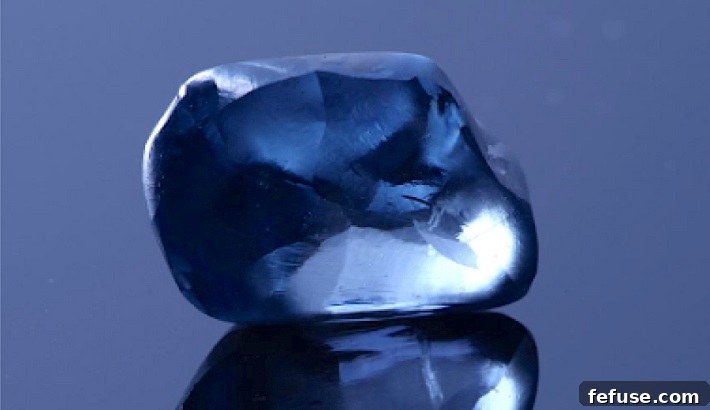
The Okavango Blue: Botswana Unveils a Historic Diamond Discovery
A Dazzling Revelation from Southern Africa’s Diamond Heart
Botswana, a nation globally recognized for its pristine wilderness and its abundant natural resources, particularly diamonds, recently captivated the world with a monumental announcement. The state-owned Okavango Diamond Company (ODC) proudly unveiled what is now considered the largest blue diamond ever discovered within the southern African country. This remarkable find reinforces Botswana’s prominent position as one of the world’s leading diamond producers and adds another extraordinary chapter to its rich mining history.
This magnificent gemstone, a 20.46-carat, oval-shaped fancy blue diamond, has been bestowed with a name that pays homage to Botswana’s unparalleled natural heritage: “The Okavango Blue.” The name celebrates the iconic Okavango Delta, a sprawling, wildlife-rich oasis and a UNESCO World Heritage site that stands as one of Earth’s most breathtaking natural wonders. The deliberate choice of this name beautifully intertwines the diamond’s intrinsic value with the nation’s environmental pride, creating a powerful narrative that extends beyond its carat weight and clarity.
The discovery of The Okavango Blue is not merely a significant commercial event; it is a moment of national pride and an affirmation of Botswana’s geological richness. Such a find, especially of a fancy coloured diamond, resonates deeply within the diamond industry and beyond, signaling the potential for continued extraordinary discoveries within the nation’s ancient kimberlite pipes. Its unveiling marks a pivotal moment, drawing international attention to Botswana’s capacity to yield not just volume, but also unparalleled quality in the realm of precious stones.
The Exceptional Rarity and Allure of Blue Diamonds
Among the dazzling spectrum of fancy coloured diamonds, blue stones are universally acknowledged as the most unusual and exquisitely rare. The Okavango Diamond Company, in presenting its latest treasure, underscored this fact, declaring their find to be among the rarest in the world. This exceptional scarcity is primarily due to the unique geological conditions required for their formation. Blue diamonds owe their distinctive hue to the presence of trace amounts of boron atoms within their crystal lattice structure during their formation deep within the Earth’s mantle. This minute impurity absorbs light differently than a pure carbon structure, resulting in the mesmerizing blue shade.
Marcus ter Haar, managing director of the Okavango Diamond Company, articulated the profound significance of this discovery in a statement that captured the industry’s excitement. “It is incredibly unusual for a stone of this colour and nature to have come from Botswana – a once-in-a-lifetime find, which is about as rare as a star in the Milky Way,” he remarked. His words highlight not only the rarity of blue diamonds in general but also the unexpected nature of such a gem emerging from a country primarily known for its high-quality white diamonds. This makes The Okavango Blue even more of a geological marvel.
Ter Haar further emphasized the diamond’s pedigree, stating, “It sits in the very top bracket of all-time historical blue diamond finds [especially because] only a very small percentage of the world’s diamonds are classified as fancy colour.” Indeed, while all diamonds are rare, fancy coloured diamonds – those exhibiting intense colours like blue, pink, green, or red – constitute less than 0.1% of all diamonds mined globally. Among these, blues are particularly coveted, often commanding astronomical prices at auction due to their incomparable beauty and extreme scarcity. The Okavango Blue, with its significant carat weight and fancy colour designation, is poised to join the ranks of these legendary gems, with the company anticipating its sale by the end of the year.
Botswana’s Enduring Legacy in the Diamond World
Botswana’s economic narrative is inextricably linked with diamonds. For decades, the nation has leveraged its immense mineral wealth to transform itself from one of Africa’s poorest countries at independence into a middle-income success story with stable governance and robust social programs. While it was briefly overtaken by Russia as the world’s top diamond-producing country in 2014, Botswana has consistently remained a powerhouse in diamond mining, contributing significantly to global supply and market stability. Diamonds are the bedrock of the country’s economy, accounting for approximately 80% of its total exports and a substantial portion of its GDP.
However, like any mature industry, Botswana’s diamond sector faces its share of challenges. The nation is grappling with the complexities of aging mines, which require substantial investment in maintenance and technological upgrades to remain productive. Furthermore, the mining operations are highly energy-intensive, making them susceptible to power shortages, and water scarcity is an increasing concern in a largely arid region. Despite these hurdles, the country’s commitment to sustainable mining practices and value addition within its borders remains strong, exemplified by initiatives like the Okavango Diamond Company, which facilitates the sorting, valuation, marketing, and sale of a significant portion of Botswana’s rough diamond production.
Botswana is home to some of the world’s most prolific diamond mines, boasting operations that have yielded spectacular finds. One such example is Lucara Diamond’s (TSX: LUC) Karowe operation, renowned globally for producing exceptionally large and high-quality diamonds. It was at Karowe, in 2016, that the now-famous Lesedi La Rona was unearthed. Weighing an astonishing 1,109 carats, Lesedi La Rona holds the distinction of being the second-largest gem-quality diamond ever found, showcasing the extraordinary potential that still lies within Botswana’s earth. Beyond diamonds, Botswana also boasts significant reserves and production of other vital minerals, including nickel, copper, coal, and iron ore, diversifying its mining portfolio and contributing further to its economic resilience.
A Glimpse into the World of Legendary Blue Diamonds
The discovery of The Okavango Blue inevitably invites comparison to other legendary blue diamonds that have captivated humanity for centuries. These gems are not just precious stones; they are historical artifacts, imbued with tales of royalty, intrigue, and immense wealth. Arguably the most famous blue diamond in history is the illustrious Hope Diamond. Known by various names throughout its storied past, including Le Bijou du Roi (“the King’s Jewel”), Le Bleu de France (“France’s Blue”), and the Tavernier Blue, this massive 45.52-carat, deep-blue diamond has a fabled history spanning over three centuries. Originally from India, it has passed through the hands of French royalty, notably Louis XIV and Louis XVI, and numerous wealthy collectors before finally finding its permanent home at the U.S. National Museum of Natural History in Washington, D.C., where it continues to mesmerize millions of visitors annually.
In more recent times, other blue diamonds have made headlines with their record-breaking sales. In 2016, a spectacular intense blue diamond, christened The Cullinan Dream, commanded an astonishing $25.4 million at a Christie’s auction in New York. This monumental sale broke all previous records for a gem of its kind, cementing its status as the most expensive blue diamond ever sold at auction at that time. The Cullinan Dream’s success underscored the surging demand and unparalleled value placed on significant fancy colour diamonds in the global market.
Another notable example of a blue diamond’s enduring appeal surfaced last year when a 6.16-carat blue diamond, with a clandestine history of being secretly passed down through European royalty for over three centuries, fetched an impressive $6.7 million at a Sotheby’s auction in Geneva. This price significantly surpassed expert expectations, selling for $1.4 million more than its highest estimate. Such sales not only highlight the intrinsic rarity and beauty of these stones but also their profound cultural and historical significance, making them highly desirable assets for collectors and investors worldwide. The Okavango Blue is poised to join this exclusive pantheon, carrying with it the prestige of its Botswanan origin and the allure of its exceptional hue.
The Journey of a Diamond: From Mine to Market and Ethical Sourcing
The journey of a diamond, from its geological formation deep within the Earth’s mantle to its eventual display in a jeweler’s showcase, is a complex and fascinating one. In Botswana, this journey begins in vast open-pit mines or underground operations where kimberlite ore, the primary source rock for diamonds, is extracted. Sophisticated technologies are employed to crush the ore, separate the heavier diamond-bearing material, and then meticulously recover the rough diamonds. Once unearthed, these diamonds undergo initial sorting and grading processes, a crucial step facilitated by state-owned entities like the Okavango Diamond Company.
The Okavango Diamond Company plays a vital role in Botswana’s diamond value chain. Established to market and sell 100% of the diamonds produced by Debswana (a 50/50 joint venture between the Government of Botswana and De Beers), ODC ensures that Botswana retains more of the value generated from its natural resources within the country. This strategic approach maximizes national revenue and fosters local economic development, moving beyond merely exporting rough stones. The company’s expertise in valuation and marketing positions it perfectly to handle a gem of The Okavango Blue’s caliber. The anticipation surrounding the stone’s expected sale by the end of the year is palpable, not just for the potential record-breaking price but also for the economic benefits it will bring to Botswana.
In today’s global market, the provenance and ethical sourcing of diamonds are paramount. Botswana is a staunch advocate and signatory of the Kimberley Process Certification Scheme, an international initiative designed to prevent “conflict diamonds” from entering the legitimate supply chain. This commitment to ethical sourcing ensures that diamonds from Botswana are ‘clean’ and contribute positively to national development rather than funding illicit activities. The Okavango Blue, discovered and brought to market by a state-owned entity, exemplifies this commitment, reinforcing Botswana’s reputation as a reliable and responsible source of precious gemstones.
Botswana’s Vision for the Future: Beyond the Sparkle
The discovery of The Okavango Blue is more than just a magnificent find; it serves as a powerful symbol of Botswana’s enduring potential and its strategic vision for the future. Such a prestigious discovery reinforces Botswana’s global standing as a significant player in the diamond industry and highlights the continued geological promise of its ancient land. It attracts renewed international interest and potential investment into the nation’s mining sector, encouraging further exploration and technological advancements that can extend the life and productivity of existing mines.
Beyond the immediate economic windfall from the sale of The Okavango Blue, the discovery contributes to Botswana’s broader goals of economic diversification and value addition. The nation is actively working to move beyond merely extracting raw materials, investing in beneficiation processes such as cutting, polishing, and jewelry manufacturing within its borders. This strategy aims to create more jobs, foster local expertise, and capture a larger share of the diamond value chain, ensuring long-term sustainable growth for its citizens.
Furthermore, the naming of the diamond after the Okavango Delta underscores Botswana’s deep commitment to environmental stewardship. The Delta is a fragile ecosystem, and the country has long been recognized for its exemplary conservation efforts. By linking this precious gem to its natural heritage, Botswana subtly highlights the balance it strives to achieve between leveraging its mineral wealth and protecting its invaluable natural environment. This holistic approach ensures that the sparkle of its diamonds goes hand-in-hand with the preservation of its pristine landscapes and abundant wildlife for future generations.
Conclusion: A Jewel Illuminating a Nation’s Pride
The unveiling of The Okavango Blue represents a momentous occasion for Botswana and the global diamond industry. This 20.46-carat fancy blue diamond is not just the largest of its kind ever found in the country; it is a testament to the unparalleled geological richness of Botswana and the dedication of its people to responsibly manage their natural resources. Its extraordinary rarity, stunning colour, and significant size place it among the world’s most coveted gemstones, promising to fetch an impressive price and further bolster Botswana’s economy.
As The Okavango Blue embarks on its journey from discovery to market, it carries with it the spirit of a nation that prides itself on its stability, its commitment to ethical practices, and its harmonious blend of economic prosperity with environmental conservation. This magnificent jewel will not only dazzle collectors and connoisseurs but will also shine a spotlight on Botswana’s enduring legacy as a world leader in diamonds, a nation where natural wonders and precious gems converge to tell a compelling story of unparalleled beauty and national pride.