
Unveiling the Secrets of Blue Diamonds: A Journey from Ancient Oceans to Earth’s Deep Mantle
Among the Earth’s most precious and enigmatic treasures, blue diamonds stand out not only for their breathtaking beauty and extreme rarity but also for the profound mysteries surrounding their genesis. These captivating gemstones, characterized by their mesmerizing cerulean hue, have long puzzled gemmologists and scientists alike. Conventional wisdom held that most diamonds formed in the shallow upper mantle, roughly 90 to 120 miles beneath the surface. However, a groundbreaking new study, spearheaded by a collaborative team of leading gemmologists and scientists from prestigious international institutions, has shattered these long-held beliefs, revealing that blue diamonds are, in fact, “superdeep” diamonds. This remarkable research indicates that these rare jewels crystallize at astonishing depths far greater than most other gem-quality diamonds, offering unprecedented insights into the Earth’s deepest geological processes. The pivotal findings of this extensive study were recently published in the esteemed scientific journal ‘Nature’, with GIA Research Scientist Evan Smith taking the lead author credit for this seminal work.
The Enigma of Type IIb Blue Diamonds: Boron, Rarity, and Unparalleled Value
The study specifically focused on the rare Type IIb diamonds, a distinct category of diamonds known for their unique blue coloration. Unlike most diamonds that derive their color from impurities like nitrogen, Type IIb diamonds owe their signature blue hue to the presence of boron atoms within their intricate crystalline structure. These boron-bearing diamonds represent an exceptionally rare subset of all natural diamonds, constituting less than 0.1% of all gem diamonds ever discovered. Their scarcity, combined with their extraordinary beauty, places them among the most valuable gemstones on the planet, often fetching astronomical prices at auction. This extreme rarity has historically presented significant challenges for researchers attempting to unravel their origins, as access to suitable samples for study has been incredibly limited. Before this recent research, the exact conditions and depths of their formation remained largely speculative, shrouded in geological mystery. The notion that such perfectly formed, high-quality gemstones could originate from extreme depths was previously considered improbable, adding another layer to their enigmatic appeal.
A Deep Dive into Diamond Origins: The Research Team and Their Quest
The ambitious endeavor to decode the secrets of blue diamonds brought together a formidable team of experts. Co-authors of this landmark study included Steven B. Shirey and Emma S. Bullock from the Carnegie Institution for Science; Stephen H. Richardson from the University of Cape Town; Fabrizio Nestola from the University of Padova; Jianhua Wang from the Carnegie Institution for Science; and Wuyi Wang from the Gemological Institute of America (GIA). This multinational and multidisciplinary collaboration underscored the complex nature of the research, requiring expertise spanning gemmology, geochemistry, and petrology. As Evan Smith articulated in an article on the GIA website, the boron content found in Type IIb diamonds has long been “unexpected and challenging to explain.” The primary reason for this perplexity lies in the fact that boron, the crucial element responsible for their blue color, is found in extremely low concentrations within the Earth’s mantle – the very region where most diamonds typically grow and crystallize. This scarcity of boron in the mantle created a significant geological paradox that scientists struggled to reconcile. Furthermore, the prohibitive value and rarity of blue diamonds made them largely inaccessible for extensive scientific scrutiny, compounding the difficulty for researchers. An additional hurdle was the near absence of mineral inclusions within these diamonds, which are invaluable microscopic geological time capsules that often provide critical clues about a diamond’s formation environment and depth.
Unlocking the Mysteries: Methodology and Groundbreaking Discoveries
Overcoming these formidable obstacles required an innovative and persistent approach. The research team embarked on a systematic screening process of diamonds submitted to the GIA over a period of two years. This meticulous effort finally yielded 46 Type IIb diamonds that contained internal mineral inclusions – precious pockets of other minerals trapped within the diamond’s structure during its growth. These inclusions, though tiny, are incredibly powerful indicators of the conditions under which the diamond formed. By carefully studying these encapsulated minerals, the research team was able to deduce the specific host rock environment and the extraordinary depths at which these diamonds had grown. Their analysis revealed a startling conclusion: the minerals identified within these inclusions are only found together under conditions of extremely high pressure, characteristic of environments found very deep within the Earth. The scientists were able to confidently assert that these blue diamonds were probably formed approximately four times deeper than most other common types of diamonds, pushing their origin well into the lower mantle, hundreds of miles below the Earth’s surface. This revelation fundamentally reshapes our understanding of where and how such pristine gemstones can originate, challenging previous models of diamond genesis.
The Oceanic Connection: Subduction and the Boron Enigma Solved
The study of these rare inclusions provided even more profound insights, leading to a revolutionary hypothesis regarding the origin of boron itself. The analyses showed that the blue diamonds grew in the presence of minerals that are consistent with having originated from ancient oceanic crust. This ocean crust, laden with boron, was then carried down into the Earth’s lower mantle through the powerful geological process known as subduction. Subduction is a fundamental component of plate tectonics, where one tectonic plate slides beneath another, descending into the mantle. It acts like a colossal conveyor belt, transporting vast amounts of surface material, including seawater and boron-rich sediments, deep into the Earth’s interior. The researchers propose that it was this subduction process that effectively ferried boron from the Earth’s surface – specifically from ancient oceans, where boron is abundant – down into the extreme depths of the mantle. There, under immense pressure and temperature, this boron became incorporated into the crystalline structure of growing diamonds, imbuing them with their characteristic blue color. This elegant explanation not only solves the long-standing mystery of boron’s presence in blue diamonds but also offers compelling evidence that elements from the Earth’s surface can cycle deep into its interior, fundamentally impacting the composition of materials formed there.
Redefining “Superdeep”: Large Gem Diamonds from Extreme Depths
For many years, the prevailing scientific consensus was that “superdeep” diamonds – those formed at exceptional depths – were typically small, irregular, and often unsuitable for use as gemstones. This perception suggested that the extreme conditions of the lower mantle were conducive to diamond formation but not necessarily to the growth of large, gem-quality crystals. However, this new study profoundly challenges that traditional view. Not only does it unequivocally reveal that Type IIb blue diamonds are among the deepest diamonds ever discovered, but it also demonstrates that these extreme depths can indeed yield magnificent, gem-quality stones. This finding gains even greater significance when considered alongside the 2016 discovery that another class of exceptionally large and pure diamonds, known as CLIPPIR (Cullinan-like, Large, Inclusions-Poor, Pure, Irregular, Resorbed) diamonds, are also superdeep. The combined evidence from these two landmark studies indicates a paradigm shift in our understanding of diamond genesis. It suggests that many of the world’s most expensive, largest, and dazzling gem diamonds, far from being superficial formations, are truly messengers from the Earth’s deepest, most extreme environments. Furthermore, this research highlights that the subduction process is capable of transporting not only boron but potentially even water from the ocean deep into the mantle, suggesting a more dynamic and interconnected Earth system than previously imagined.
Broader Implications for Geosciences and Gemmology
The implications of this groundbreaking research extend far beyond the realm of precious gemstones, offering invaluable insights into the fundamental processes governing our planet. For geoscientists, these “superdeep” blue diamonds serve as natural probes, providing direct samples from regions of the Earth’s mantle that are otherwise inaccessible. They offer a unique window into the chemical composition, temperature, and pressure regimes of the lower mantle, helping to refine models of mantle dynamics and the global carbon cycle. The discovery of boron’s oceanic origin through subduction illuminates the complex interplay between the Earth’s surface and its interior, demonstrating how elements can be recycled over vast geological timescales. For gemmologists, this study deepens the understanding of diamond formation environments, potentially aiding in the identification and classification of rare diamond types. It also reinforces the idea that the provenance of a diamond can tell a compelling story about Earth’s history, adding another layer of appreciation to these already magnificent jewels. This scientific breakthrough underscores the interconnectedness of Earth’s systems, from the vast oceans to the deepest reaches of its molten interior, with blue diamonds serving as sparkling testaments to this incredible geological journey.
Conclusion: A Dazzling Revelation from the Earth’s Core
In conclusion, the meticulous research by GIA Research Scientist Evan Smith and his international team has profoundly reshaped our understanding of blue diamonds and, by extension, the dynamic processes within our planet. These Type IIb diamonds, with their striking blue color attributed to boron, are now definitively recognized as “superdeep” diamonds, forming at astonishing depths four times greater than previously imagined. More remarkably, the study offers compelling evidence that the boron responsible for their captivating hue originates from ancient oceans, transported into the deep mantle via the powerful mechanism of subduction. This revelation not only resolves a long-standing geological puzzle but also challenges the notion that large, gem-quality diamonds cannot originate from such extreme environments. Coupled with earlier findings on CLIPPIR diamonds, this research firmly establishes that many of the world’s most spectacular and valuable gemstones are, in fact, extraordinary messengers from the Earth’s enigmatic interior. These dazzling blue marvels remind us that even the most beautiful objects can hold the deepest scientific secrets, inviting us to look beyond their surface brilliance to appreciate the incredible geological journeys they have undertaken.
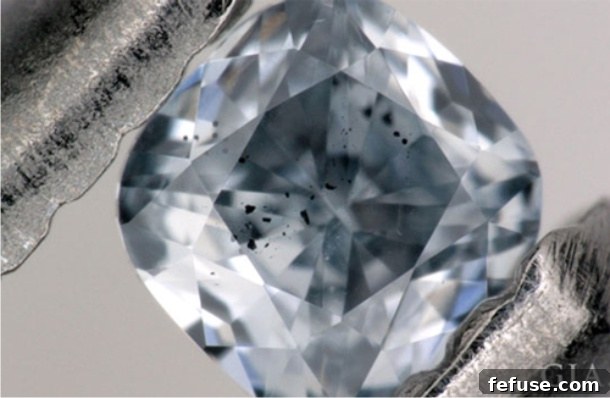
Pic caption: A stunning blue boron-bearing diamond, showcasing its unique color, with visible dark inclusions of a mineral called ferropericlase that were meticulously examined as part of this groundbreaking study. This particular gem weighs a delicate 0.03 carats. Photo by Evan M. Smith, Courtesy GIA.
News Source : gjepc.org