
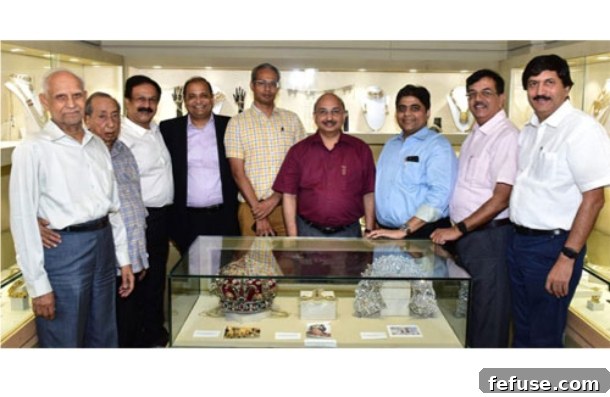
In the heart of Rajasthan, a state synonymous with regal history, vibrant culture, and unparalleled artistry, stands the Museum of Gems and Jewellery Jaipur – a testament to the region’s illustrious legacy in the world of precious stones and exquisite adornments. Last week, this cultural beacon celebrated a significant milestone: its first anniversary. The event was not merely a commemoration but a grand affirmation of the museum’s burgeoning role in preserving and promoting India’s rich jewellery heritage, drawing an impressive assembly of senior government officials and influential figures from Jaipur’s esteemed gems and jewellery trade.
The anniversary celebration was an affair of considerable prestige, underscoring the collaborative spirit between governmental bodies and industry leaders in championing cultural initiatives. Shri D.B. Gupta, the Chief Secretary to the Government of Rajasthan, graced the occasion as the Chief Guest, his presence signifying the state’s deep commitment to fostering cultural institutions. Adding to the eminence of the gathering were Shri Pramod Agrawal, the distinguished Chairman of the Gem & Jewellery Export Promotion Council (GJEPC), and Shri Kuldeep Ranka, Rajasthan’s Principal Secretary for Tourism. Both served as Guests of Honour, their participation highlighting the museum’s dual importance for both the commercial jewellery sector and the burgeoning tourism landscape of Rajasthan.
The genesis of this remarkable institution is rooted in the extraordinary vision and dedication of one individual: Dr. Rajnikant Shah (MD Medicine) from New York. Dr. Shah’s journey is a compelling narrative of passion and serendipity. Having embarked on a successful career as a physician, he made the momentous decision in the 1970s to leave his medical practice behind and join his brother in the dynamic world of the gemstone business. This pivotal shift ultimately led him to conceptualise and establish the Museum of Gems and Jewellery Jaipur – a project he initiated post-retirement from his business ventures. His profound understanding of both the commercial and aesthetic dimensions of gemstones, coupled with an unwavering desire to preserve this invaluable heritage for future generations, proved to be the driving force behind the museum. Crucially, his ambitious undertaking received enthusiastic and indispensable support from the wider gems and jewellery trade, recognising the profound value such an institution would bring to Jaipur and India.
The museum’s first anniversary also marked an exciting expansion of its exhibits, delighting connoisseurs and casual visitors alike. A special new section was unveiled, dedicated to the enchanting world of bridal jewellery – pieces that are not just adornments but symbols of tradition, celebration, and familial legacy in Indian culture. Complementing this, another fascinating display showcased jewellery that has graced the silver screen, worn by stars in some of Bollywood’s most well-known films. This cinematic connection adds a layer of glamour and accessibility, allowing visitors to appreciate the artistry of Indian jewellery through the lens of popular culture. These new additions underscore the museum’s commitment to presenting a diverse and engaging collection that appeals to a broad audience, from historians and researchers to fashion enthusiasts and cinema buffs.
During the celebratory event, the speakers shared insights into the museum’s trajectory and ambitious future plans. Currently, the Museum of Gems and Jewellery Jaipur is housed within the venerable Chamber Bhavan. However, the vision extends far beyond its present location. Speakers articulated exciting plans for the museum to eventually shift to its own, dedicated premises. This future move signifies a commitment to growth, offering the potential for expanded exhibition spaces, state-of-the-art conservation facilities, and enhanced visitor experiences. A standalone building would allow the museum to further solidify its identity as a premier cultural institution, capable of hosting larger collections, interactive displays, educational workshops, and perhaps even research facilities dedicated to the study of gemology and jewellery design. Such an expansion would undoubtedly elevate Jaipur’s standing as a global hub for jewellery heritage.
Jaipur, often hailed as the ‘Pink City,’ possesses an identity intrinsically woven with the lustre of precious stones and the intricate beauty of handcrafted jewellery. For centuries, it has stood as a beacon of excellence in the global gem and jewellery trade. The city’s history is steeped in royal patronage, with its maharajas being avid collectors and patrons of extraordinary jewellery, leading to the flourishing of unique craftsmanship such as Kundan (foil-set jewellery), Meenakari (enamelling), and Polki (uncut diamond jewellery). The famous Johari Bazaar, the jewellers’ market, has for generations been a vibrant hub where master artisans have honed their skills, passing down techniques and designs that are both timeless and breathtaking. It is against this rich historical backdrop that the Museum of Gems and Jewellery Jaipur assumes immense significance. It serves not just as a repository of beautiful objects but as a guardian of this living heritage, ensuring that the stories, techniques, and artistic evolution of Jaipur’s jewellery tradition are preserved and celebrated for eternity.
The museum’s collections, particularly the new sections, offer a vivid narrative of Indian jewellery’s cultural significance. Bridal jewellery, for instance, is far more than mere decoration; it embodies deeply ingrained customs, reflects regional identities, and carries the blessings of generations. Displaying these intricate pieces provides a window into India’s diverse matrimonial traditions. Similarly, the Bollywood-inspired section highlights the profound influence of cinema on fashion and jewellery trends in India. It showcases how designers integrate traditional motifs with contemporary aesthetics to create pieces that captivate both on-screen and off. Beyond these specific themes, the museum aims to showcase the journey of a gemstone from its raw state in the earth to its polished perfection, illustrating the complex art of gem cutting, polishing, and setting. It also elucidates the various periods of Indian jewellery design, from ancient civilizations to the Mughal era, through the British Raj, and into modern times, demonstrating the continuous evolution of forms, materials, and artistic expressions.
The impact of an institution like the Museum of Gems and Jewellery Jaipur extends far beyond its physical walls. For tourism, it significantly enhances Jaipur’s appeal as a cultural destination. Visitors seeking an authentic experience of Rajasthan’s heritage now have a dedicated space to delve into the glittering world that has defined a significant part of the city’s identity. For the local jewellery industry, the museum acts as a powerful platform for promotion, education, and inspiration. It can foster greater appreciation for Indian craftsmanship globally, attract new talent to the trade, and encourage innovation rooted in tradition. For local artisans, it provides recognition for their invaluable skills and acts as a source of inspiration, connecting their contemporary work to a glorious lineage of artistry. Most importantly, for all visitors, the museum offers an immersive cultural experience, fostering a deeper understanding and appreciation for the intricate artistry and profound cultural significance of Indian jewellery.
The presence of key industry leaders and government officials at the anniversary event underscores the synergistic relationship between public and private sectors in driving cultural and economic growth. Organizations like the GJEPC play a crucial role in promoting India’s gem and jewellery exports and protecting the interests of the trade. Their involvement with the museum ensures that the institution remains relevant to the industry while fulfilling its mandate of heritage preservation. The collaborative spirit demonstrated at the anniversary celebration bodes well for the museum’s future, promising continued support and resources as it embarks on its journey towards greater prominence and impact.
As the Museum of Gems and Jewellery Jaipur looks ahead to its future, particularly the move to a new, dedicated premise, the possibilities are boundless. This expansion will not only accommodate larger and more diverse collections but also facilitate the establishment of educational programs, research initiatives, and public engagement activities. Imagine specialized workshops on traditional jewellery-making techniques, seminars on gemology, or international collaborations that bring global perspectives to Jaipur’s heritage. The museum is poised to become an indispensable resource for students, scholars, designers, and enthusiasts worldwide, further cementing Jaipur’s reputation as a global centre for jewellery art and knowledge. It is a beacon of heritage, innovation, and educational outreach, poised to inspire generations and safeguard the glittering legacy of Indian craftsmanship.
Pic caption: At the event (standing l to r) Dr. Rajnikant Shah, Dr. K. L. Jain, Hon Secretary, Rajasthan Chamber of Commerce & Industry, Shri Rajiv Jain, former chairman GJEPC, Shri Pramod Agrawal, Chairman GJEPC, Shri Kuldeep Ranka, Principal Secretary Tourism, Rajasthan, Shri D. B. Gupta, Chief Secretary, Rajasthan, Shri Vijay Kr. Chordia, Convener of GTL Jaipur, Shri Ajay Kala, Hon Secretary Jaipur Chamber of Commerce & Industry and Shri Sanjay Kala, Member National Exhibition Committee, GJEPC and President Jewellers Association Jaipur
News Source: gjepc.org