
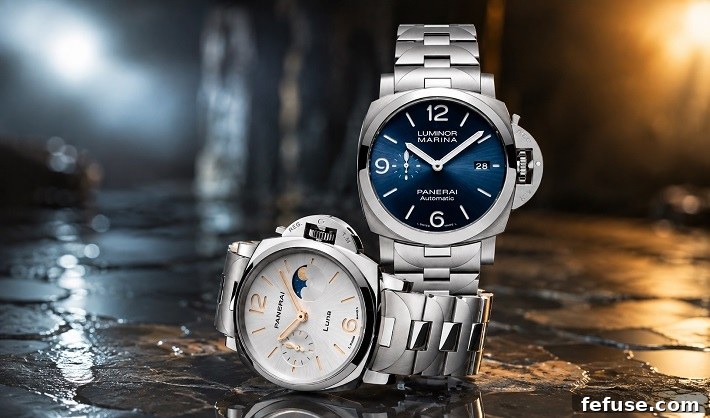
Panerai Lags as Luxury Watch Market Recovers
The recent recovery in the luxury watch market has exposed a notable weakness in Richemont’s portfolio: Panerai is not participating in the renewed demand that is boosting several of its peers. While the broader secondary market gains momentum, Panerai’s price performance and trading activity remain subdued compared with other Richemont brands.
Once celebrated for its oversized cases and military-inspired heritage, the Italian-born Swiss maker has struggled to attract the same buyer enthusiasm seen for competitors. Secondary-market data indicates that Panerai’s volumes have lagged behind, and trading activity has shown little improvement since early 2024, even as brands like Cartier and Vacheron Constantin register stronger interest.
Market indices and sales platforms confirm the wider rebound. The Bloomberg Subdial Watch Index records the strongest gains since 2022, and EveryWatch reports a sharp uptick in traded value, with watches sold in the first half of the year rising more than 37% to $10.5 billion. In that wider context, Panerai stands out for moving against the prevailing trend.
Pricing data for Panerai reflects that divergence. According to Subdial figures, the average price of a Panerai watch was roughly 8% lower in April 2026 than it was in January 2024. By contrast, many other Richemont names have seen meaningful price appreciation over the same period: Piaget has climbed over 30%, Jaeger-LeCoultre around 24%, and Vacheron Constantin about 13%, with Cartier and IWC also posting gains.
This underperformance points to a deeper question about Panerai’s fit with current luxury-watch preferences. The brand’s identity has long revolved around bold, large-format designs—exemplified by the Luminor and Radiomir models—that helped popularize oversized timepieces during the boom of the late 1990s and 2000s. Those strong, distinctive cues are part of what made Panerai famous, but they may now clash with shifting tastes.
Contemporary buyers increasingly favor smaller case sizes, subtler styling and watches that offer stronger jewelry appeal. These evolving preferences have benefited brands with refined aesthetics, pushing demand away from more overtly masculine or utilitarian designs. As a result, Panerai’s aesthetic positioning appears less aligned with the market that is driving the current secondary-market recovery.
The disconnect matters for Richemont because its watch division overall is performing well. Specialist watchmakers within the group reported approximately 8% sales growth recently, with Vacheron Constantin, Jaeger-LeCoultre and A. Lange & Söhne among the standout performers. Richemont is also actively reshaping its watch brand mix—for example, through the planned sale of Baume & Mercier to Italy’s Damiani Group—making the clarity and competitiveness of each brand increasingly important.
Panerai’s persistent weakness could therefore intensify internal debate about the brand’s strategic direction and future role within the conglomerate. The challenge facing Panerai is not only to weather a cyclical downturn but to respond to a structural shift in consumer preferences. With buyers gravitating toward different designs and categories, Panerai must weigh whether to evolve its product offering or risk falling further behind.
Ultimately, the key question is whether Panerai can reinvent its appeal while retaining the distinctive oversized identity that defines it. Any successful repositioning would need to balance respect for the brand’s heritage with design, sizing and positioning choices that resonate with today’s buyers. Until Panerai finds that balance, it may struggle to capture its share of the renewed demand lifting much of the rest of the luxury watch market.