
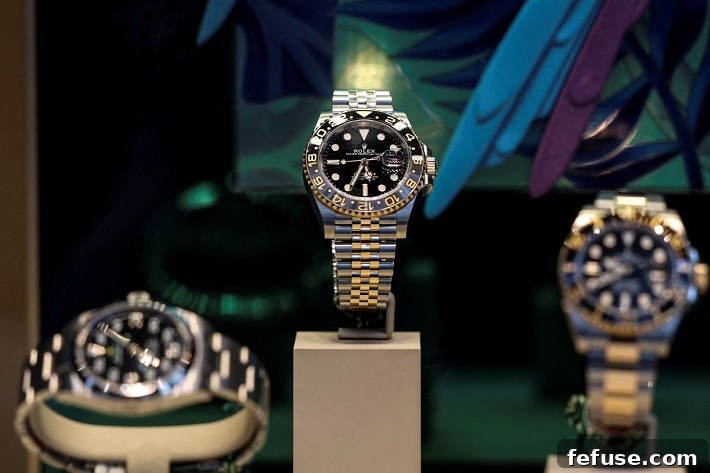
Rolex Raises Prices on Gold Watches Amid Rising Precious Metal Costs
Rolex has applied another round of price increases to its gold watch collections, underscoring the resilience of the ultra-luxury segment even as demand for luxury goods shows signs of moderation in some markets. This adjustment is the brand’s second notable price revision in 2026 and highlights how premium watchmakers are managing higher input costs while relying on steady interest from affluent buyers.
According to industry observers and market analysts, Rolex raised prices of its precious-metal models by roughly 5% in major markets including the United States, the United Kingdom and Hong Kong. The move follows an earlier correction at the start of the year, illustrating that multiple increases within a single year have become a more common pricing strategy among top-tier watchmakers looking to protect margins.
A primary driver behind these adjustments is the sharp rise in the price of gold and other precious metals. Over the past two years gold has climbed close to record levels, significantly increasing production costs for manufacturers that use substantial quantities of metal in their high-end models. While brands often absorb some of these cost pressures, many are now passing a portion to consumers—particularly for models that signal exclusivity and long-term value.
Rolex’s decision mirrors a broader sector trend. Several major luxury houses across the watch and jewellery industries have implemented similar increases recently, reacting to higher material costs, currency fluctuations and other market pressures. For many of these brands, price adjustments are also a way to preserve perceived exclusivity and to ensure that distribution remains selective.
The latest increase surprised some dealers and collectors, who noted that a mid-year rise of this magnitude is less typical outside of scheduled annual updates. Still, periodic price changes are an established feature of the luxury watch market, and the willingness to raise prices again indicates confidence that demand for certain premium references will hold despite higher retail tags.
Demand dynamics are shifting within the broader market. Analysts emphasize that the luxury watch segment has become increasingly reliant on high-net-worth buyers seeking exclusive, investment-oriented pieces. While discretionary spending among middle-income consumers has softened in various regions, demand for rare and precious-metal timepieces remains comparatively robust, driven by collectors and investors who view these watches as both wearable luxury and potential long-term assets.
This pattern is especially evident among iconic Rolex references: precious-metal models have seen substantial cumulative price increases over recent years, reinforcing their dual identity as luxury goods and collectible investments. The brand’s limited production, strong resale values and durable secondary-market demand help maintain pricing power even when the wider economy experiences uncertainty.
At the industry level, there has been a clear tilt toward higher-value products. Swiss exports of premium watches priced above 20,000 Swiss francs have expanded significantly relative to pre-pandemic levels and now account for a meaningful share of the industry’s export value. That shift indicates luxury watchmakers are focusing more on wealthy collectors—customers who are less sensitive to incremental price rises and who prioritize rarity and provenance.
Market experts point to several factors that sustain Rolex’s appeal: enduring brand prestige, tightly controlled availability, and consistent resale performance. Together, these elements create a market dynamic in which supply constraints and strong secondary-market demand reinforce the brand’s ability to increase prices without a proportionate drop in interest for its most sought-after models.
For retailers and collectors, the recent increases mean recalibrating stock valuations and expectations in the secondary market. For consumers considering a purchase, higher retail prices may accelerate decisions to buy now rather than later, particularly for models perceived as investment-grade. At the same time, the sector-wide trend toward premiumization could lengthen waitlists and heighten competition for limited-edition and precious-metal references.
As luxury watchmakers continue to navigate rising raw material costs and changing customer behavior, Rolex’s latest round of price increases signals that the industry’s upper tier remains confident in the spending power of the global ultra-wealthy. That cohort continues to drive growth and shape product strategies in the high-end watch market, ensuring that premium references stay at the center of both retail and collector attention.