
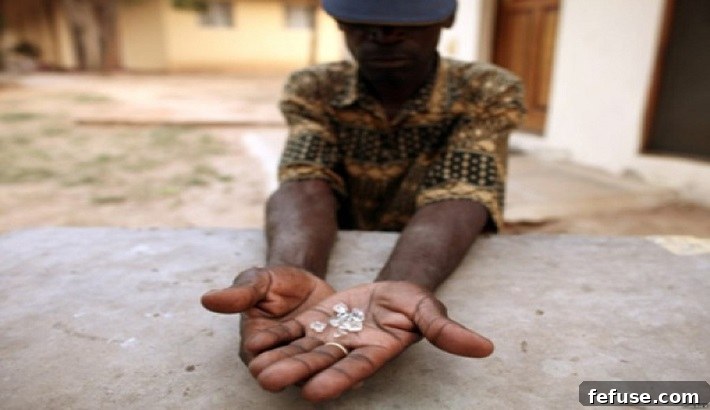
Alrosa’s Strategic Pursuit: Securing a Dominant Role in Zimbabwe’s Diamond Industry
In a move that could significantly reshape the future of Zimbabwe’s mining landscape and reinforce its position in the global diamond trade, Alrosa, the prominent Russian state-controlled diamond miner and the world’s largest by volume, has articulated its conditional interest in the nation’s diamond reserves. The company’s chief executive, Sergey Ivanov, confirmed that while Alrosa is prepared to assess the quality and potential of these reserves over the next six months, any subsequent mining operations would be contingent upon securing a majority stake. This stipulation ensures comprehensive management and operational control over any proposed project, signaling Alrosa’s strategic intent to govern its investments directly.
Zimbabwe, a country aggressively pursuing foreign investment to stimulate its economic recovery and growth, has been proactive in reforming its investment climate. Recent legislative changes have aimed to reduce restrictions on foreign participation across various commodity sectors. Although similar reforms for the diamond and platinum industries are still awaiting official implementation, the government has publicly committed to such revisions. This policy evolution is crucial for attracting major international players like Alrosa, who seek regulatory clarity and a favorable investment environment to deploy substantial capital and expertise.
The Mandate for Majority Control: Alrosa’s Core Condition for Zimbabwean Ventures
Sergey Ivanov’s statement to Reuters unequivocally outlined Alrosa’s prerequisite for engagement: “Of course, we’ll only be ready to participate in projects in cases where we can have management control and operational control of the assets.” This foundational requirement translates into a demand for at least a 51 percent stake, which would empower Alrosa with the definitive authority to guide project strategy, implement its advanced operational methodologies, and ensure alignment with its global standards for efficiency and sustainability. Ivanov expressed confidence that this level of control would be attainable should the discussions progress to detailed negotiations on project advancement.
For a global mining giant like Alrosa, insisting on a majority stake is a strategic imperative rather than a mere preference. Such control facilitates swift decision-making, ensures rigorous oversight of mining processes, allows for the direct application of best practices in environmental and social governance (ESG), and ultimately enhances the prospects for long-term profitability and responsible resource management. From Zimbabwe’s perspective, accommodating this demand could unlock access to Alrosa’s cutting-edge technology, significant financial resources, and unparalleled expertise in complex deep mining, potentially revitalizing its diamond sector and maximizing the value extracted from its mineral wealth, which has sometimes faced challenges related to transparency and operational optimization.
Historical Alliances Paving the Way for Future Partnerships in Zimbabwe
The political relationship between Russia and Zimbabwe is anchored in historical solidarity, dating back to Zimbabwe’s struggle for independence from British rule, during which Russia, alongside China, provided crucial support. This enduring geopolitical alignment has played a significant role in Zimbabwe’s recent decision to select Alrosa as one of two international partners for its state diamond company. The other chosen partner is China’s Anjin Investments, reflecting a strategic pivot towards nations with established historical ties and a demonstrated willingness to invest in the critical mineral sector.
This partnership is anticipated to inject much-needed capital and technical know-how into Zimbabwe’s diamond industry, which possesses substantial untapped potential. The selection of Alrosa underscores a broader trend among African nations to diversify their international partnerships beyond traditional Western investors, engaging with countries that offer alternative development models and investment approaches. These collaborations are typically structured to offer mutual benefits, providing host nations with economic development and specialized expertise, while granting foreign investors access to valuable natural resources and strategic market positions.
Navigating the Evolving Global Diamond Market Dynamics
The global diamond market is currently undergoing profound transformations, marked by an anticipated decrease in supply from conventional sources and the concurrent emergence of new market segments. Alrosa, a cornerstone of the industry, alongside Anglo American’s De Beers – recognized as the largest producer by value – consistently forecasts a significant contraction in the supply of natural diamonds over the coming years. This expected decline is primarily attributable to the depletion of several long-standing, prolific mines, such as Rio Tinto’s iconic Argyle project in Australia, which recently concluded operations, creating a noticeable void in the global natural diamond supply chain.
This impending scarcity elevates the strategic importance of discovering and developing new diamond reserves, particularly in regions across Africa that are considered significantly under-explored. Zimbabwe, with its documented diamond potential, thus emerges as a vital frontier for leading companies like Alrosa. Their objective is to secure future supply streams and sustain market leadership amidst a tightening natural resource base. The relentless pursuit of new, economically viable sources is paramount to satisfy the persistent global demand for natural diamonds, which continue to symbolize luxury, rarity, and enduring value.
The Distinct Markets: Natural vs. Lab-Grown Diamonds
While laboratory-grown diamonds have entered the consumer market, incrementally adding to the overall diamond supply, Alrosa maintains a resolute stance on their fundamental distinction from natural gems. Aligning with De Beers’ position, Alrosa categorizes lab-grown diamonds as a separate and distinct market segment. A crucial differentiating factor highlighted by both industry leaders is the intrinsic re-sale value: natural diamonds inherently possess and often appreciate in re-sale value over time, a characteristic generally absent in their lab-grown counterparts. This core difference profoundly influences consumer perception and long-term investment viability.
This clear distinction informs Alrosa’s core business strategy. Despite De Beers’ foray into marketing laboratory diamonds as jewelry in recent years, Alrosa has firmly expressed no interest in emulating this path. The Russian miner remains singularly focused on the exploration, extraction, and global distribution of natural diamonds, capitalizing on their unique geological origins, finite nature, and inherent value. This unwavering commitment reinforces the timeless appeal of natural diamonds as truly precious, scarce resources, distinct from their manufactured alternatives. Alrosa’s strategy reflects a broader industry debate on how best to position and differentiate these two categories in the minds of consumers, investors, and the wider market.
Alrosa’s Ambitious Expansion Trajectory Across the African Continent
Beyond its focused efforts in Zimbabwe, Alrosa is systematically expanding its operational footprint throughout Africa, recognizing the continent’s immense, yet largely untapped, diamond potential. Regions like Zimbabwe and Angola are specifically identified as critically under-explored, representing significant opportunities for companies possessing the requisite technological capabilities and substantial financial resources to execute complex, large-scale mining projects. This strategic pivot towards Africa aligns with prevailing global trends, where major mining corporations are increasingly turning to emerging markets for future growth and resource security.
Last year, Alrosa publicly announced its intention to increase its equity stake in Angola’s thriving diamond sector, a transaction that Sergey Ivanov anticipates will reach finalization “in the near future.” This carefully structured deal is designed to grant Alrosa a 41 percent stake, precisely mirroring the 41 percent share held by the Angolan government, with the remaining equity allocated to Chinese investors. This balanced ownership model in Angola exemplifies a paradigm of shared responsibility and strategic partnership, frequently favored by host governments keen on maintaining substantial control and benefiting from their national resources.
Beyond Equity: The Critical Importance of Governance and Transparency in African Investments
Ivanov underscored that while the size of the equity stake is undoubtedly vital, it is not the sole determinant of a successful and sustainable partnership for Alrosa. In the Angolan context, for instance, the company has dedicated considerable effort and resources to forge comprehensive agreements on paramount aspects such as corporate governance and transparency. Moreover, the deliberate establishment of an independent advisory board further exemplifies a deep-seated commitment to robust oversight, ethical practices, and accountability. These crucial measures are indispensable for cultivating investor confidence, guaranteeing sustainable and responsible operations, and effectively mitigating the inherent risks associated with complex mining ventures in dynamic emerging economies. The Angolan operational model serves as a robust illustration of Alrosa’s holistic approach to international investment, which prioritizes long-term stability and mutual benefit alongside immediate access to valuable resources.
Proactive Strategies: Navigating Geopolitical Headwinds and Sanctions
In an increasingly volatile and complex global geopolitical landscape, Alrosa is proactively implementing sophisticated strategies to insulate itself from potential adverse impacts, particularly those arising from U.S. sanctions. The company is strategically developing and diversifying its trading infrastructure to facilitate transactions in a broader range of currencies beyond the predominant U.S. dollar. This includes a growing capacity to conduct international business using Indian rupees, Chinese Renminbi (RMB), and euros, thereby strategically reducing its reliance on the dollar as the primary medium of international exchange for a significant portion of its global operations.
Ivanov noted that this currency diversification currently accounts for “a couple of percent” of Alrosa’s extensive business portfolio. He clarified that a wholesale, complete divestment from the dollar would be irrational, as such an abrupt shift could potentially distort global market dynamics and introduce new, unforeseen inefficiencies. However, the company is meticulously preparing for future geopolitical contingencies. “But in case there’s some geopolitical escalation, we should be able to switch to other currencies,” he affirmed, emphasizing a pragmatic and forward-looking approach to comprehensive risk management. This strategic foresight allows Alrosa to maintain operational flexibility and enhance its resilience in the face of evolving international relations, thereby securing its vital supply chains and payment mechanisms across diverse global markets.
Conclusion: Alrosa’s Vision for a Dynamic and Resilient Diamond Future
Alrosa’s strategic maneuvers in Zimbabwe, coupled with its broader aggressive expansion across the African continent, underscore a clear and ambitious vision for the future trajectory of the global diamond industry. By prioritizing majority control in new ventures, the company aims to optimize operational efficiency, ensure responsible mining practices, and maximize the long-term value of its substantial investments. Its unwavering commitment to the natural diamond sector, complemented by a robust and proactive strategy for navigating complex geopolitical challenges, firmly positions Alrosa as a resilient, innovative, and forward-thinking leader within the highly competitive mining sector.
The diligent pursuit of new, largely under-explored reserves in resource-rich Africa is not merely about securing future diamond supply; it is equally about elevating the continent’s pivotal role in the global diamond value chain. As the worldwide supply of natural diamonds continues to diminish and consumer demand remains robust, Alrosa’s calculated and strategic investments in promising regions like Zimbabwe and Angola will prove instrumental in shaping the market dynamics for many decades to come, ultimately ensuring the enduring allure, availability, and sustainable supply of these cherished and precious gems.
NewsSource: mining.com