
Decoding the Gold Market: Local Demand vs. Global Headwinds
The precious metals market is a complex interplay of local demand, global economic indicators, and geopolitical developments. Today, gold prices in India witnessed a modest recovery, snapping a four-day losing streak. This uptick was primarily fueled by a weakening Indian Rupee, which inflates the cost of imported gold, and robust buying by jewellers gearing up for the auspicious wedding season. However, this domestic resurgence was significantly tempered by persistent weakness in international gold prices, preventing more substantial gains. Such contrasting dynamics underscore the multifaceted factors influencing gold’s valuation, making it a fascinating asset for both investors and consumers.
Indian Gold Market: A Deep Dive into Domestic Dynamics
The Indian market, being one of the largest consumers of gold globally, often exhibits unique pricing behaviors influenced by local customs and economic conditions. On this particular day, gold prices saw an increase of Rs 80, bringing 10 grams to Rs 32,150. This followed a challenging period last week, where gold had shed Rs 620 over four days, including a Rs 180 fall on Saturday to Rs 32,070 per 10 gram. The recovery was a welcome sign for many after this recent downturn.
Specifically, in Delhi, gold of 99.9% purity and 99.5% purity each recovered by Rs 80, reaching Rs 32,150 and Rs 32,000 per 10 gram, respectively. Sovereign gold, a popular investment choice for many Indians, also mirrored this upward trend, climbing Rs 100 to settle at Rs 24,800 per piece of 8 gram. This segment, often favored for its purity and government backing, showed resilience amidst the broader market movements.
The Role of Wedding Season and the Rupee’s Influence
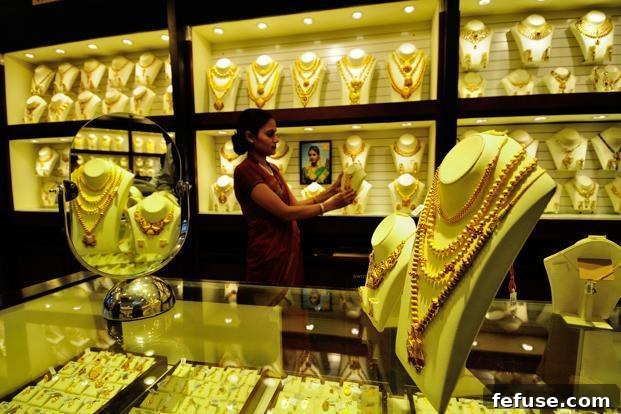
One of the primary drivers behind the recent domestic buying spree is the upcoming wedding season in India. Gold holds immense cultural and traditional significance in Indian weddings, serving as a key component of bridal trousseaus and ceremonial gifts. Jewellers typically stock up on inventory in anticipation of this peak demand period, contributing to localized price surges. This cyclical demand provides a strong floor for gold prices in the Indian market, even when global sentiments are bearish.
Another critical factor bolstering domestic gold prices is the depreciating Indian Rupee. As India imports nearly all its gold, a weaker Rupee makes these imports more expensive when converted into local currency. Today, the Rupee was trading near 73 to a US Dollar, a level that significantly inflates the landed cost of gold. This currency-induced cost pressure often acts as a cushion for local prices, preventing them from falling in tandem with international rates and explaining why gold prices in India have paradoxically shown an upward trend this year despite global weakness.
Silver Market Performance: Following the Precious Trend
While gold often garners most of the headlines, silver also plays a crucial role in the precious metals market, both as an investment and an industrial commodity. On the day, silver prices generally moved in line with gold, albeit with its own set of distinct movements. Silver ready advanced by Rs 150, ending the day at Rs 38,150 per kilogram. Meanwhile, weekly-based delivery silver saw a more significant rise of Rs 235, settling at Rs 37,115 per kilogram.
However, silver coins presented a picture of stability, holding steady at Rs 75,000 for buying and Rs 76,000 for selling of 100 pieces. This demonstrates that while the broader market for silver may experience fluctuations driven by industrial demand and speculative trading, certain segments, particularly those popular among retail investors, can exhibit more consistent pricing. The dual nature of silver, serving both as a safe-haven asset and a vital component in various industries, contributes to its unique price dynamics.
Global Gold Markets: Battling the Strengthening Dollar and Hawkish Fed
In stark contrast to the moderate gains seen in the Indian market, global gold prices continued their subdued trend, falling to their lowest in a month. The primary culprit behind this international weakness is a surging US Dollar. The Dollar Index, which benchmarks the greenback against a basket of six major currencies, was hovering near a 16-month peak. A stronger dollar makes dollar-denominated assets like gold more expensive for holders of other currencies, thereby dampening international demand.
Adding to gold’s woes are the hawkish signals emanating from the US Federal Reserve. Expectations that the Fed is firmly on track to tighten borrowing costs have significantly weighed on investor sentiment towards non-yielding assets such as gold. As Hareesh V, Head of Commodity Research at Geojit Financial Services, aptly noted, “The dollar is gaining strength after last week’s Fed meeting and positive U.S. economic data, which is weighing on non-yielding assets like gold.” This analysis underscores the direct correlation between a strengthening dollar and the diminishing appeal of gold as an alternative investment.
The Federal Reserve’s Stance and Its Economic Implications
The Federal Reserve had, in its recent meeting, reaffirmed its commitment to raising interest rates, with plans for a hike in December and potentially two more by mid-2019. This aggressive stance is predicated on an upbeat US economy, characterized by robust growth and rising wage pressures. Higher interest rates in the US typically translate into stronger bond yields, making interest-bearing assets like government bonds more attractive to investors. In this scenario, gold, which does not offer any yield or dividends, becomes relatively less appealing as an investment.
Investors seeking returns might opt for instruments that provide a regular income stream, diverting capital away from gold. This shift in investor preference is a significant factor contributing to the global downtrend in gold prices. The prospect of sustained interest rate hikes creates an environment where holding gold, with its storage costs and lack of yield, becomes less profitable compared to other investment avenues, especially for large institutional investors.
The Shadow of the US-China Trade War
Globally, gold prices have already tumbled over 11% from their April peak. This decline has been exacerbated by the unfolding US-China trade war. Paradoxically, while trade tensions often prompt investors to seek safe-haven assets, the ongoing dispute has seen the US Dollar emerge as the preferred refuge. In times of global economic uncertainty, the dollar’s status as the world’s reserve currency, coupled with the robust US economy, often positions it as the ultimate safe haven, siphoning investment away from traditional havens like gold.
This confluence of a strengthening dollar, a hawkish Federal Reserve, and the trade war’s impact on investor sentiment has created a challenging environment for gold in international markets. The consistent preference for the dollar amidst these global uncertainties underscores a fundamental shift in how investors perceive and react to geopolitical and economic risks.
Conclusion: Navigating the Complexities of Gold Investment
The current state of the gold market vividly illustrates the intricate dance between local and global economic forces. While domestic demand in India, fueled by cultural traditions and a depreciating Rupee, provides a degree of insulation, the overarching strength of the US Dollar and the Federal Reserve’s commitment to higher interest rates continue to exert significant downward pressure on international gold prices. For investors, this creates a nuanced landscape where understanding both micro (local demand, currency movements) and macro (global interest rates, geopolitical tensions) factors is paramount.
The dual performance of gold – showing resilience in India while struggling globally – highlights its unique position in the global financial ecosystem. As markets continue to evolve, monitoring the interplay of currency valuations, central bank policies, and consumer behavior will be crucial for predicting the future trajectory of this timeless precious metal.
News Source: livemint.com