
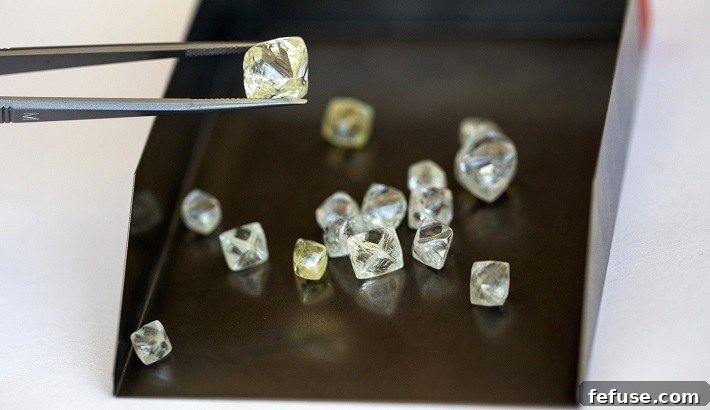
De Beers Rough Diamond Sales: Navigating the Complexities of the Global Diamond Market in Late 2019
The global diamond industry, a sophisticated ecosystem blending natural wonder with intricate commerce, constantly provides crucial insights into economic health and consumer sentiment. As 2019 drew to a close, market stakeholders keenly observed announcements from industry giants, with De Beers Group, a leading global diamond company, at the forefront. The provisional rough diamond sales figures for their tenth sales cycle (Sight 10) of 2019 unveiled a multifaceted picture of a market grappling with substantial challenges yet simultaneously exhibiting nascent signs of stabilization.
De Beers Group officially disclosed that the provisional value of rough diamond sales, encompassing both Global Sightholder Sales and Auctions, for Sight 10 of 2019 reached an estimated US$ 425 million. This figure, while marking a modest improvement over the final sales value of US$ 400 million from the preceding Cycle 9, notably lagged behind the US$ 544 million recorded in Cycle 10 of 2018. This significant year-on-year disparity prominently highlighted the persistent headwinds and widespread adjustments that had characterized the diamond sector throughout much of 2019.
A Challenging Landscape: The Diamond Industry in 2019
Indeed, 2019 proved to be an exceptionally demanding year across the entire diamond value chain, from raw material extraction to final retail. A combination of factors contributed to a notable slowdown. The market experienced an observable oversupply of rough diamonds, concurrently with diminished demand from the midstream segment – the critical sector comprising cutters and polishers. This dynamic led to a substantial build-up of polished diamond inventory, frequently acquired at higher rough diamond prices, subsequently compressing profit margins for manufacturers and diminishing their capacity for new rough purchases.
The midstream, heavily concentrated in regions like India, contended with severe liquidity constraints and reduced profitability. This financial pressure fostered a highly cautious approach to replenishing rough diamond inventories. Such prudence directly translated into softer demand during the rough tender sales conducted by major miners, including De Beers and Alrosa. Throughout the year, these leading producers responded strategically by offering enhanced flexibility to their sightholders, permitting deferred purchases or implementing slight price adjustments, all in an effort to stabilize the market and alleviate financial pressure on their crucial client base.
Leadership Insights: De Beers’ Perspective on Market Dynamics
In his comments regarding the Sight 10 results, Bruce Cleaver, CEO of De Beers Group, articulated a perspective that carefully balanced prevailing market realities with a degree of cautious optimism. He stated: “Following continued polished diamond price stability in the lead up to the final sales cycle of the year, we saw further signs of steady demand for rough diamonds during Sight 10.” Cleaver’s remarks underscored a pivotal development: the stabilization of polished diamond prices. For many months prior, the continuous depreciation of polished prices had severely eroded confidence and profitability within the midstream. Any indication of stabilization was therefore a profoundly welcome sign, hinting at a potential bottoming out of market declines.
The phrase “steady demand,” employed by Cleaver, should be interpreted within the context of the year’s pervasive challenges. Far from suggesting a booming market, it indicated that demand was not deteriorating further; rather, it showed a slight, yet significant, uptick as the industry prepared for the immensely important end-of-year holiday sales season. This crucial period, encompassing festivals like Diwali, along with Thanksgiving, Christmas, and the approaching Chinese New Year, traditionally accounts for a substantial proportion of annual diamond jewelry sales, making strategic inventory replenishment a necessity for both retailers and manufacturers.
Detailed Analysis: A Closer Look at the Sales Figures
The provisional sales figure of US$ 425 million for Sight 10, 2019, when compared against the US$ 400 million achieved in Cycle 9, represented a modest 6.25% improvement. This marginal increase, while not indicative of a robust recovery, was nevertheless a positive directional shift following an extended period of declining or stagnant sales. It suggested that ongoing inventory correction efforts across the midstream, combined with initial holiday season purchasing, might have begun to yield some beneficial outcomes. However, the substantial year-on-year gap of over 21% relative to the US$ 544 million generated in Cycle 10, 2018, served as a potent reminder of the depth and scope of the market correction that had transpired over the preceding twelve months.
The pronounced decline from the previous year’s figures vividly illustrated the dramatic shift in market conditions. In 2018, the diamond market had experienced a period of relatively strong health, propelled by robust consumer demand in key global markets. The subsequent year, however, necessitated a rapid recalibration, compelling miners and manufacturers to adapt swiftly to a new operational environment characterized by tighter margins and more judicious purchasing behaviors. The 2019 sales figures were, therefore, a direct reflection of this essential, albeit challenging, adjustment phase.
Key Factors Influencing Rough Diamond Demand in 2019
Several fundamental factors exerted a direct influence on the patterns of rough diamond demand observed during late 2019:
- Polished Diamond Inventory Levels: Elevated inventories of polished diamonds within the midstream acted as a significant deterrent to new rough diamond purchases. Manufacturers prioritized liquidating existing stock before committing to substantial new acquisitions.
- Polished Diamond Price Stability: As highlighted by Bruce Cleaver, the stability of polished prices was absolutely critical. Declining polished prices create considerable market uncertainty and diminish the incentive for manufacturers to acquire rough, as the potential value of their finished product could decrease even before its sale.
- Global Consumer Confidence and Retail Spending: The trajectory of global economic growth, particularly in major diamond-consuming markets such as the United States, China, and India, played a pivotal role. Any downturn in consumer confidence directly impacts discretionary spending on luxury items, including diamond jewelry.
- Industry Liquidity and Financial Health: The overall financial health of the midstream sector, including its access to credit and favorable lending terms from banks, significantly influenced its capacity to purchase rough diamonds.
- Strategic Marketing and Branding: Ongoing marketing and branding initiatives, particularly those spearheaded by organizations like the Diamond Producers Association (DPA, now known as the Natural Diamond Council), were essential in sustaining and nurturing consumer desire for natural diamonds amidst the increasing prominence of lab-grown alternatives.
De Beers’ Strategic Adaptations in a Volatile Market
As a preeminent force within the diamond industry, De Beers consistently adjusts its operational strategies to align with prevailing market conditions. In 2019, this involved adopting a more flexible and responsive approach towards its sightholder clients. Traditionally, sightholders are committed to purchasing specific volumes of rough diamonds from De Beers. However, in direct response to the market downturn, De Beers, along with other major diamond producers, offered greater leniency, allowing sightholders to either refuse a certain percentage of their allocated rough diamond boxes or defer purchases entirely. This strategic flexibility, while having an immediate impact on sales figures, was deemed crucial for preserving long-term client relationships and supporting the financial health of the midstream, which is indispensable to the entire diamond value chain.
Concurrently, the company maintained its substantial investment in generic diamond marketing through the DPA. These campaigns meticulously emphasized the unique heritage, intrinsic rarity, and profound emotional value inherently associated with natural diamonds. This strategic focus aimed to clearly differentiate natural diamonds and sustain robust consumer demand, particularly among younger generations, thereby ensuring the enduring long-term viability and appeal of the industry.
Anticipating 2020: Hopes and Cautions (A Pre-Pandemic Perspective)
From the unique vantage point of late 2019, the diamond industry collectively looked towards the upcoming year with a palpable blend of apprehension and cautious optimism. The modest improvement observed in Sight 10 sales was interpreted by some analysts as a tentative, yet meaningful, step towards comprehensive market stabilization. Expectations were high for a robust holiday sales season, which traditionally translates into renewed demand for rough diamonds during the first sales cycles of the new year, as retailers actively seek to replenish depleted inventories.
However, industry analysts also prudently cautioned that a sustained and robust recovery would fundamentally depend on several interconnected factors: a continued and thorough rebalancing of inventory levels across the entire midstream, consistent and healthy growth in major retail markets globally, and a stable and supportive macroeconomic environment. The long-term resilience and prosperity of the diamond market, it was widely understood, would pivot on its agile ability to adapt to evolving consumer preferences and to effectively communicate the timeless and enduring allure of natural diamonds to new generations of buyers.
The insightful data provided by De Beers’ Sight 10 sales for 2019, initially reported by esteemed industry sources such as the Gem & Jewellery Export Promotion Council (GJEPC), offered a crucial benchmark for thoroughly understanding the complex interplay of supply, demand, and sentiment within the intricate global diamond trade. These figures highlighted a market actively undergoing a profound transition, implementing necessary adjustments to ensure its future vitality and sustained appeal.
Conclusion: The Diamond Market in a State of Evolution
The provisional rough diamond sales figure of US$ 425 million for De Beers’ Cycle 10, 2019, while registering a slight improvement over the preceding cycle, undeniably reflected a profoundly challenging year for the global diamond industry. The significant year-on-year decline from 2018 figures underscored a profound market correction, primarily driven by factors such as oversupply, substantial inventory overhangs, and a predominantly cautious sentiment prevailing within the midstream sector. Nevertheless, the carefully worded remarks from De Beers CEO Bruce Cleaver, which highlighted indications of polished price stability and “steady demand,” offered a crucial glimmer of hope, suggesting that the most severe phase of the downturn might have begun to subside, and that the market was tentatively establishing a new equilibrium as it approached a critical period of sales.
Ultimately, late 2019 represented a pivotal and transformative moment for the diamond sector. It was a period characterized by deep introspection, strategic adaptation, and a concerted collective effort to re-establish a more sustainable market equilibrium. While the path ahead was acknowledged to be uncertain, the incremental improvements observed in the final sales cycle of the year provided a welcome sign of potential revitalization. These developments set the stage for what industry leaders earnestly hoped would evolve into a more stable and prosperous 2020. The diamond industry, renowned for its inherent resilience and enduring appeal, continued its journey of evolution, diligently navigating global economic shifts while steadfastly striving to captivate new generations with the timeless and unparalleled beauty of natural diamonds.
Source: GJEPC industry reports and expert market analysis for the specified period.